After five hospitals failed to spot that she had a rare but potentially fatal complication of childbirth, Amisha Adhia is to launch a campaign urging the NHS to do more to diagnose the condition and save lives.
Pregnant women are at much greater risk of developing placenta accreta spectrum if they have already given birth by caesarean section or had IVF treatment.
If it is not identified before the woman goes into labour, she is at risk of having to undergo an emergency hysterectomy or bleeding to death from a severe haemorrhage.
The NHS says between one in 300 and one in 2,000 women develop placenta accreta. Doctors are warning that the numbers of women at risk are growing because more babies in England are being born by C-section (45%) than vaginally (44%).
“Placenta accreta can cause catastrophic bleeding in minutes if it isn’t anticipated,” said Adhia, who has set up the Action for Accreta campaign with her husband, Nik. She said she feared women with the condition were not being identified because too few NHS maternity specialists correctly diagnosed it, exposing women and their babies to severe risks.
Placenta accreta occurs when the placenta, which gives the foetus nutrients and oxygen, grows too deeply into the wall of the woman’s uterus and blocks some or all of the cervix. This makes the usual separation of the placenta from the uterus during birth difficult.
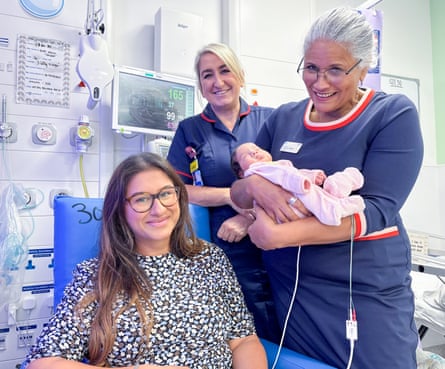
Childbirth experts at five London hospitals told Adhia she did not have the condition. But Dr Chineze Otigbah, a consultant obstetrician, established that she did. Her intervention meant Adhia, 36, received appropriate care when she gave birth to her daughter, Ishaani, last September under the doctor’s care at Queen’s hospital in Romford, north-east London.
“I am alive today because Dr Otigbah recognised the danger and acted. I was repeatedly told that I had almost zero risk of placenta accreta as my placenta was high up, rather than low lying. But it was there and it was deeply invasive.
“I was reassured into danger. I was carrying a condition that could have killed us both. I felt unheard. I thought I was going to die.”
Adhia lost almost a litre of blood while delivering Ishaani by C-section, much less than other births involving placenta accreta, but suffered no serious complications. Her experience of being “assessed, downgraded and ignored” by the five hospitals, who she says “dismissed” her concerns that she had placenta accreta, prompted her and her husband to raise awareness of the condition.
About 40 women who suffered setbacks during pregnancy or labour as a result of their placenta accreta going undiagnosed have contacted the couple after seeing their posts on social media.
There are no figures indicating how often placenta accreta develops or causes complications because the NHS does not record the information. Even the annual MBBRACE-UK report on maternal health and outcomes of childbirth contains no details. Studies from the US and Israel suggest the prevalence could be as high as one in 111 pregnant women.
Eight baby and maternal health groups have backed the campaign, including Birthrights and the Birth Trauma Association. Separately, the baby charities Tommy’s and Sands in a joint statement welcomed it for “helping to highlight important gaps in awareness, surveillance and learning” about serious complications of pregnancy.
Current guidance from the Royal College of Obstetricians and Gynaecologists (RCOG), which represents childbirth doctors, says placenta accreta and placenta praevia, which can also cause major blood loss, “are associated with high maternal and neonatal morbidity and mortality”. Rates of both had risen and would keep increasing as a result of the rise in C-sections, the higher average maternal age and increased use of “assisted-reproductive technology”, it added.
The Adhias recently gave evidence to Valerie Amos’s inquiry into maternity care in England that was ordered last year by Wes Streeting, the health secretary, who is also the couple’s MP. They urged Amos to include recommendations in her report that the NHS should do more to identify placenta accreta.
“I am deeply concerned that women are falling through the gaps in our current system,” said Otigbah.
“The main risk factors for PAS are C-sections and IVF, which have risen massively. [But] the NHS has not kept up to date with this reality. Not every hospital has PAS specialists, so subtle warning signs can be overlooked.”
The couple said they wanted the RCOG, which is updating its guidance, to include advice on diagnosing and managing the atypical form of PAS, which Amisha had.
An RCOG spokesperson said: “Placenta accreta spectrum is a rare but potentially very serious complication of pregnancy, where the placenta attaches too deeply into the wall of the womb, which can cause heavy bleeding and trauma at birth.
“According to current data, it affects between 1 in 300 and 1 in 2,000 pregnancies, although in the UK and around the world, the incidence is increasing.
“We know that early identification of placenta accreta through pregnancy scans and appropriate follow-up imaging is extremely important, so that care can be carefully planned, with the appropriate specialist teams, which improves outcomes for women and babies.”
It said the updated guidelines were expected to be published later this year.
NHS England did not respond directly to the concerns raised. Prof Donald Peebles, its national clinical director for maternity, said: “Placenta accreta spectrum is rare, but when it does occur it can cause potentially life-threatening bleeding, which is why identifying women at higher risk early in pregnancy is so important.
“Maternity teams are trained to look for the warning signs, with women who’ve previously had a caesarean among those most at risk, and where necessary, patients are referred to specialist NHS centres.”
Disclaimer : This story is auto aggregated by a computer programme and has not been created or edited by DOWNTHENEWS. Publisher: theguardian.com