Jack Cameron Stanton
FICTION
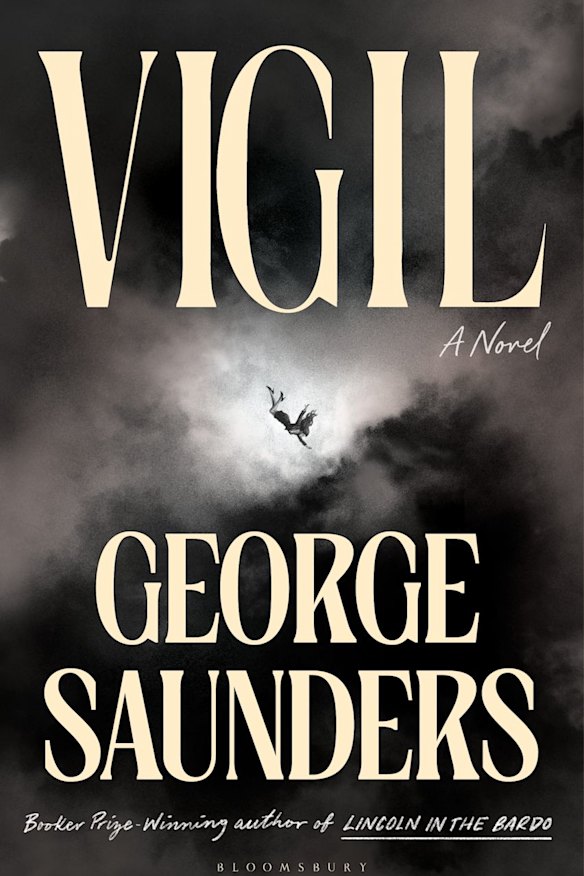
Vigil
George Saunders
Bloomsbury, $32.99
Before the 2017 publication of Lincoln in the Bardo, George Saunders was primarily a short story writer known for absurd satires of corporate and working-class America. Think feuds between employees pretending to be cavepeople, a strip waiter at an airplane-themed restaurant, a murder spree in a failing historical amusement park.
Bardo found a way to use unconventional narrative — a patchwork chorus of ghostly voices— and reach a widespread audience. It was a unicorn, in other words, beloved by critics and everyday readers, picking up the Booker Prize along the way. Recently, his Story Club on Substack has become the regular hangout for a cosmopolitan range of aspiring writers and inquisitive readers. With his kind personality and his naively confected (but often hilarious) screwball fictions, Saunders has carved out a niche as the Care Bear of American letters.
It’s likely Vigil, Saunders’ second novel, will be haunted by its spiritual predecessor, Lincoln in the Bardo. Here again, we keep the company of weird ghosts that speak in semi-infantilised voices, who enter and exit the stage by blasting through walls or falling headfirst into the ground, and for whom the liminal space between life and death is diffuse with Zen Buddhist outlooks.
But apart from these spectral borrowings, and despite what the critics will tell you, the resemblance ends there. Vigil takes place on Earth, beginning when the ghost of Jill Blaine falls from the heavens to the deathbed of the octogenarian oil tycoon KJ Boone. Jill is tasked with “comforting” Boone before he dies. But this “charge” is a controversial one: Boone has profiteered through his climate-wrecking business and hardened his heart to adversaries. By “entering the orb of my charge’s thoughts”, Jill has a supernatural capacity for empathy; she can read Boone’s mind and vicariously experience moments of his life. He regrets nothing.
Can Jill help Boone repent for his sins against the planet? Should she? The novel maintains this dilemma throughout and asks whether it is ethical to invite unconditional absolution to those chiefly responsible for perpetuating environmental decline.
Jill isn’t Boone’s only ghostly visitation. The ghost of an unnamed Frenchman warns Jill against comforting Boone, claiming that “to comfort one who remains wilfully ignorant of what he has done is to provide no comfort at all … If you truly wish to comfort him, bring him to admit his sin, then repent of it”. This repentance all seems rather unlikely because … which sins? How well do you reckon Gina Rinehart or Roman Abramovich would receive a salvation-promising spirit keeping vigil by their deathbed, urging them to forsake everything to which they had devoted their lives?
Like real-world capitalist evildoers, Boone sees the world and his role in it differently to those caterwauling environmentalists. He supplied the power, kept the lights on, acquired earthly comforts of his own. This is where, I feel, Vigil diverges substantially from Lincoln in the Bardo: its occupations are firmly contemporary rather than historical, a book about the ethics and polarity that defines much of our public discourse about climate change. The catastrophists versus the realists, each conceiving the other as irredeemably deluded.
Saunders hopscotches around Manichean good and evil in his cosmic struggle, employing a Zen-inspired non-duality that sits a little uneasy with the novel’s ethical stakes. Jill justifies her judgment-free comforting of Boone as recognising that each human being is “an inevitable occurrence upon which it would be ludicrous to pass judgment”. The Frenchman, the novel’s resident cynic, is quick to challenge Jill’s outlook: “Do you believe it? Really believe it? Bad and good are the same? Damage does no harm? The guilty are innocent, the sinner and the saint may both sit at the right hand of the Father, enjoying equal portions?”
There are many similar debates on ethical responsibility. But Boone’s Atlas Shrugged justifications (a man getting ahead selfishly for the greater good of society) and Jill’s unquestioning duty to her quest leave them to perform roles that feel mostly ideological and thematic, far loftier charges than the earthbound concerns of character and plot.
In my less generous moods, I see Saunders’ imaginative pyrotechnics — goofball side characters, strange occurrences, the reality-bent story world — as misdirection for the novel’s main drawback: unmemorable characters. To be fair, Saunders doesn’t really write characters as flesh and bone mimicry. They’ve always been his little finger puppets.
Despite its big-picture philosophising about how we may judge the old guard of fossil-fuel oligarchs, into which I feel Saunders hasn’t mined deep enough, the real joys are found on the line level. Saunders writes extraordinary comic scenarios and voices. And sentence by sentence, Vigil is a joy.
The Booklist is a weekly newsletter for book lovers from Jason Steger. Get it delivered every Friday.
From our partners
Disclaimer : This story is auto aggregated by a computer programme and has not been created or edited by DOWNTHENEWS. Publisher: www.smh.com.au