
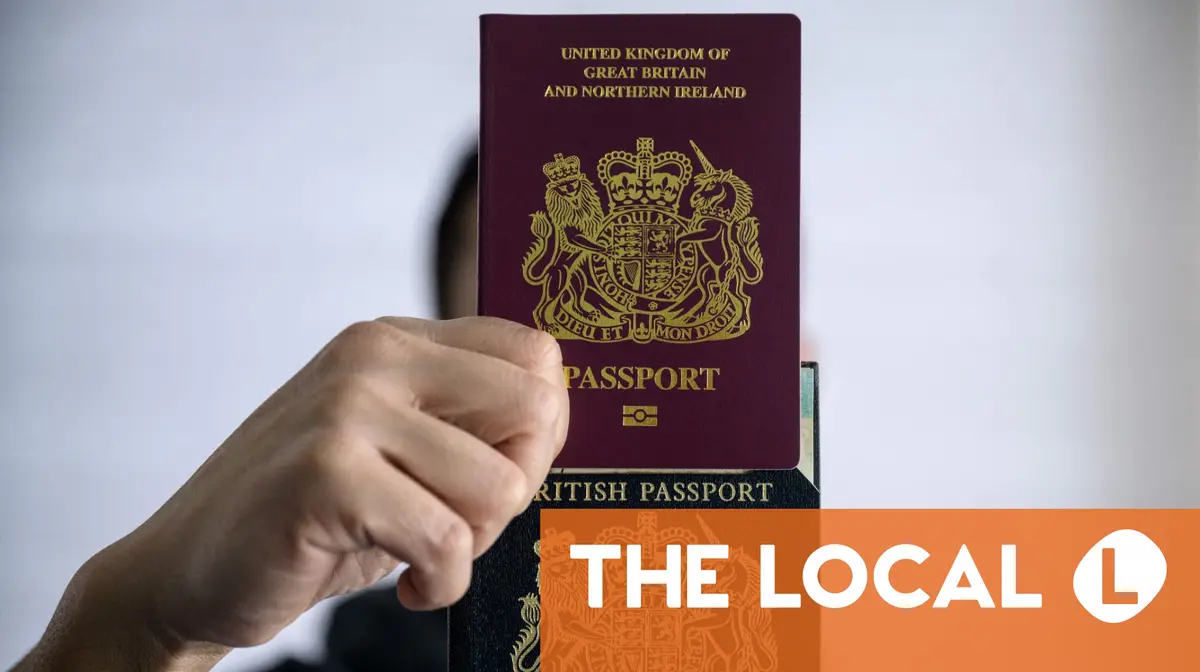
Upcoming rule changes to the UK’s new ETA border system have angered dual national Brits, but updated travel guidance from the government and a major airline suggests those without valid British passports may be allowed entry – as long as they have an expired UK passport.
With the deadline for new UK border rules fast approaching, updated travel advice has suggested that dual national Brits without a valid UK passport will be allowed to travel to the UK – albeit with several caveats.
This follows statements from the Home Office and major airline Ryanair that expired British passports could be accepted as a form of alternative documentation by passengers who need to prove they are British.
The development, however, does not provide a solution for those Brits who have never held a British passport but are still considered dual national Brits, such as children born abroad to UK nationals. Or even for those who didn’t hang on to their expired passport.
READ ALSO: Will British dual nationals really be forced to have a valid UK passport from February?
Ahead of the end of the ‘tolerance period’ for the Electronic Travel Authorisation (ETA) system on 25th February, British dual nationals have been targeted with official messaging suggesting that they will only be able to enter the UK if they have a valid British passport or alternatively a Certificate of Entitlement, which costs £589.
Those without the correct paperwork could even be denied boarding or turned away at the border, British authorities previously warned.
However, with the new ETA system due for full roll-out from next week, both the British government and Ryanair have expressed some flexibility on documentation and proof of citizenship.
Reporting from The Independent’s Travel Correspondent Simon Calder suggests that “carriers” have been informed that they can accept expired British passports issued as far back as 1989 “at their discretion” and with the condition that it is “accompanied by a valid passport issued by a nation whose citizens do not require a visa to travel to the UK.”
Government guidance seems to confirm this. In yet another statement to try to clarify all the confusion around the rules for dual nationals, the Home Office said: “At their own discretion, carriers can accept an expired British passport as alternative documentation. Separately, individuals who have previously had a British passport can apply for an emergency travel document if they urgently need to enter the UK.
“In line with current practice, on arrival at the UK border, Border Force will still assess a person’s suitability to enter the UK and conduct additional checks if required,” it added.
Ryanair for its part has suggested that an expired passport would be sufficient proof of British citizenship in order to board a flight returning to the UK.
“Yes, we will allow a passenger to board a flight to the UK if we are satisfied that the passenger is a British national, an Irish national or is in possession of any other status in the UK, including passengers who hold an old stamp/vignette with indefinite leave to remain,” the airline said in a statement.
“Airlines are required to check that passengers of non-visa countries eligible for ETA have one. If passengers do not have an ETA, we are required to check any other document that may allow them to enter the UK,” it added.
This obviously still leaves a huge amount of uncertainty for those concerned who are travelling to the UK and is far from the solution called for by many British dual nationals which is simply to allow them to get an ETA on their other non-British passport.
What are the rules?
Dual-nationals abroad have expressed anger at the change, telling The Local they felt they were being ‘punished for having dual citizenship’ and describing the ETA system as a “money making racket”.
Ever since the launch of ETA, there has been confusion when it comes to British dual nationals. The Home Office had done little to allay these fears, but for a full breakdown of the rules, or what is understood of them so far, at least, read The Local’s explainer here.
In short: British or Irish nationals travelling on their UK or Irish passport do not require the electronic travel authorisation known as the ETA.
Many British dual nationals, however, might not have a British passport anymore. These people have always previously had the option of simply using their other passport to enter the UK but the rule change makes this more difficult, if not impossible.
This is because the website and app used to apply for the ETA demands that people list any other nationalities they possess – but does not allow applicants to select ‘British’ as another nationality – meaning that dual nationals cannot truthfully complete the ETA application and travel on their other passport. Basically British dual nationals have been told thy cannot get an ETA.
They would therefore be at risk of being accused of making a false declaration if they hadn’t applied for and paid for a new passport (for £108) or a Certificate of Entitlement, which costs £589.
READ ALSO: Explained: The UK’s £16 ETA travel permit
Disclaimer : This story is auto aggregated by a computer programme and has not been created or edited by DOWNTHENEWS. Publisher: thelocal.de



