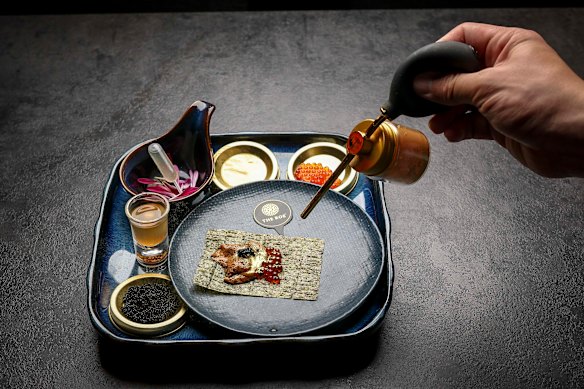
The first thing to notice about the sea urchin roe carefully arranged on my plate is its resemblance to tiny orange tongues. Oomph-Loompah tongues, I think.
The second is the taste. Salty, creamy, rich and sweet, the roe is bursting with umami.
Unprocessed long-spined sea urchins.Credit: Eddie Jim
And the third? The texture. It’s mushy in a way that sends waves of mild panic through anyone who’s ever eaten prawns or white-fleshed fish left out in Australia’s summer heat. But this roe is as fresh as they come. Less than 24 hours ago, it was inside one of our nastiest invasive predators – a long-spined sea urchin.
Long-spined and short-spined sea urchins are native to Australian waters: long-spined urchins in NSW, and short-spined urchins in Victoria. But as climate change warms our oceans and changes ocean currents, sea urchins are reaching plague proportions, shifting their range and devastating ocean habitats.
It’s estimated there are billions of long-spined sea urchins in NSW waters alone, and perhaps hundreds of millions more marching along the 8000-square-kilometre area between southern NSW to Tasmania, and further along to Western Australia.
Sea urchins feed on kelp forests that provide food and shelter for marine species and remove pollutants such as nitrogen and phosphorous from water. When urchins’ numbers become overabundant, their voracious feeding patterns wipe out kelp forests entirely, creating what scientists describe as “urchin barrens”.

A barren created by long-spined sea urchins on the NSW South Coast.Credit: Great Southern Reef Foundation
A study in August estimated 240 million short-spined urchins proliferate in Port Phillip Bay. Kelp cover has declined by 59 to 98 per cent over the past 40 years, and native urchins have become up to four times more abundant.
But where scientists see devastation, restaurant managing director James Liew and head chef Johnson Teoh see opportunity. Which brings us back to the urchin roe on my plate.
From their high-end dedicated urchin restaurant and museum in suburban Melbourne, aptly named The Roe, the pair and their colleagues – about 200 in total – are building a fledgling empire they hope will help address the scourge of urchins.
They have divers working urchin hotspots in Batemans Bay in NSW, Mallacoota in Victoria and in Tasmania, where urchins have devoured more than 30 per cent of the kelp forest over the past 30 years.
Sea urchin specialist restaurant The Roe.Credit: Eddie Jim
Harvested urchins are whisked to Melbourne, where they are processed and then either served to diners within a day, or sent out to retailers around the country and overseas. Last year, they exported about 500 tonnes of urchin roe.
“We call it sea butter,” Teoh says. “It really melts in your mouth and you really can taste the oceans. It just lingers long after.”
It’s not just roe, also known by its Japanese name uni, on offer here. Staff ferment lesser-grade roe, and create byproducts including urchin kombucha, urchin cold-brew coffee, urchin umami seasoning and urchin soy sauce.
Sea urchins are a prized delicacy in many Asian countries, particularly in Japan, which consumes 80 per cent of the world’s supply.
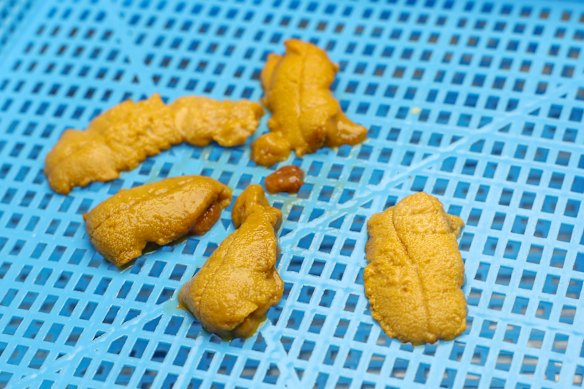
Sea urchins being processed in the kitchen at The Roe.Credit: Eddie Jim
But globally, supplies are dwindling due to overfishing. Australia has the opposite problem – in our clean and warm waters, urchins are proliferating. To make matters worse, they can live up to 200 years.
“The Great Southern Reef actually covers 8000 kilometres of coastline in the south of Australia,” Tiew says. “At the moment, the sea urchins are populating and cover about 2000 kilometres of the coastline, which is a quarter.”
Upstairs from The Roe restaurant, Tew walks us through a fever-dream of a museum, its walls lined with aluminium foil, and decorated with diving equipment and inflatable sea urchins.
The eye-catching decor may be whimsical, but the museum’s message is serious: without concerted intervention, long-spined sea urchins will destroy Australia’s kelp forests, which are critical habitat for scores of species.

A fever dream with a serious message: upstairs at The Roe in Glen Waverley.Credit: Eddie Jim
“They eat everything,” Tiew says. “Even when they are out of food, they could still stay alive for 10 years, because they could just scrap off some of the minerals of the rocks.”
The Invasive Species Council says there is no evidence of commercial industries successfully controlling pest species, let alone eradicating them.
However, co-founder Tim Low said management zones established in south-west Tasmania had probably slowed the progress of sea urchins.
For urchin harvesting programs to be successful from a population management perspective, he said, any harvesting program should be subsidised with ongoing funding, and harvesting should be targeted to specific problem areas.
Most Viewed in Environment
Disclaimer : This story is auto aggregated by a computer programme and has not been created or edited by DOWNTHENEWS. Publisher: www.smh.com.au