When Logitech signaled the end of the universal remote era by announcing the death of its Harmony product line in April 2021, I was sad to see it go. Though it had dominated the universal remote market for most of the preceding 20 years, Logitech’s Harmony had become a relic. As streaming eclipsed physical media, as affordable smart TVs with built-in apps proliferated, and as HDMI-CEC became a ubiquitous way for devices to talk to each other, the need for a programmable, universal infrared remote gradually dissipated. Even the addition of Bluetooth and Wi-Fi to Harmony’s control toolbox couldn’t save it from rapidly declining sales.
Still, many folks have held on to their legacy IR devices and have added newer, Bluetooth, and networked gadgets to their smart homes. For them, a true, whole-home remote that doesn’t cost a fortune or require a professional integrator would be enthusiastically welcomed.
That’s the elevator pitch for the Cantata Haptique RS90 universal remote (€349/$406): Based on an Android platform, the RS90 promises to do everything a top-of-the-line Harmony could do, plus far more, including voice commands—a feature Logitech never successfully implemented.
In theory, the RS90 should be the last remote you’ll ever need. In reality, it’s a beautiful piece of hardware that has a long way to go if it ever wishes to assume the universal remote throne that Logitech abandoned.
Photograph: Simon Cohen
A New Friend
Even though my own Harmony Elite had been gathering dust for more than a year, my inner geek celebrated the arrival of a new generation of universal remotes.
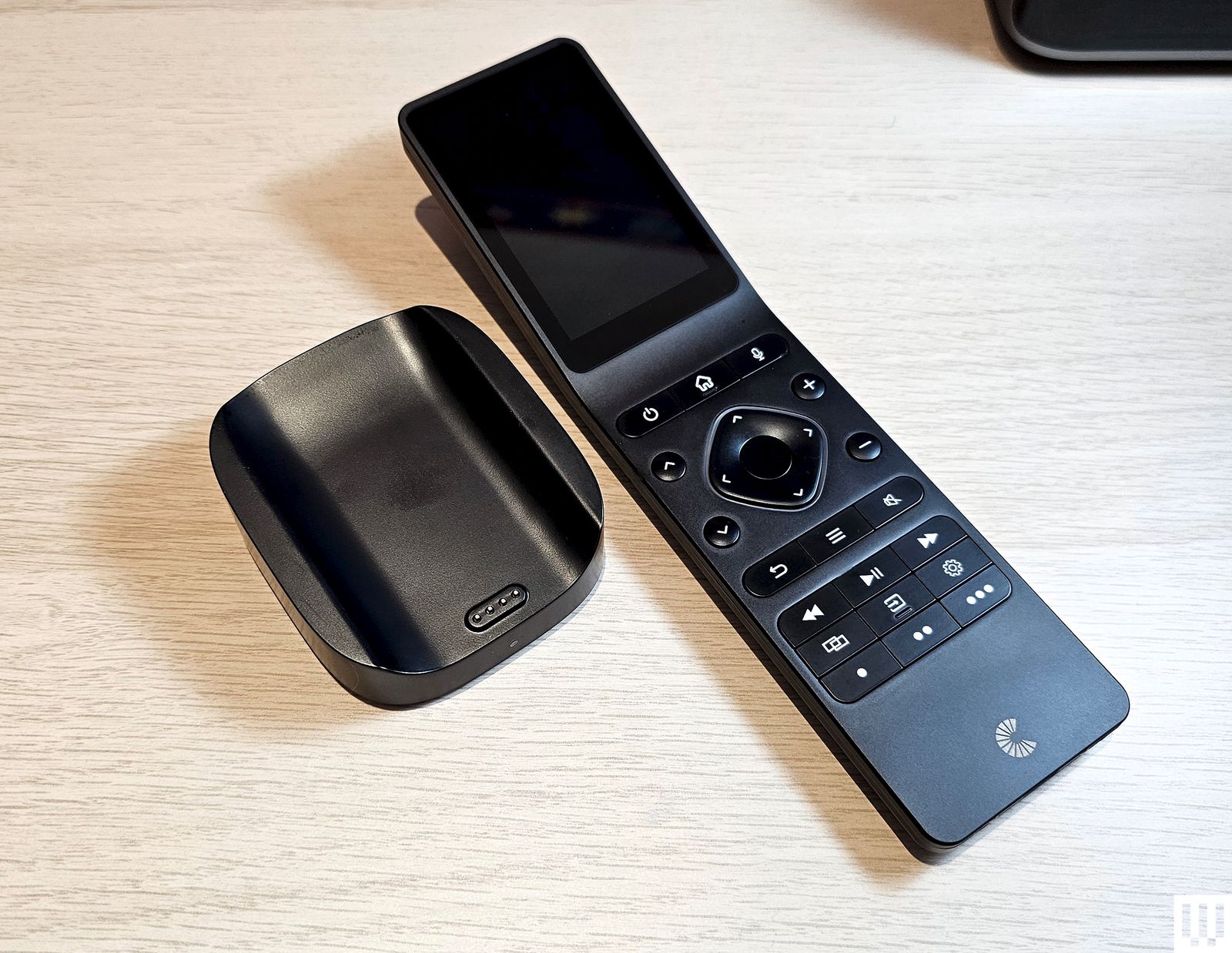
It doesn’t hurt that the Haptique RS90 is very easy on the eyes. It eschews the usual button-festooned glossy plastic baton in favor of a sleek, angled aluminum chassis. The bottom portion sports a simple (and backlit) 24-button keypad, while the top features a 3.1-inch color touchscreen and an IR emitter. It looks like Bang & Olufsen’s ahead-of-its-time 1991 Beolink 7000 remote, but reimagined for today’s devices.
Under the hood, the RS90 packs smartphone levels of computational firepower: an ARM Octacore processor with 3 GB of RAM, 16 GB of storage, and both Bluetooth and Wi-Fi connectivity. It has a built-in mic and speaker and comes with a charging cradle to keep its internal battery topped up when not in use. A custom version of Android 12 runs the whole show, with Cantata’s software as the default experience. Canata plans to release a fancier version known as the RS90x that uses an OLED screen, has more internal storage, and possesses a fingerprint reader and, crucially, an IR receiver (something the RS90 notably lacks).
Disclaimer : This story is auto aggregated by a computer programme and has not been created or edited by DOWNTHENEWS. Publisher: wired.com