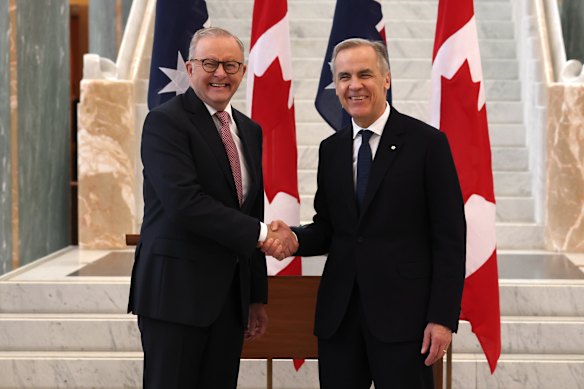

Middle powers such as Canada and Australia will be overrun by increasingly assertive global superpowers unless they join together on defence, trade and technology, Canadian Prime Minister Mark Carney has told the Australian parliament in a rare address.
Carney revealed in address to a joint sitting of parliament that Australia will join a critical minerals alliance run by the G7, a collection of the democratic world’s most advanced economies, in a bid to ensure China cannot dominate this crucial sector.
Carney used his parliamentary address to expand on the themes of his breakout speech at the World Economic Forum in Davos, Switzerland, in which he declared an end to the “fantasy” of the post-World War II rules-based order.
“In a post-rupture world, the nations that are trusted and can work together will be quicker to the punch, more effective in their responses, more proactive in shaping outcomes, and ultimately more secure and prosperous,” Carney said on Thursday.
“Middle powers like Australia and Canada hold this rare convening power because others know we mean what we say and we will match our values with our actions… In a world of great power rivalry, middle powers have a choice: compete for favour or combine for strength.”
Canada has seen an outburst of nationalism since US President Donald Trump returned to office, proclaiming Canada the “51st state” of America, imposing tariffs on Canadian goods and musing about the country coming under US control.
As major powers like China, the United States and Russia grow increasingly assertive, Carney said smaller nations were concluding that they must pursue “greater strategic autonomy”.
“When the rules no longer protect you, you must protect yourself,” he said.
“A country that cannot feed itself, fuel itself or defend itself has few options.
“In response, Canada’s strategic imperative is to build sovereign capabilities in these critical sectors, at home and abroad, by convening coalitions with trusted, reliable partners like Australia, to ensure that integration is never again a source of our subordination.”
Carney is just the fifth world leader to address the Australian parliament in the past decade, following Indonesian President Joko Widodo, Ukrainian President Volodymyr Zelensky (by videolink), Papua New Guinea Prime Minister James Marape and Philippines President Ferdinand “Bongbong” Marcos Jr.
Carney labelled his framework for engaging the world as “variable geometry – creating different coalitions for different issues, based on common values and interests”.
“Every agreement signed, every coalition deepened, every commitment made is variable geometry in practice,” he said.
Carney singled out critical minerals as a key area where Australia and Canada should partner to ensure the two democracies are not vulnerable to economic coercion.
“In the old world and even to a degree today, the temptation has been to see ourselves as competitors. In this new world, we should be strategic collaborators,” Carney said.
“To boost investments, accelerate technical cooperation, enhance supply chain resilience, expand our domestic processing abilities, while boosting our strategic autonomy.
“Which is why, earlier today, we signed a series of new agreements on critical minerals, including Australia joining the G7 minerals alliance – the largest grouping of trusted democratic mineral reserves in the world.”
As well as critical minerals, Carney singled out defence, artificial intelligence, trade and access to capital as other key areas where Australia and Canada should work closer together.
“Rather than lamenting the fall of the old order, let us redouble our efforts to build the new one,” he said.
Carney appeared at an event in Sydney on Wednesday, where a memorandum of understanding was signed to try to unlock more collaboration between the Australian superannuation sector and Canadian pension funds.
Canadian Defence Minister David McGuinty told this masthead he hoped the two nations would strike a visiting forces agreement to allow their troops to operate easily from each other’s military facilities while conducting more joint exercises.
Cut through the noise of federal politics with news, views and expert analysis. Subscribers can sign up to our weekly Inside Politics newsletter.
 Matthew Knott is the foreign affairs and national security correspondent for The Sydney Morning Herald and The Age.Connect via X, Facebook or email.
From our partners
Disclaimer : This story is auto aggregated by a computer programme and has not been created or edited by DOWNTHENEWS. Publisher: www.smh.com.au