
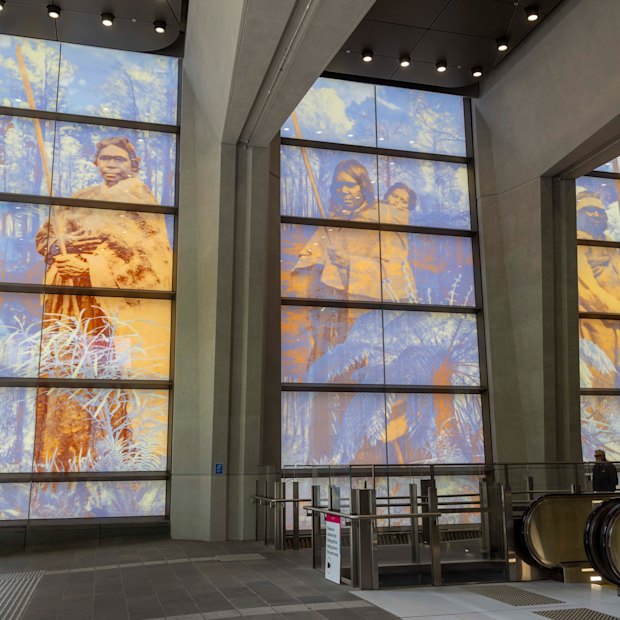
Danie Mellor’s work Forever at State Library station.Credit: Wayne Taylor
On Wednesday morning I set off to view the public art installed in Melbourne’s new Metro Tunnel with a great sense of anticipation and even old-fashioned civic pride.
Having recently returned to Melbourne after six years of living in Hobart, where public transport is virtually non-existent and the debt-ridden Tasmanian government is about to splurge more than $1 billion on a stadium for the AFL, the thought of the Victorian government investing in trains, and embedding public art in the new rail project to boot, cheered me immensely.
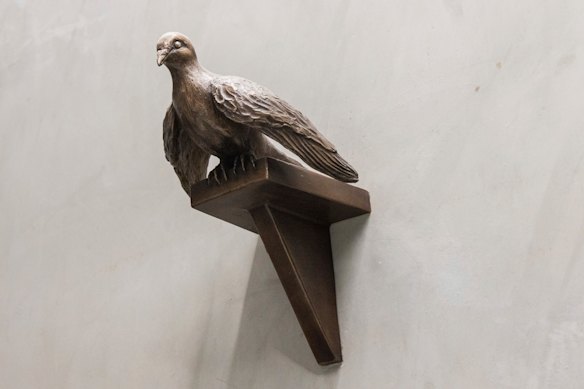
A bronze carrier pigeon by artist Fiona Hall at Anzac Station.Credit: Paul Jeffers
The six selected artists are an impressive and accomplished bunch, well worthy of the exercise. Three of them – Maree Clarke, Raafat Ishak and Patricia Piccinini – live and work in Melbourne, and what a terrific way to celebrate their practice.
Public art, by virtue of its public-ness, is subject to fierce debate – everyone gets to see it, and everyone has an opinion. Sometimes the opinions are vicious; Melbourne’s textbook case is Ron Robertson Swann’s Vault (1980), which was lumbered with a regrettable nickname and banished from the City Square following a public outcry. Belatedly embraced by the city, the sculpture now sits on the forecourt of the Australian Centre for Contemporary Art.
It’s a brave artist who takes on a public art commission, and I imagine a particularly daunting task making public art for a train station. There’s so much visual and virtual noise to compete with: cavernous spaces, concourses, ticket barriers, timetables, escalators, elevators, toilets, platforms, advertising, fast food joints. And while the audience is captive, it’s also distracted and harried. The Metro Tunnel adds another competitive layer – much of the architecture is stunning, with a contemporary take on soaring vaulted ceilings, allusions to a golden era of train travel, giant sculptural lights evoking the industrial age, and a vibrant colour scheme of orange and yellow.
In judging the success of the related art, there are two questions to consider: is it any good, and how does it work in the architectural setting? The answer to the first is a resounding yes; the answer to the second needs qualification.
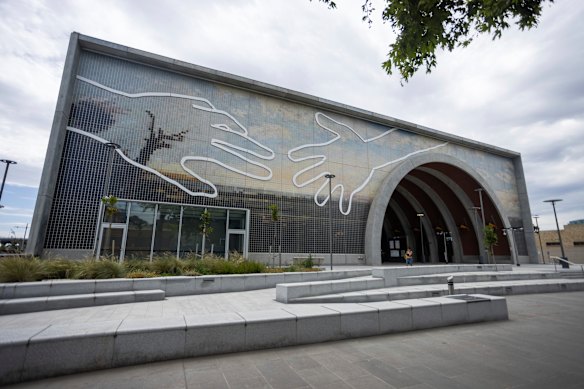
Come Together by Abdul Abdullah at Arden Station.Credit: Paul Jeffers
Of all the works, Perth-born artist Abdul Abdullah’s Come Together, on the facade of Arden station in North Melbourne, is the most resolved – a seamless marriage of art and architecture. The station’s minimal rectangular facade is punctured by a tunnel-like archway entrance that is repeated internally with a thrilling cascade of soaring brick arches like a whale’s ribcage.
Abdullah’s work extends across the entire face of the building with a pixelated backdrop of a colonial painting, J.S. Calder’s View from Royal Park across West Melbourne Swamp (1860). Superimposed on this ethereal vision of early Melbourne is the outline of two giant hands reaching out to each other – an image that immediately evokes Michelangelo’s famous fresco in the Sistine Chapel, The Creation of Adam. Abdullah’s hands are far more prosaic, cartoonishly rendered in a thick white outline. Their power lies in their simplicity; in the act of one ordinary human hand reaching out to touch not a god, but another human hand. It’s a tender, stirring image, with layers of meaning, and a counterpoint to an era of orchestrated rage, polarisation and extremism. Abdullah’s simple gesture beckons compassion, reconciliation, peace.
Parkville station is privy to one of Australia’s most successful artists, the delightfully weird Patricia Piccinini, best known for her soulful hybrid creatures, her cute Truck Babies and of course her Skywhales.
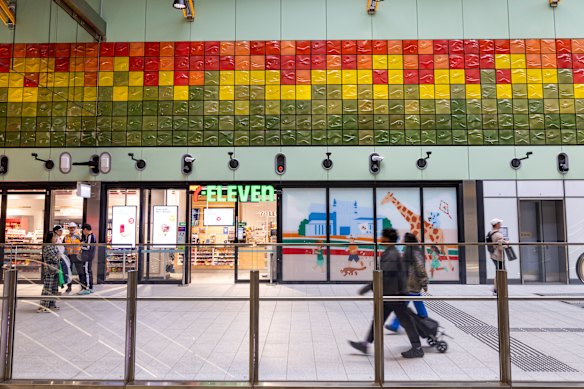
Patricia Piccinnini’s colourful mosaic at Parkville StationCredit: Jason South
Here, Piccinini has riffed on her “panel works” of the early 2000s, vast grids of moulded plastic squares in shiny colours inspired by the metallic surfaces of cars. The Parkville station services the precinct’s hospitals and the University of Melbourne, and it’s the hospital visitors and patients that Piccinini particularly bore in mind when designing the work. She has chosen the uplifting palette of spring for her panels, creating a long expanse of greens, yellows and reds, which nicely pick up the yellows and orange of the surrounding architectural beams and lights. Unfortunately, one can’t help notice that the work also collides with the gaudy colours and neon signs of the fast food joints that run below it.
Raafat Ishak’s Future Wall Painting, a series of colour-backed glass murals at Anzac station, is more sympathetically located – although smack in the middle of one of Ishak’s murals is a huge, luridly bright advertising screen, a placement that feels most impolite.
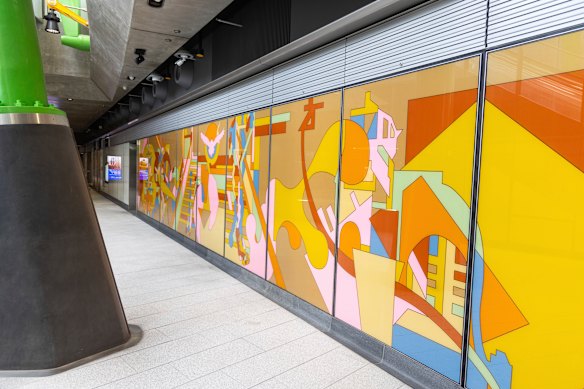
Part of Raafat Ishak’s Future Wall Painting, located throughout Anzac Station.Credit: Paul Jeffers
Ishak is known for his graphic, hard-edged paintings that merge the abstract and figurative. He is a wonderful colourist, and his glass murals are a harmonious blend of seemingly sparring colours such as mustard, pink, blue, mint green and taupe. Here Ishak’s dynamic, linear designs reflect the movement and connectivity of the rail network, as well as the surrounding environment across time, with references to Indigenous history, local flora and fauna and the contemporary buildings of St Kilda Road.
A small space near an elevator is reserved for the work of Sydney-born and Hobart-based artist Fiona Hall, who pays tribute to the Anzac legacy with her intricate botanical drawings etched on glass panels. Against a dark backdrop that oozes hints of blood red, Hall’s etchings highlight species that grow where Australians fought at Gallipoli and on the Western Front, such as the Flanders Poppy, Lone Pine and Gallipoli Rose, as well as symbolically Australian plants, such as the golden wattle and lemon-scented gum. Flanking the elevator shaft are bronze statues of two Victorian-bred carrier pigeons who bravely delivered critical messages through storms and heavy fire during World War II.
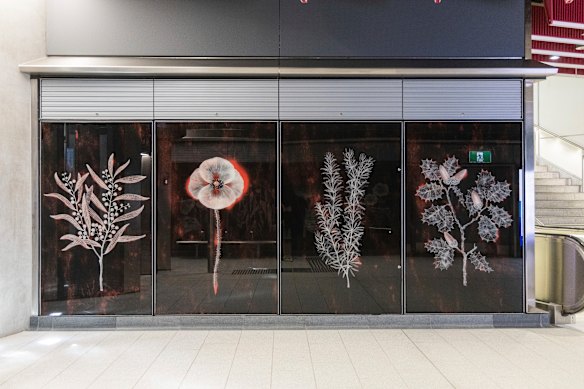
Intricate botanical drawings by Fiona Hall at Anzac Station.Credit: Paul Jeffers
I did wonder about the location of Hall’s work, down a gloomy end of the station, a little like an afterthought and easy to miss. Ishak was the first artist selected for Anzac station, and then a decision was made to also include Hall’s work because of its quality and reference to the Anzac legacy. Perhaps more could have been made of it.
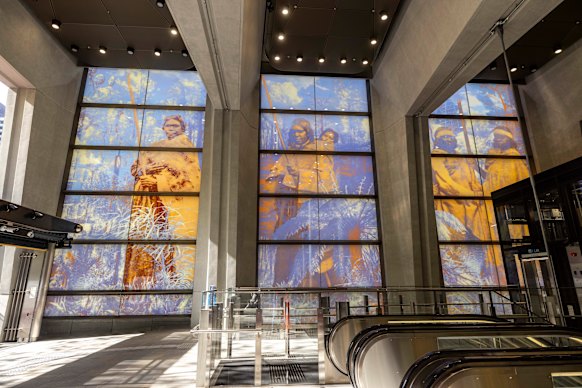
State Library Station features artwork by Danie Mellor, based on historic photos of Wurundjeri Woi Wurrung women.Credit: Wayne Taylor
Queensland-born artist Danie Mellor’s Forever, towering photographic images of Wurundjeri Woi Wurrung women and children on the facade of State Library Station, reinstate Indigenous history in the most beautiful and evocative of ways. Created from photographs sourced from the library archive and Mellor’s own photographs of Wurundjeri Country, these powerful images are best viewed from inside the station, where they glow like stained glass.
The work of Victorian First Nations artist Maree Clarke extends across the five new stations in the form of native animal prints made from coloured granite and embedded in the platforms’ floors. There are 35 large footprints in all, a wondrous array of patterns and shapes, of animals from the Kulin Nation, extinct and not, that the urban dweller may struggle to identify (I did). But that too is the point – drawing attention to the deep history of these traditional lands on which we walk.
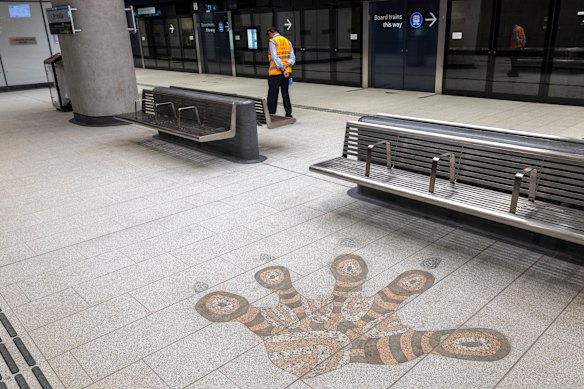
Maree Clarke’s large-scale footprints link all five stations. This one is in Parkville. Credit: Jason South
Clarke’s work is the only art in the Town Hall station. Mexican-Canadian artist Rafael Lozano-Hemmer’s commission was abandoned after a series of challenges, including the pandemic.
It’s a shame, as Lozano-Hemmer’s works are spectacularly immersive and interactive, and because there’s a space at Town Hall begging for art, a grand platform with futuristic columns and soaring ceilings of a scale that reminds me of the Tate Modern’s Turbine Hall. A gargantuan screen extends across the length of the platform’s back wall – disappointingly, this screen will be surrendered to advertising. And yet it presents the perfect opportunity to display the video work of Australian artists – plenty come to mind: Shaun Gladwell, Tracey Moffatt, Christian Thompson, David Rosetzky, The Huxleys, to name a few. One could even initiate a Town Hall video prize and present a rotating series of winning videos. Anything, surely, than another overwhelming screen bombarding us with things to do and buy.
The Booklist is a weekly newsletter for book lovers from Jason Steger. Get it delivered every Friday.
Most Viewed in Culture
Disclaimer : This story is auto aggregated by a computer programme and has not been created or edited by DOWNTHENEWS. Publisher: www.smh.com.au






