A long-awaited trial into Greece’s worst train crash has descended into chaos hours after it began, with relatives of the 57 people killed in the disaster screaming “shame on you” at judges who were forced to adjourn the hearing until next month.
More than three years after the disaster, grieving families denounced the proceedings as a caricature of justice amid demands the trial be held elsewhere. The five-member panel of judges called multiple recesses on Monday before announcing the hearing would be postponed until 1 April.
Speaking from the purpose-built courtroom in Larissa, the town closest to the crash in central Greece, Panos Ruci, who lost his son Denis, said: “The courtroom is simply not fit for purpose. There are so many relatives and lawyers and it’s like a chicken coop in there.”
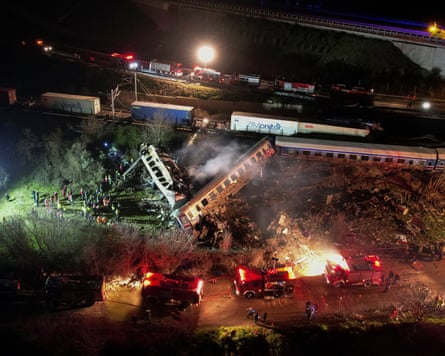
Denis was killed instantly on 28 February 2023, when the Thessaloniki-bound intercity train he was travelling on collided with a freight carrier heading south. The passenger train had been crammed with students returning from a holiday weekend in Athens.
The crash, in the Vale of Tempe, ignited a massive explosion that lit up the night skies for more than an hour. Investigators blamed the fireball for the subsequent deaths of passengers whose remains were only partly recovered, compelling officials to hand over bodies in sealed caskets.
About 350 witnesses have been called to take the stand in a trial that could last years. Among the 36 people who face charges are rail officials and the station manager who confessed to putting the locomotives on the same track – an error that meant the two trains were unknowingly barrelling towards one another for 12 minutes.
To the fury of survivors and the families of victims, however, none of the accused will be politicians in relevant posts at the time of the crash. Two former government members are under investigation, but neither has appeared before a court.
“All we want is justice,” said Ruci, who last year staged a 23-day hunger strike outside the Greek parliament to press authorities to have his son’s remains exhumed to “properly determine” the cause of death through toxicological tests.
His demand was eventually met, and the grief-stricken father is among those who have come to symbolise the battle for retribution. “If there is no justice we will go to the European court of human rights,” he said. “There should be a political reckoning, too.”
Three years on, the centre-right government of the prime minister, Kyriakos Mitsotakis, is still facing fallout from the rail disaster.
Relatives have pointed to an inept public inquiry and rushed decision to gravel over the crash site – losing valuable evidence – as proof of the state’s compromised handling of the tragedy.
Adding to widespread consternation, the European Public Prosecutor’s Office (EPPO) has also weighed in, highlighting delays in using EU funds to improve the signals system along tracks connecting Athens and Thessaloniki, the country’s two largest cities.
Laura Codruța Kövesi, the body’s chief prosecutor, has publicly said the collision could have been prevented if the automated safety system had been installed with the €41m (£35m) of EU funds that had been funnelled into the project.
The failure to make the upgrade has spurred EPPO to bring additional charges against 16 employees connected to the signals contract.
On Monday, rail workers, who had frequently warned of the risks to safety on the network, staged a 24-hour strike in what their union called “an act of collective remembrance, protest, and democratic vigilance”.
Analysts said the chaotic scenes that played out in Larissa were likely not only to exacerbate public anger over the disaster, but also to further damage confidence in mainstream politics in Greece.
Disclaimer : This story is auto aggregated by a computer programme and has not been created or edited by DOWNTHENEWS. Publisher: theguardian.com