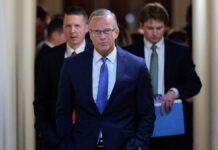
A clash over the urgency of fixing the security gaps that led to the Bondi massacre prompted the resignation that has plunged the royal commission into disarray.
The Royal Commission on Antisemitism and Social Cohesion was thrust into the spotlight on Wednesday night when former ASIO boss Dennis Richardson quit his role as a special adviser to Commissioner Virginia Bell, saying he felt surplus to requirements.
The former spy boss and US ambassador had finished interviewing heads of the intelligence agencies in mid-January, and was focused on delivering a concrete set of recommendations about intelligence and policing failures in the commission’s interim report, due in April.
But sources with knowledge of the commission’s workings said Richardson felt his role became untenable when Bell decided the interim report would not contain substantive recommendations or findings.
Bell, according to the sources not permitted to speak about the commission publicly, wanted the interim report to leave open key questions for “further exploration”, reserving key recommendations for the final report in December.
Richardson was willing to delay the interim report to allow time for hearings to inform more substantial findings about intelligence failures.
But Bell, who prides herself on meeting deadlines, did not seek a time extension from the government.
According to sources familiar with the disagreement, Richardson believed delaying substantial recommendations on security until December would mean missing the opportunity to implement lessons from the worst terror attack in Australian history. He also feared any security recommendations would be lost in the other findings on antisemitism.
Richardson, who was being paid $5500 per day, said his resignation was “an embarrassment all around” but insisted the credibility of Bell’s royal commission remained intact.
“I didn’t necessarily see my last job of this kind being more of a highly paid researcher,” Richardson told reporters in Canberra on Thursday before conducting a round of media interviews. “I saw my job as being a little bit more than that.”
“It’s just that it’s now reached a point where I think my value-add is pretty limited.”
Sources familiar with the relationship between Bell and Richardson said they had “different views of the world” that proved irreconcilable despite their respect for each other.
“The cultural and philosophical differences were too great” between the former High Court justice and the security establishment figure, one source said.
Richardson has told confidantes he concluded he was the “odd one out” in the relationship and that he should step aside so Bell could complete the work as she saw fit.
Richardson had been contracted until May, with an option for extension.
Bell revealed in her opening address last month that delays in obtaining material from key agencies made it unlikely “will be in a position to adduce evidence concerning the adequacy of the security arrangements for the Hanukkah event and aspects of the effectiveness of the work of intelligence and law enforcement agencies before the deadline for the production of the interim report”.
“That evidence may end up being led after the interim report is delivered and in that case, it will form part of the final report,” she said.
Bell added that Richardson was “uniquely well-placed to advise on the material that the commission should seek from our intelligence and security agencies in order to test the effectiveness of our preparedness for a terrorist attack.“
Bell declined to comment on Richardson’s public remarks after he resigned.
Prime Minister Anthony Albanese was initially reluctant to call a federal royal commission, instead tapping Richardson to conduct a standalone review into intelligence agencies.
After a weeks-long campaign for a royal commission led by the families of Bondi victims, the prime minister finally agreed, announcing the federal probe into antisemitism on January 9.
The view inside the government is that the Richardson blowup proves that Albanese was right to prefer a Richardson-led review in which the former spy had full autonomy.
Leading Jewish figures, including former treasurer Josh Frydenberg, made no public comments about Richardson’s resignation, which took the community by surprise.
The Jewish community is intent on retaining public trust for such a critical inquiry.
The Coalition, which pushed for a royal commission over summer as Albanese’s personal polling numbers took a hit, did not ask any questions about Richardson in Question Time. Albanese has not yet commented on the matter.
Frontbenchers James Paterson, Andrew Hastie and Michaelia Cash said the resignation was a disaster.
Paterson called Richardson’s resignation “a disaster for the royal commission, for its credibility, ultimately for its findings and recommendations”.
Hastie said: “We need to have a talk about militant political Islam, we need to talk about the role that our intelligence agencies, our law enforcement agencies, played in all of this.”
Cash, the shadow attorney-general, said the Australians would lose confidence in the royal commission due to Richardson stepping aside.
“You need to question whether the royal commission’s ability to investigate the intelligence and anti-terror dimensions of this tragedy have been seriously undermined,” she said.
Cut through the noise of federal politics with news, views and expert analysis. Subscribers can sign up to our weekly Inside Politics newsletter.
 Paul Sakkal is chief political correspondent. He previously covered Victorian politics and has won Walkley and Quill awards. Reach him securely on Signal @paulsakkal.14Connect via X or email.
 Matthew Knott is the foreign affairs and national security correspondent for The Sydney Morning Herald and The Age.Connect via X, Facebook or email.
From our partners
Disclaimer : This story is auto aggregated by a computer programme and has not been created or edited by DOWNTHENEWS. Publisher: www.smh.com.au