It was a thumping tackle in driving rain that highlighted the Wallabies’ hunger to beat the British and Irish Lions in the third Test in Sydney.
But Dylan Pietsch’s shot into the chest of Lions winger Tommy Freeman could be penalised in the future after World Rugby announced a law trial lowering the legal tackle height from shoulder to sternum at elite underage level – and which could end up being implemented at the highest level.
World Rugby revealed this week it would use the World under-20s Championship in Georgia next year to extend a trial of the new tackle height, which has been trialled in 11 countries over the last two years at the community level – including Australia.
As has been the case for the past two years in the Shute Shield, the Hospital Cup and all amateur competitions in Australia, any tackles above the sternum can be sanctioned as high contact, with the goal being to train defenders to get lower, and reduce the chance of head contact and concussion.
The shoulder is still the legal height limit for a tackle at professional level.
Research indicates the risk of concussion is 4.2 times higher when a tackler’s head is above the ball carrier’s sternum, according to World Rugby.
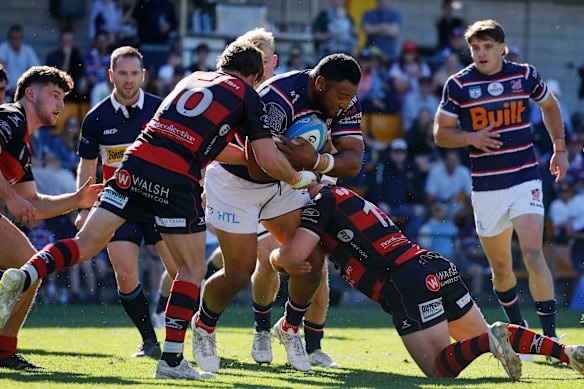
Norths and Easts contest the 2024 Shute Shield grand final, under the new tackle height.Credit: Karen Watson/Sydney Rugby Union
The governing body said data from over 150,000 tackles under the new trials had shown a reduction in upright tackles of eight per cent in men’s community rugby, and 10 per cent in women’s rugby.
There were wildly different returns in terms of reported reductions in concussion, so far. The Irish Rugby Football Union reported a 50 per cent drop in concussions with the lower tackle height, and French data showing a 27 per cent reduction. Most nations – including Australia – reported more modest reductions of about five per cent, and researchers say it’s still early days with the data.
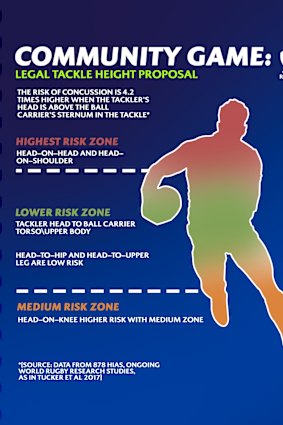
World Rugby’s tackle height guideline document.Credit: World Rugby
But as seen with the responses of Shute Shield players and coaches, the transition to a lower tackle height at community level was mostly done without fuss, and players and referees adapted. Common-sense interpretation settled in, and not all tackles in the chest zone get penalised.
World Rugby also announced recently the sternum height would be extended into law at community level.
But the move that could see the sternum tackle height eventually become law at professional level, too, will come via a further trial at the world under 20s; the annual tournament between the best colts – and future Test players.
World Rugby vice-chair Jonathan Webb said during the week the results of the under 20s trial would then be assessed for suitability at the elite levels. But he believes it would have to be done via a full roll-out, rather than another limited trial.
“If this is successful and shows good metrics and positive outcomes, the question is whether we take that into the elite game,” he said.
“That is going to be a big decision, but my own feeling is that it will have to be an all or nothing. That will be very complex, the game is far faster, the game is under huge scrutiny, the pressure on players and referees is enormous.”
As with club trials, the lower tackle height at the under 20s worlds will not apply to pick-and-drives and only referees – not the TMOs – can call high tackles. But in a potentially contentious addition, ball carriers can be penalised for leading dangerously with their head.
Junior Wallabies coach Chris Whitaker said the changes won’t affect his side too much given all his squad will have used the tackle height for two years.
“It won’t make a massive change for us,” he said. “The players adapt pretty quickly but the hardest thing will probably be the referees adjusting to it. What you found was in our club footy is they went super hard early, and then found middle ground a bit.”
Referees in Shute Shield and other major competitions developed a style where low-impact chest tackles were mostly not pulled up, and a second tackler – like Pietsch in Sydney – was also given more leniency if there was contact above the sternum.
“The hard one may be how they referee the second tackler (at the World under 20s championship). We tend to coach our first guys to chop tackle (low),” Whitaker said.
“In club footy they would allow for the fact the first guy to have taken the speed out of the tackle, and the second guy can still be higher up if they’re deemed to be wrapping the guy up. Hopefully that will still be how it plays out.”
Whitaker hopes the lower tackle focus may help with more offloading and speed in the game, but said a focus in his team’s preparation next year will be working on how a ball carrier avoids penalties for leading with the head.
“That will be a bit of a challenge, you train guys to get their body height low. That’s probably going to be a big one to look at, how it gets reffed,” he said.
Most Viewed in Sport
Disclaimer : This story is auto aggregated by a computer programme and has not been created or edited by DOWNTHENEWS. Publisher: www.smh.com.au