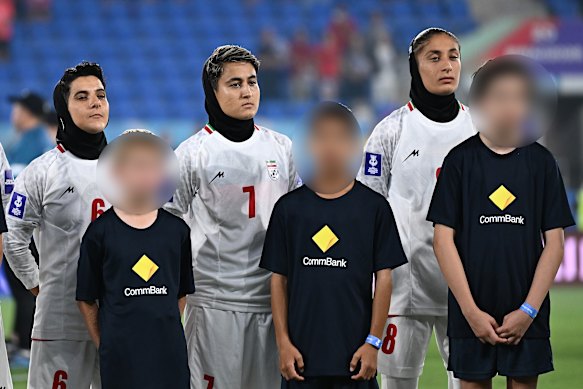

Amid worry about the cohesiveness of our communities, Australians united this week in their concern for the Lionesses, Iran’s aptly named soccer team, after its players were branded “wartime traitors” by the Iranian regime for failing to sing their national anthem before an Asian Cup match on the Gold Coast.
For those of us who have never experienced authoritarianism, it was distressing to watch its dark hand stretch to our shores as the women were threatened for exercising what we would consider basic freedom of expression.
Herald journalist Emma Kemp has covered the Lionesses for years. She knows how tightly they are controlled at international tournaments, and how afraid they have been of saying anything to trigger reprisals against their families. When she saw “their version of defiance, standing silently instead of singing” as bombs fell on their homeland, Kemp was in disbelief – “not because this team was not capable of such bravery,” she said, “but because the danger of such a protest felt so real”. She wrote this piece about why it was such a courageous act.
As concern for the women’s welfare grew, including from United States President Donald Trump, five players fled their hotel and were granted asylum. The rest remained with their entourage, which included suspected members of the Islamic Revolutionary Guard Corps. As columnist Jacqueline Maley wrote, state-sponsored coercive control was playing out before our eyes in a Gold Coast holiday resort.
As the Lionesses packed their bags after their final loss and were bussed to the airport, Australia hoped more players would stay. In the end, only one more did.
We don’t know what went through their heads – whether they feared reprisals against their loved ones if they stayed, or felt that they would rather face whatever was in store for them than risk never seeing their families again. Through their contacts, Kemp and Billie Eder gave subscribers an insight into the dilemma facing one of them, 24-year-old Golnoosh Khosravi, who eventually decided to leave. “She was like, ‘I have everything in Iran’,” a source told them. “‘I know there’s a war and everything, but I don’t know what’s the right thing to do. I don’t know what they’re going to do to us when we get there’.”
Amid a blitz of confusing information, Herald reporter Amber Schultz raced to Sydney airport armed with her passport and an overnight bag. At the last second, and despite Iranian officials’ attempts to evade scrutiny, she jumped on flight MH140 to Kuala Lumpur to follow the team members on the first leg of their circuitous route towards an uncertain future in a war-torn home. She spoke to some of them in the moments before they boarded the plane in Sydney; it was the only time they spoke directly to a journalist during their trip to Australia.
“It wasn’t clear whether any of us would even get on the flight, amid delays at immigration as the women were questioned, and further delays as one considered staying behind,” Schultz says. “I worried for the women, their faces grave and with some crying as the plane took off.”
A beautiful photograph by Ben Symons brought home the poignancy of this story. It showed a member of the Iranian soccer team staring out the window of a Qantas aircraft, with “Spirit of Australia” written above her; a woman imprisoned by her authoritarian state, even while she is in our free country.
It was a reminder of how lucky we are to live in a democracy, where we are free to scrutinise our leaders – as James Massola and Lucy Macken did in this piece on Opposition Leader Angus Taylor’s investment and property portfolio, and Rob Harris did in his profile of the newly elected National Party leader Matt Canavan. But we can’t take our democracy for granted; as Peter Hartcher wrote last week, one in three Australian adults do not agree that democracy is always preferable to other forms of government.
As the war in the Middle East continues, the Herald’s Europe correspondent, David Crowe, and chief photojournalist Kate Geraghty – an experienced and decorated war photographer – have been on the ground in Lebanon, where Israeli bombs are striking the Iranian-backed group Hezbollah, and there is talk of a possible land invasion. Hundreds of thousands of people have been displaced, and hundreds are dead.
Crowe and Geraghty have watched people scrambling away from areas that are about to be bombed, and have met the families now living in stadiums and on streets. They are based in Beirut, and have been watching the bombs fall.
For this weekend, they have filed from the Al Najdeh Hospital in Nabatieh, in Southern Lebanon, where about 20 people are taken each day because of the drone strikes. Locals have been told to leave, but some don’t have money or cars. The injuries are serious. Many patients die. Geraghty’s photographs and Crowe’s words create a vivid sense of what their lives have become. I commend their work to you.
Get a note directly from our foreign correspondents on what’s making headlines around the world. Sign up for our weekly What in the World newsletter.
From our partners
Disclaimer : This story is auto aggregated by a computer programme and has not been created or edited by DOWNTHENEWS. Publisher: www.smh.com.au