By Rachael Dexter
Victoria Police officers were “cruel, inhuman” and “degrading” when they sprayed capsicum spray at protesters at the 2019 International Mining and Resources Conference (IMARC), the Supreme Court has found in awarding $54,000 in a landmark class action case.
The ruling has prompted calls from a human rights organisation for a total ban on the use of the spray in public order policing.
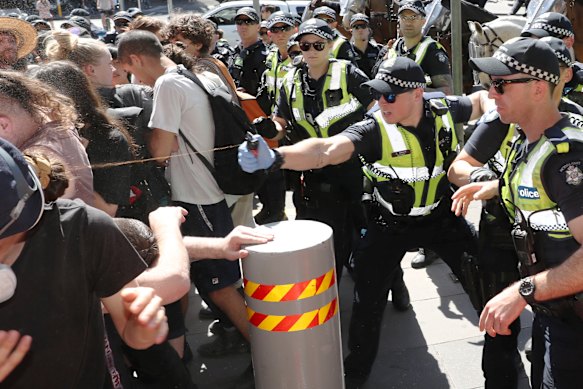
Police use pepper spray as protesters attempt to stop conference members entering during a protest against the International Mining and Resources Conference in Melbourne in October 2019.Credit: AAP
Justice Claire Harris delivered her judgment in the long-running case on Friday, finding the state of Victoria legally responsible for the unlawful physical assault (battery) and the violation of human rights committed by police against the lead plaintiff, climate activist and documentary maker Jordan Brown.
Anthony Kelly, spokesperson for Melbourne Activist Legal Support, which monitored the protest and gave evidence in the case, said it was “a landmark decision” that the Victorian government needed to take on board.
“A total ban on the use of OC spray at public order policing is a logical and sensible response to this decision,” Kelly said.
Grahame Best, SC, who represented Brown, said the court found both times Brown was sprayed constituted battery, noting that the first time he was “standing huddled, not moving” and the second time he was “running away from the protest”. The court found this use of force was “not reasonable, proportionate, and therefore unlawful”.
Dozens of protesters were doused with the spray – also known as oleoresin capsicum (OC) foam – after police attempted to arrest two climbers who had unfurled a sign outside the Melbourne Convention Centre on October 30, 2019.
The judge on Friday found the deliberate use of capsicum foam on Brown was unlawful and awarded him $54,000 – made up of $40,000 in general damages, $4000 in special damages and $10,000 in aggravated damages, which Harris said recognised the “increased distress and humiliation” caused by police actions.
The case was described as the first class action against Victoria Police specifically concerning the use of OC spray in a public protests, and advocates expect the ruling to set a major precedent for public order policing tactics in the state.
Harris said the case raised “very difficult questions” given the “dynamic and occasionally chaotic crowd environment” faced by police and found that police actions limited Brown’s rights to freedom of movement and peaceful assembly.
However, she warned the case wouldn’t necessarily set a new standard.
“The evidence will not set a precedent for every other case,” she said. “It is important to appreciate that these conclusions are necessarily limited in their effect to the use of OC aerosols as relevant to the plaintiff’s circumstances in the circumstances of this particular proceeding.”
Police issued a statement after the judgment saying: “The public should have confidence our members are highly trained and there are strict rules surrounding the use of OC spray.
“It provides police with a vital tool to safely resolve situations of violence or serious physical confrontation. As this trial forms part of a class action with further matters before the court it would be inappropriate to comment further.”
Kelly said the ruling was a “vindication” for those affected and noted that when OC spray was first introduced in 1995, the then police minister promised Parliament it would not be provided for public demonstrations.
“Victoria Police have usurped that promise in the years since, and now use it on sickeningly regular times against entire crowds of people who are often doing nothing more than simply standing holding their ground,” Kelly said.
The trial focused heavily on whether the actions of police officers, primarily from the Public Order Response Team (PORT), were an “unreasonable, unlawful and disproportionate use of force” in breach of the Crimes Act and the Victorian Charter of Human Rights.
The State of Victoria admitted that two officers deployed OC foam against the plaintiff, but defended the claim on the basis of lawful justification, primarily self-defence or to assist in a lawful arrest.
The police union had previously defended the actions of its officers as justified, proportionate and lawful. It has been approached for comment.
Police Minister Anthony Carbines has been approached for comment.
Legal costs will be determined in February 2026.
Start the day with a summary of the day’s most important and interesting stories, analysis and insights. Sign up for our Morning Edition newsletter.
Most Viewed in Politics
Disclaimer : This story is auto aggregated by a computer programme and has not been created or edited by DOWNTHENEWS. Publisher: www.smh.com.au