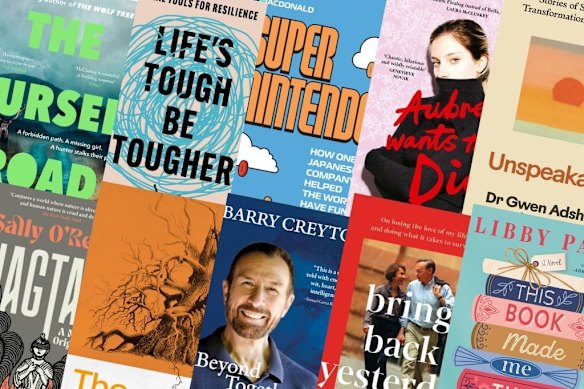
Tis week’s reviews feature everything from vampires and literary whimsy to the history of Nintendo and how to build resilience.
FICTION PICK OF THE WEEK
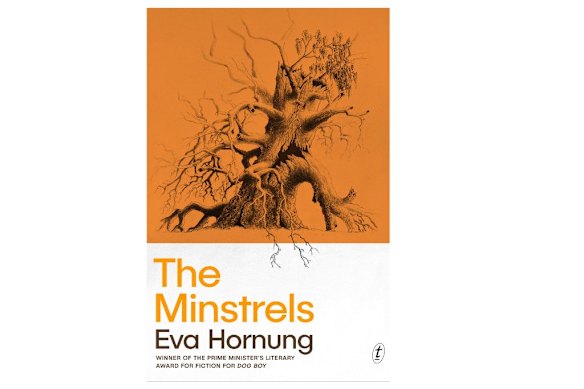
The Minstrels
Eva Hornung
Text, $34.99
Award-winning author of Dog Boy and The Last Garden, Eva Hornung wrestles in The Minstrels with the colonial settler imaginary. Gem and Will grow up in rural Australia, near a spectacular gorge and river pool known as The Minstrels. It’s sacred to the Indigenous people living on Country and also popular with other locals in the rural farming community. The novel portrays the nuances of Gem’s connection to the land, following her (and to a lesser degree, her brother Will) from childhood through adult life, as the precarity of her birthright becomes apparent. The novel combines realistic historical fiction with apocalyptic cli-fi: a technological crisis destroys the property system and presages a return to land rights by use, or through force and conquest, rather than the rule of law. Gem’s relationship with Uncle Jim, a First Nations elder, is explored, and her maturing sense of place undergirds the novel and confronts dramatic disruption in an unfolding catastrophe. Most of the novel is fictionalised except the Aboriginal language – Adnyamathanha, Yura Ngawarla – characters come to speak, and Hornung has seeded the narrative with complicated issues that bloom, in her characteristically fertile prose, into ambivalent flower.
The Cursed Road
Laura McCluskey
HarperCollins, $34.99
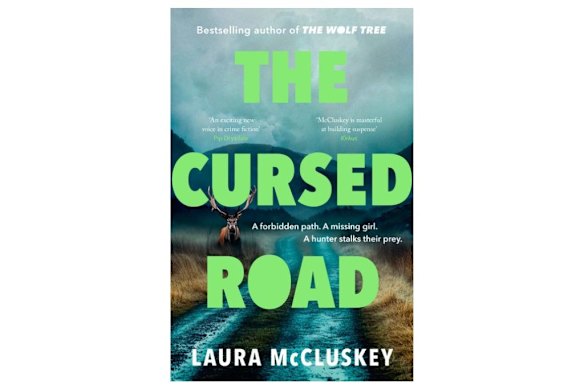
The Scottish detectives in Laura McCluskey’s The Wolf Tree make a welcome return in The Cursed Road. The hot-headed, quick-witted DI Georgina Lennox and her more stolid and experienced offsider DI Richard Stewart have a new case to solve. They’re headed to a remote and mountainous location in the Highlands, where a young woman’s body has been discovered on a remote and little-used road. Answers are to be found in the town of Kilcree – a place of ancient feuds and competing versions of history, where the locals rely upon (and are deeply ambivalent about) deer-hunting tourism. The cast of characters includes activists and rich trophy-hunters, a newshound, an incompetent copper and a shadowy figure on the lam, and McCluskey cranks up the forbidding atmosphere and suspense as the case shifts from a police procedural into a chase thriller, the police hunting the killer through hostile wilderness, hoping to catch their quarry before they’ve got another corpse on their hands. If you enjoy spiky, hard-bitten Scottish crime fiction, you’ll love this one.
Hagtale
Sally O’Reilly
Scribe, $29.99
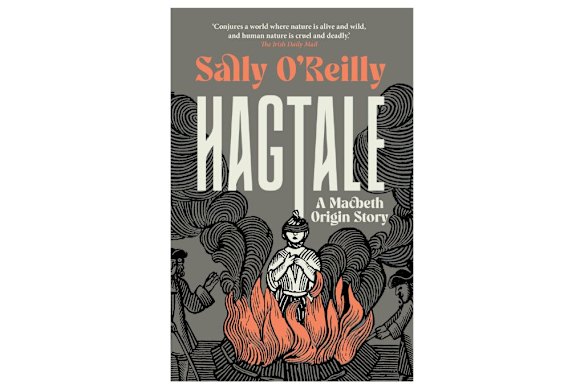
Yet another reworking of Shakespeare, Sally O’Reilly’s Hagtale takes us into the nightmare backstory of Macbeth. Where Scottish crime queen Val McDermid reinvented Lady Macbeth as a survivor in Queen Macbeth (2024), substituting the mad scene with a cunning escape, O’Reilly turns her into a protégé of the witches. In this telling, Lady Macbeth is Wulva, a feral child who’s found and raised by witches, taken from the forest, educated in human ways, and sent to live with the Macduffs. A second strand in the tale sees a monk, Brother Rowan, researching the history of the Scottish kings some centuries afterwards. Making Lady Macbeth as bound to the witches as her future husband risks transforming her into a lesser piece in a supernatural chess game. Wulva is certainly not the “fiendlike queen” Malcolm describes, and O’Reilly does manage to highlight the gendered social limitations of the time. In the end, though, Hagtale comes across as a strange and superfluous fiction that fails to render the human complexity captured in the Scottish play.
Aubrey Wants to Die
Pip Knight
HarperCollins, $34.99
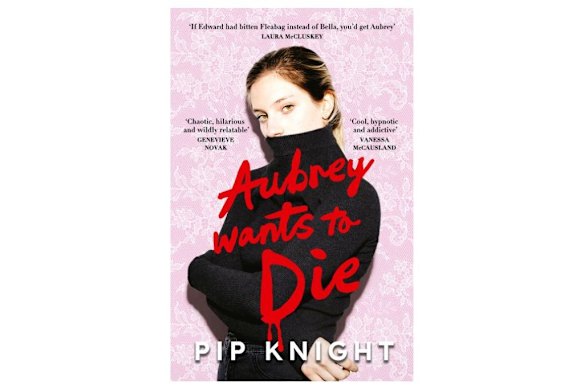
Aubrey looks young and beautiful, and she’s a hopeless romantic… in truth, she’s a 150-year-old vampire with suicidal tendencies. None of the usual vampire powers or weaknesses seem to apply to her, except needing to steal blood from hospitals and the like. Oh, and the undead part. Our heroine has tried to end her cursed existence by all the usual vampire-vanquishing means – garlic, holy water, sunlight … you name it, nothing works. Then she finds her soulmate, Jonathan, and the world gets rosier until he accuses her of being too clingy and dumps her unexpectedly. Enter the vampire who sired her, the aristocratic Oscar, who introduces Aubrey to a whirlwind of blood and pleasure and power. Will she be able to win Jonathan back, now that she’s a real vampire? Or is she in for another surprise? Vampire fiction… well, it never gets old, and Pip Knight has a twisted and cynically funny take on it. Aubrey Wants to Die mashes elements of romcom into the dark-hearted gothic architecture; it presents a heroine who must learn to see immortality as something other than an eternal opportunity for existential crises.
This Book Made Me Think of You
Libby Page
Viking, $34.99
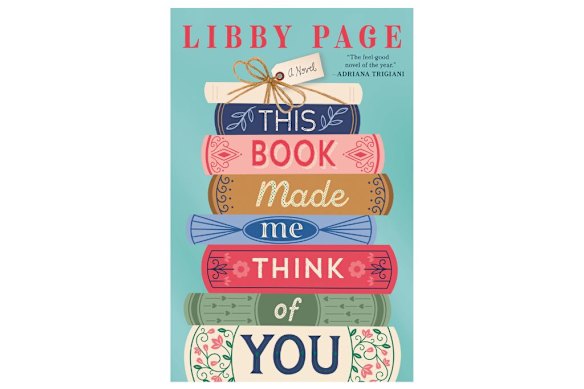
Lifelong bookworm Tilly Nightingale has always been an avid reader. She devoured fiction as a child, met her husband Joe in a bookstore, and turned to a career in publishing, becoming an editor in London. When Joe is diagnosed with cancer and dies, Tilly stops reading and stops turning pages in her life. She’s frozen with grief, until local bookseller Alfie gives her a gift from Joe – a copy of Roald Dahl’s Matilda with a letter from her late husband inside it, promising a cache of books, one per month for a year, each with another encouraging missive from beyond the grave. The initially reluctant Tilly slowly resumes reading. She grows closer to Alfie (who has his own struggles at the bookstore), reconnects with family, starts planning and travelling, and relearns to embrace and honour the power of literature, something she’s always fervently believed in. It’s perhaps too cute and comfortable to be of much help to the truly grief-stricken, but This Book Made Me Think of You should appeal to bibliophiles who like wisdom delivered with whimsical charm.
NON-FICTION PICK OF THE WEEK
Bring Back Yesterday
Bob Carr
Allen & Unwin, $32.99
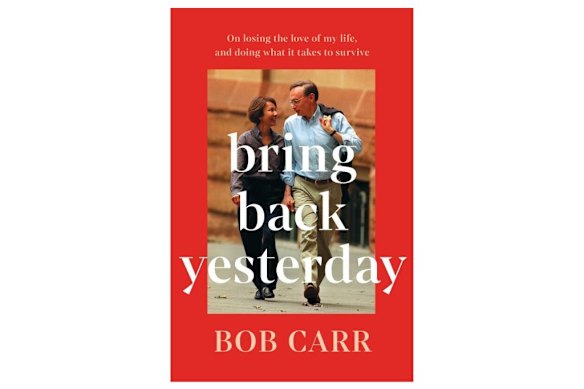
On a carefree day in October 2023, Bob Carr and his wife Helena were strolling through Vienna’s Leopold Museum when Carr spotted a plaque next to an Egon Schiele painting saying: “Death lives in all living things”. Helena died suddenly the next day of an aneurysm, and when Carr flew back to Australia, it was with his wife’s ashes in an urn – the impulse to write down the Schiele quote not so much an intimation as, perhaps, an unconscious acknowledgement that even in the midst of Arcadian happiness, death exists. It’s emblematic of the subtlety and depth of his meditation on their lifetime together, part memoir, part record of grief in all its visitations and part portrait of Helena, from her Malaysian childhood to her move to Australia and meeting the budding politician who became premier of NSW. At times, he writes of the post-Helena self in the third person, symptomatic perhaps of lingering shock and dissociation, for what comes through so powerfully is the brutal suddenness of her death and the sense of obliteration that followed. Among other things, this candid and frank, but reflective and deeply felt love letter to his lost “friend” reminds us never to take anyone or anything for granted.
Beyond Togetherness: A Life
Barry Creyton
Origin Imprint, $34.95
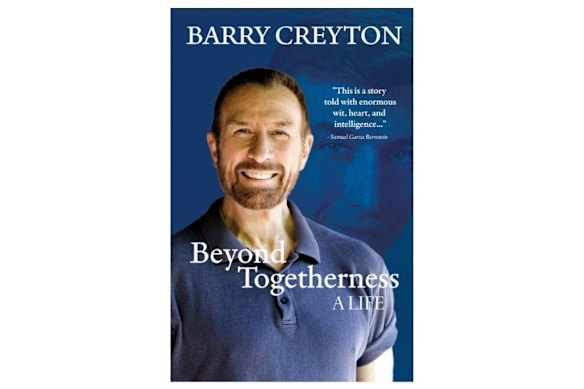
The title notwithstanding, actor/writer Barry Creyton is best known to many Australians as one of the co-founders of the 1960s TV satire The Mavis Bramston Show. But there’s a lot more to it than that, his memoir taking in his sexuality (he concealed his homosexuality from the public in the early days) and his childhood, growing up in Brisbane with a strict Victorian mother and a drunken father. As much as his mother tried to thwart his acting ambitions, he eventually entered, one can’t help but feel, the escape of theatre. His journeyman years led to Mavis, national fame, being mobbed in public, and even being kidnapped by university students. When Mavis exhausted itself, he left for the US, where he has lived for more than 30 years with his partner. Entertaining, always with a satiric touch, this is as much a journey through the showbiz world as the author’s life.
Super Nintendo
Keza MacDonald
Faber, $34.99
You might wonder what could justify a whole book on video games manufacturer Nintendo – and I do – but Keza MacDonald (video games editor at the Guardian) at least makes it explicable. The games may be digital and the reality virtual, but MacDonald insists it’s an affirmation of “what makes us human”: the desire to have fun, play being an intrinsic part of life for Homo ludens. It’s this that Nintendo has tapped into since the 1960s when the company started manufacturing toys. And, she argues, so successfully that Nintendo (with billions of players and profits that dwarf anyone in the entertainment business) has become a cultural phenomenon, far-reaching enough to be represented in the Victoria and Albert Museum. This is the story of Super Mario, The Legend of Zelda and Pokemon told with the infectious and witty enthusiasm of someone who discovered this world as a child and whose inner child is still released through games culture.
Life’s Tough, Be Tougher
David Buttifant & Nick Farr
Allen & Unwin, $34.99
When Buttifant and Farr – both with extensive experience in elite coaching – talk about life being “tough”, they’re drawing on deep, personal experience. Buttifant was fixing his bike tyre one morning when, on hearing his wife’s agonised cries, he rushed back into the house to discover their eldest son had taken his own life. Of course, it broke him. But observing the example of his 12-year-old, he determined to somehow get through it. Likewise, Farr, trapped in a Himalayan storm, watched his workmate and climbing companion die. The experience “changed the way I lived”. The keyword in their guide to dealing with what life throws at us is “resilience”, and, they argue, it’s not something you’re born with, but a skill to be learnt, its four pillars being the physical, emotional, social and psychological. The title might carry echoes of a coach revving the team up (and there’s a definite touch of that), but there are lots of practical strategies here in what they call their resilience “tool box”.
Unspeakable
Dr Gwen Adshead & Eileen Horne
Faber, $34.99
Nadia and her son Besim, refugees from the Bosnian-Serbian civil
war, first came to the attention of psychotherapist Gwen Adshead in
1997 after they had fled Sarajevo and entered the UK as refugees. Her
husband had gone out one morning in Sarajevo to get bread and was meant to be back in 10 minutes. When she saw his obliterated
body in the morgue, there was enough of him left to fill a black
garbage bag. In the UK, the son wasn’t speaking and Nadia was
crying incessantly. Over many heart-wrenching sessions with
Adshead, Nadia was beginning to find a new post-traumatic self. It’s
just one of the case studies in this examination of trauma from the
front line. Adshead insists, though, it is not a book about trauma, but
survival. Drawing on her extensive experience and training, as well as
philosophy and literature, she often challenges beliefs about trauma,
especially the idea that trauma does “irreversible damage”, when “post-traumatic growth is as possible as post-traumatic stress.” Confronting,
moving, compassionate, but ever hopeful.
The Booklist is a weekly newsletter for book lovers from Jason Steger. Get it delivered every Friday.
Disclaimer : This story is auto aggregated by a computer programme and has not been created or edited by DOWNTHENEWS. Publisher: www.smh.com.au