
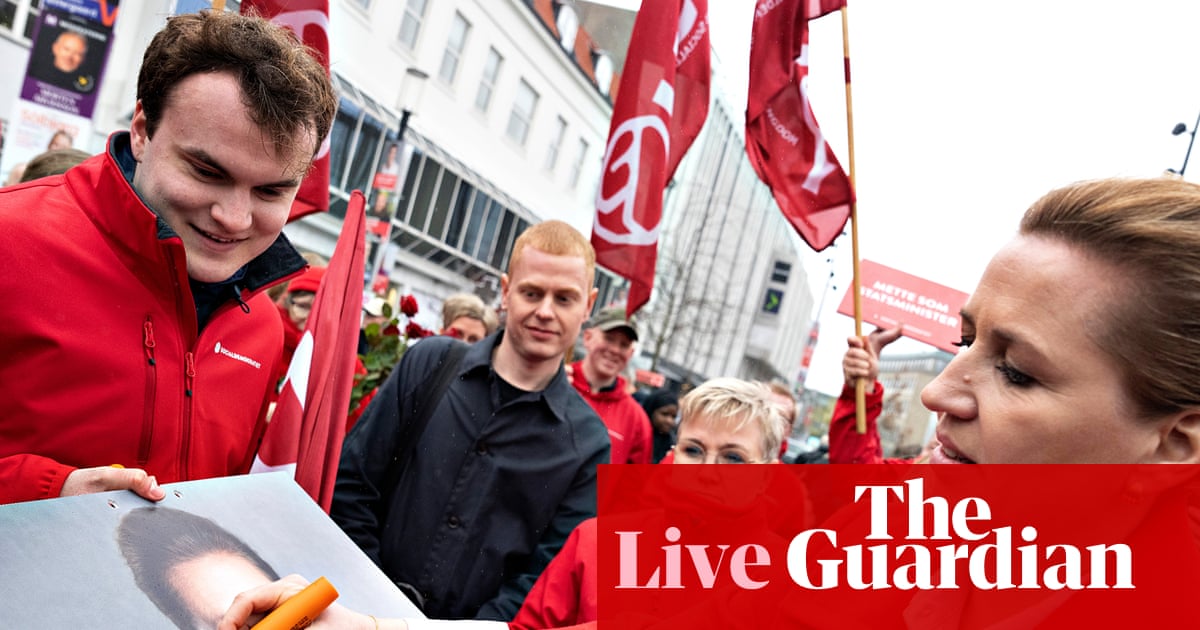
We now have the final results with 100% counted, but we are yet to hear from the prime minister, Mette Frederiksen.
Here is the final set of results:
Social Democrats (S, A) 21.9% (38 seats)
Green Left (SF, F) 11.6% (20)
Liberal Party (V) 10.1% (18)
Liberal Alliance (I) 9.4% (16)
Danish People’s Party (DF, O) 9.1% (16)
Moderates (M) 7.7% (14)
Conservative People’s Party (DKF, C) 7.6% (13)
Red-Green Alliance (Ø) 6.3% (11)
Denmark Democrats (AE) 5.8% (10)
Danish Social Liberal Party (RV, B) 5.8% (10)
The Alternative 2.6% (5)
Citizen’s Party 2.1% (4)
… which translates to 84 seats for the “red bloc” and 77 seats for the “blue bloc” – so no overall majority – and 14 for Moderates in the middle.
The voter turnout was 83.7%.
… and on that note, it’s a wrap for today!
-
The “red bloc” secured 84 seats in the new parliament, as the “blue bloc” got 77 seats, both short of the 90 seats required for majority.
-
Former prime minister and current foreign minister Lars Løkke Rasmussen, the leader of the non-aligned centre-right Moderates, has emerged as the likely kingmaker with 14 seats which will probably decide the next administration (12:43, 20:37, 22:40, 23:26, 23:45).
-
Denmark now faces weeks of coalition talks, but the outgoing defence minister and Liberal Party’s leader Troels Lund Poulsen appeared to rule out the continuation of the current three-party arrangement (00:22).
We will be back in the morning for more reactions as the dust begins to settle on today’s hectic election day.
But for now, good night!
If you have any tips, comments or suggestions, email me at jakub.krupa@theguardian.com.
I am also on Bluesky at @jakubkrupa.bsky.social and on X at @jakubkrupa.
in Copenhagen
Mette Frederiksen’s Social Democrats and Denmark’s other left-leaning parties appear to have failed to win enough votes to gain a clear mandate to form a government in an election fought amid geopolitical tensions with the US over Greenland.
With 99% of the vote counted late on Tuesday night, the prime minister’s party looked to have won the most votes but performed worse than expected, with nearly 22% of the vote, leaving the Social Democrats and the other left-leaning parties that form the “red bloc” with 84 seats, short of a majority in the 179-seat parliament.
But the right-leaning parties of the “blue bloc” also fell short, with 77 seats, putting the foreign minister, Lars Løkke Rasmussen, the leader of the non-aligned centre-right Moderates, in the spotlight as kingmaker with 14 seats.
Denmark now faces weeks of coalition talks, after which another centrist coalition appears likely to emerge.
Having reportedly spent much of the night smoking his pipe, Rasmussen emerged at the Moderates party late into the night to give a speech to jubilant supporters.
He urged Frederiksen and Troels Lund Poulsen, the leader of Denmark’s Liberal party, with whom he has been in coalition for more than three years, to “come down from the trees” and join him in the centre ground.
“What is clear – with all conceivable reservations – I think is that there is no red majority to the left of us, and there is no black-blue majority to the right of us,” he said to cheers.
We now have the final results with 100% counted, but we are yet to hear from the prime minister, Mette Frederiksen.
Here is the final set of results:
Social Democrats (S, A) 21.9% (38 seats)
Green Left (SF, F) 11.6% (20)
Liberal Party (V) 10.1% (18)
Liberal Alliance (I) 9.4% (16)
Danish People’s Party (DF, O) 9.1% (16)
Moderates (M) 7.7% (14)
Conservative People’s Party (DKF, C) 7.6% (13)
Red-Green Alliance (Ø) 6.3% (11)
Denmark Democrats (AE) 5.8% (10)
Danish Social Liberal Party (RV, B) 5.8% (10)
The Alternative 2.6% (5)
Citizen’s Party 2.1% (4)
… which translates to 84 seats for the “red bloc” and 77 seats for the “blue bloc” – so no overall majority – and 14 for Moderates in the middle.
The voter turnout was 83.7%.
Oh-oh.
The Liberal Party’s Troels Lund Poulsen goes all in as he says he wants to see a blue government as he appears to rule out another link up with Mette Frederiksen’s Social Democrats.
Remember, he is still the defence minister in the outgoing administration.
“I think we should form a blue center-right government. Otherwise, the Liberal Party will go into opposition,” he says.
If he stands by his comments tomorrow morning when the dust settles, this will make the coalition talks a lot trickier.
We are likely to see long weeks of discussions before a new government can be formed.
in Copenhagen
Arriving at Christiansborg at around midnight, trailed by cheering supporters carrying placards calling for their leader to be prime minister, Troels Lund Poulsen said he is still a candidate for prime minister.
He said in a speech:
“We need a new government. And that’s also why I’m happy that Venstre [Denmark’s Liberal Party] has become the largest blue party.”
As he arrives for his party’s election night party, the Liberal Party’s leader Troels Lund Poulsen tells reporters that he is happy to see his party come top of the blue bloc and signals willingness to talk with the Moderates about forming a centre-right government.
With less than 10 minutes until midnight in Denmark, 99% votes have now been counted.
Here are the latest numbers, via DR:
Social Democrats (S, A) 21.9% (38 seats)
Green Left (SF, F) 11.6% (20)
Liberal Party (V) 10.1% (18)
Liberal Alliance (I) 9.4% (16)
Danish People’s Party (DF, O) 9.1% (16)
Moderates (M) 7.7% (14)
Conservative People’s Party (DKF, C) 7.6% (13)
Red-Green Alliance (Ø) 6.3% (11)
Denmark Democrats (AE) 5.8% (10)
Danish Social Liberal Party (RV, B) 5.8% (10)
The Alternative 2.6% (5)
Citizen’s Party 2.1% (4)
Twelve parties will enter the next parliament.
That puts the “red bloc” at 84 seats in the new parliament, and the “blue bloc” at 77, with 14 seats for the Moderates, who will play a key role in deciding a new majority.
As discussed earlier, there will also be four MPs for Greenland and the Faroe Islands (two each).
Lars Løkke Rasmussen is now speaking, celebrating his party’s result in the election.
He says there have been “ups and downs” and that he does not even have a speech ready for the occassion, as you never know how things will go.
But he is clearly very pleased with the outcome, saying his party proved there is appetite for moderate, centrist voices.
He says it was a confusing election campaign, with so much focus on domestic politics against the backdrop of the US-Israeli attack on Iran.
He says his focus in coalition talks will be on issues, not on personalities and top jobs, and that will drive his considerations in discussions.
He says the other two parties of the outgoing government “ran to corners” to mobilise voters around their polarising proposals and issues, but now they will need to come back to “the middle” for talks about what’s next.
We will need days and weeks to see what that means in practice.
in Copenhagen
Oh, and just like that, he’s out of hibernation!
Lars Løkke Rasmussen is on TV wading through crowds to go to his election party with a pipe in his mouth.
If you are wondering what the likely kingmaker, Lars Løkke Rasmussen, is doing behind the scenes: well, he appears to be… just chilling, drinking coffee and smoking his trademark pipe, according to a senior aide who is with him tonight.
Earlier this month, he said in an interview that it was his favourite thing to do when he needs to think deeply about something. Well, he has got plenty to think about tonight!
In his other unusual habits, he confessed he occasionally uses hand soap to brush his teeth if there is no toothpaste available, and follows it with a cup of strong coffee.
He also likes sausages, it seems, which he served to voters as part of his campaign.
Quite a character.
Traditionally, Danish party leaders participate in a late-night debate on election night to offer their first reactions to the results.
But, somewhat unusually, the debate got cancelled this morning, as leaders are seemingly reluctant to speak too soon.
We are yet to hear from some of the biggest names, including the prime minister, Mette Frederiksen, or the likely kingmaker, Lars Løkke Rasmussen.
Given how tight and complex these results are, you can see why: no one wants to make a premature statement that could jeopardise potential coalition talks on live TV.
If you’re wondering about these numbers and why they don’t add up to the total number of seats 179, it’s because the exit poll and the projection do not include the four MPs for Greenland and the Faroe Islands (two each).
in Copenhagen
One of the surprise issues of the election was the treatment of Denmark’s pigs, earning the nickname “svinevalg“ (pig election).
Per capita, Denmark is the world’s most intensive pig-producing country, creating 30 million pigs per year (the equivalent of around five pigs per person a year).
Greenpeace said the election has shown there is a movement demanding Danish agriculture to change, citing systemic abuse to pigs, drinking water pollution and damage to fjords.
Christian Fromberg, political campaign lead at Greenpeace Denmark, said:
“This election could be a turning point, with broad implications for the industrial livestock industry even beyond Denmark’s borders. Across the country people are demanding change – it’s now up to the incoming government to listen.”
Disclaimer : This story is auto aggregated by a computer programme and has not been created or edited by DOWNTHENEWS. Publisher: theguardian.com









