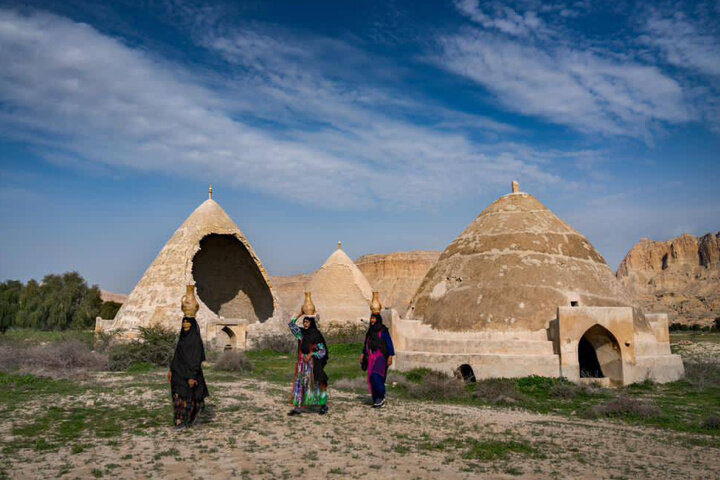
TEHRAN– In the hinterland of the Persian Gulf and in the east of Hormozgan province, the village of Behdeh is a little-known gem, carrying ancient knowledge in the field of handmade pottery; knowledge that is rooted in the historical memory and daily life of the women of this land.
It is understood by the native word ‘Charu’. Charu means mortar in the local dialect of the south, but in Behdeh it refers to a set of technology, skills, lived experience and art of the rural women from generation to generation.
‘Charu’ in Behdeh is a narrative of the continuity of the past and the present; a narrative of hands that have turned clay into history and of women who have quietly preserved part of Hormozgan’s cultural identity in form of simple but lasting vessels.
According to Miras Aria , anthropological studies and field studies show that pottery in Behdeh was mainly in the hands of women. In addition to daily responsibilities such as housekeeping, participation in agriculture, harvesting dates, cultivating summer crops and providing water, women have used their hands to transform clay into practical and beautiful vessels.
These potteries are made without the use of a potter’s wheel and completely by manual methods; a method that, from a technological perspective, is reminiscent of the very ancient traditions of southern Iran.
The patterns of Behdeh pottery are mainly geometric and simple, but at the same time, they have a distinctive identity. The broken lines, the repetition of regular shapes, and the minimal compositions express the creative and systematic minds of the female potters; women who have achieved a unique skill through experience and oral transmission, without having received formal training. These patterns are not only decorative, but also carry meaning and are part of the cultural narrative of the region.
Archaeological evidence obtained from the sites around the Behdeh plain dates the history of pottery in this region to the fifth millennium BC. The study of the surface pottery, and settlement remains discovered in historical areas indicate the continuity of life and the importance of this plain in different periods, from prehistoric eras to the Sassanid period. This historical continuity transforms Behdeh pottery from a local skill to a link in a long chain of civilization on the coast of Persian Gulf.
In a study conducted with an ethnographic approach, various groups were interviewed; from old masters who are known in the memory of the locals as ‘masters’ to women who participated as family workers in the process of preparing clay, shaping, and firing the potteries.
Middle-aged men of the village were also interviewed about childhood memories and the role of pottery in the family economy, and even people who played a role in transporting and selling pottery vessels expressed their narratives.
Charu was not only an economic activity, but also a stage for social solidarity and the promotion of women’s status in the village structure. The income from the sale of pottery has made an important contribution to the household economy and has turned women into active players in local livelihoods. In this way, Behdeh pottery can be considered a prominent example of the link between cultural heritage and social empowerment.
KD
Disclaimer : This story is auto aggregated by a computer programme and has not been created or edited by DOWNTHENEWS. Publisher: tehrantimes.com