
Updated ,first published
Prime Minister Anthony Albanese has declared he has no sympathy for 34 Islamic State-linked Australians trying to re-enter the country, saying the government would provide no help to the families, even as a close associate of Home Affairs Minister Tony Burke is reported to be helping them leave the camp where they have been living.
“We have a very firm view that we won’t be providing assistance or repatriation,” Albanese said on ABC Radio.
The effort to bring the families back to Australia is being organised by western Sydney doctor and Lebanese Muslim community figure Jamal Rifi, according to sources who cannot be identified because they are not authorised to speak publicly.
Rifi is close to Burke, and spearheaded the Friends of Tony Burke campaign to re-elect the minister in the seat of Watson at the last election. Rifi is believed to be organising the effort on the ground in the Middle East. Attempts to reach him have been unsuccessful.
The prime minister’s stated position seems to conflict with statements of the camp’s governor, Hakamia Ibrahim, who told a journalist in Syria overnight that the Australian government had “issued passports and the necessary documents for the families, and informed their relatives to receive their loved ones from the camp”. Her statement can be seen below:
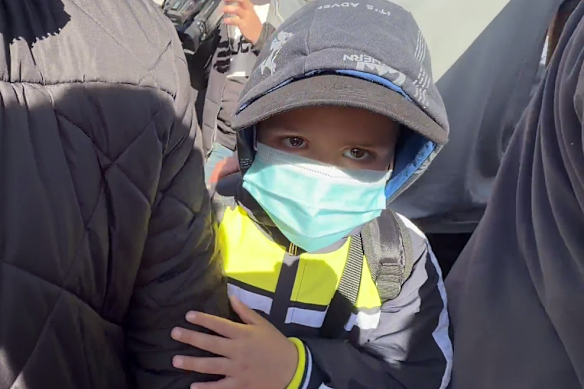
The group of women and children, who have been in internment camps in Syria for almost seven years, began their journey back to Australia late on Monday. But 50 kilometres from the Roj camp, they were turned around and forced to return.
The Department of Foreign Affairs and a spokesman for Foreign Minister Penny Wong have not clarified what documents, if any, the Australian government issued to allow the families to travel on Monday.
Albanese said that if the group made it to Australia they would “face the full force of the law”.
Opposition Leader Angus Taylor called for the government to do everything in its power to prevent the women from returning to Australia.
“These are individuals who chose to associate with a terrorist caliphate,” he said.
“This is not aligned with the values we as Australians believe in: democracy, the rule of law, the basic freedoms including freedom of religion. The door must be shut to people who do not believe in those things.
“Australians expect our borders and communities to be protected from individuals connected to extremist violence.”
Liberal home affairs spokesman Jonno Duniam urged the government to impose temporary exclusion orders on the women to prevent them from returning to Australia.
A spokesman for Burke said in relation to Duniam’s call that the government was “constantly receiving advice from our agencies about whether the threshold for temporary exclusion orders has been met”, and would “always act in accordance with advice”.
Albanese said in the ABC interview that: “My mother would have said ‘If you make your bed, you lie in it’.
“These people went overseas supporting Islamic State and went there to provide support for people who basically want a caliphate … We want to make it clear, as we have to the people involved, if there are any breaches of the law, they will face the full force of the Australian law.”
He added that: “Australian law applies and there are obligations that Australian officials have.” This is a reference to a requirement under Australian law for the government to help citizens stranded overseas by issuing a passport if they present themselves to an Australian embassy.
Advocates for the families said last year that Albanese adopted the “no assistance” stance after an earlier series of repatriations in 2022. That prompted a minor political backlash from local communities and the opposition.
Since then, wives and children of former Islamic State fighters have been required to find their own way to an embassy. The closest to Syria is in Beirut.
When two women and four children were smuggled out of al-Hawl camp in Syria and into Lebanon last year, the government gave them passports in Beirut to return to Melbourne. However, the policy has effectively trapped dozens of women and children in al-Roj camp in north-east Syria, which is harder to escape using people smugglers.
The government’s policy also precluded an offer by the US military to assist.
In an interview with Syrian media on Monday night, Ibrahim, the Roj camp’s governor, explained what had happened after the government-assisted 2022 repatriations of women and chidlren.
“Previously there were also deportations of some families,” Ibrahim said, according to the translation provided by Kurdish media. “The deportation was carried out through coordination with the Department of Foreign Affairs, through which they were transferred to their respective countries.
“The Australian government later stated that it was facing certain policy-related issues and was therefore unable to repatriate additional families.”
She said the promised departure to the Syrian capital, Damascus, then to Australia, had been paused for an unspecified period of time, saying: “It’s not cancelled, it’s postponed.”
It’s unclear what caused the delay, but local sources say there had been a disagreement between the Syrian government in Damascus, the Kurdish administration that runs the camp and the Australian families who are organising the repatriation.
Documents released in estimates last year say that the women and children could have been extracted by the US military without Australians having to set foot in Syria.
An August letter to Burke written by the representative of the families, Kamalle Dabboussy, and the head of Save the Children Australia, Mat Tinkler, said the families were prepared to “take control of their own destiny” by taking up the offer from the United States.
However, that offer foundered because the Australian government would not issue passports.
The Americans have long urged other countries to bring their own citizens home, with US Admiral Brad Cooper saying it was an issue of global security. He said in September that “repatriation reduces opportunity for extremist influence”.
Cut through the noise of federal politics with news, views and expert analysis. Subscribers can sign up to our weekly Inside Politics newsletter.
 Michael Bachelard is a senior writer and former deputy editor and investigations editor of The Age. He has worked in Canberra, Melbourne and Jakarta, has written two books and won multiple awards for journalism, including the Gold Walkley.Connect via X or email.
 Matthew Knott is the foreign affairs and national security correspondent for The Sydney Morning Herald and The Age.Connect via X, Facebook or email.
From our partners
Disclaimer : This story is auto aggregated by a computer programme and has not been created or edited by DOWNTHENEWS. Publisher: www.smh.com.au





