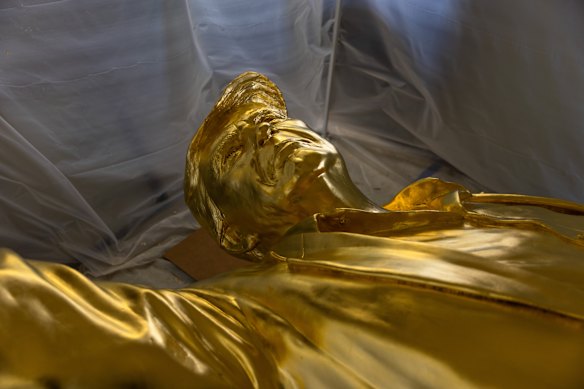
The giant effigy was dreamt up to promote a crypto scheme and is set to go on display at one of the US president’s golf courses.
It’s known as Don Colossus.
At 4.5 metres tall, the statue of US President Donald Trump, mounted on its 3-tonne pedestal, is about the height of a two-storey building – a giant effigy cast in bronze and finished with a thick layer of gold leaf.
For more than a year, the golden statue has been at the centre of one of the stranger moneymaking ventures of the Trump era. A group of cryptocurrency investors paid $US300,000 ($433,400) to have a sculptor create it as a tribute to Trump, an outspoken crypto proponent.
Then they used it to promote a meme coin called $PATRIOT.
Now, improbably, the project appears close to fruition. A pedestal made of concrete and stainless steel was installed last month on the grounds of Trump’s golf complex in Doral, Florida. Pastor Mark Burns, one of the organisers of the effort and a friend of Trump’s, told his collaborators that the president planned to attend the statue’s unveiling there, according to messages reviewed by The New York Times.
“It LOOKS FANTASTIC,” Trump wrote to Burns in December.
Nearly everyone in the crypto world has tried to profit from the Trump presidency, striking business deals with his family or seeking regulatory relief from his administration. But few have attempted it as boldly as the backers of $PATRIOT.
A meme coin is a type of cryptocurrency with hardly any function beyond speculation. It’s usually based on a viral joke or celebrity mascot, and is worth only as much as online fans are willing to pay. The crucial ingredient is internet hype, enough to convince potential buyers that the price will keep going up.
The construction of a giant statue was an expensive way to gin up social media excitement. But it was a potentially profitable plan. The investors who financed the statue were given stashes of the coins, which can sometimes skyrocket in value, according to one of the project organisers. For months, the backers of Don Colossus posted work-in-progress images on the social platform X and forged alliances in the MAGA world, with the aim of securing a marketing coup – a spot for the statue on an official Trump property.
The $PATRIOT coin went on sale in late 2024 and briefly surged, as Trump promised to turn the United States into the “crypto capital of the planet”. At an event in Washington during inauguration weekend, the coin’s backers presented a bronze miniature of the statue to Steve Bannon, Trump’s former adviser, and mingled with other conservative influencers.
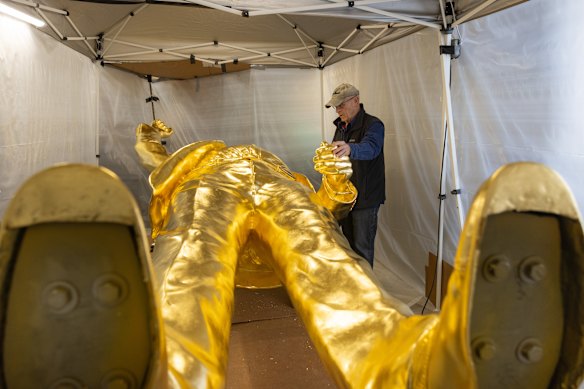
But delays and infighting have marred the venture, offering a window into the volatile world of meme coins, which are plagued by scams that often end up costing investors money. The $PATRIOT coin’s price cratered last year, losing nearly all of its value. As the coin’s backers rushed to finish the statue and boost coin sales, they clashed with their Ohio-based sculptor, Alan Cottrill.
In text messages reviewed by the Times, Cottrill said he was owed $US75,000 for the intellectual property rights to the statue.
“You are using my copyrighted image in marketing your token!” he wrote to one of the coin’s backers last month.
‘I had him very lifelike. The crypto guys said I had to get rid of some of the turkey neck. I had to thin him down.’Alan Cottrill, designer of Don Colossus
“Yes lol as we planned to from day 1,” replied Ashley Sansalone, a crypto developer who worked on $PATRIOT, as well as a separate coin called Elon GOAT.
In a statement, Sansalone said Cottrill would be paid in full before the statue was unveiled. “Under any business agreement, there’s always some funds withheld until the finished product is complete,” he said.
But it is not clear when the statue will go on display.
After the Times asked the White House and the Trump Organisation about $PATRIOT on Monday, the president’s son, Eric Trump, posted about it on X.
“We appreciate the support and enthusiasm,” he said, “but we want to be crystal clear – we are not involved in this coin.”
Creating Don Colossus
The plan to build Don Colossus was hatched in a group chat on Telegram, a messaging app where the crypto faithful gather to share tips and promote coins. It was July 2024, and Donald Trump had just survived an assassination attempt in Butler, Pennsylvania, his fist raised in the air.
Sansalone wanted to turn that image of defiance into the basis of a meme coin. He teamed up with Dustin Stockton, a right-wing activist, as well as Brock Pierce, a politically connected crypto investor with a long history of legal and financial disputes.
Not long after the bullet grazed Trump’s ear, Sansalone reached out to Cottrill, 73, whose bronze statue of Thomas Edison is on display in the US Capitol. Over the years, Cottrill had built statues of more than a dozen presidents, including 3-metre monuments to presidents George Washington and Thomas Jefferson.
The crypto investors wanted Trump’s statue to be even taller. They also requested certain cosmetic adjustments.
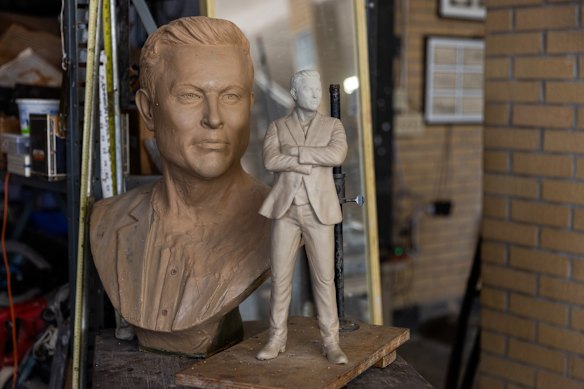
“I had him very lifelike,” Cottrill said in an interview last month. “The crypto guys said I had to get rid of some of the turkey neck. I had to thin him down.”
By Trump’s inauguration, Cottrill had finished the statue – a bronze goliath, not yet covered in gold leaf, but taller than anything he had sculpted before. That December, Trump posted a link to an article about the project in Breitbart News, which said that Stockton was in touch with the inaugural committee, discussing plans to unveil the statue the weekend of Trump’s swearing-in.
The timing of the post was perfect. The $PATRIOT coin had recently gone on sale.
“The people’s crypto token,” its website reads. “The statue they couldn’t cancel.”
Then came two major setbacks. The frigid weather in Washington caused a logistical mess, scuttling plans to unveil the statue. And shortly before his swearing-in, Trump launched his own competing meme coin, $TRUMP.
By the end of January, the price of $PATRIOT had plunged more than 90 per cent.
‘A juicy, juicy spot’
The investors were cultivating an influential ally: Burns, the prominent pastor and Trump confidant, sometimes described as the president’s informal “spiritual adviser”.
Burns began working on the statue after Pierce introduced him to the team. He soon became instrumental in a plan to reinvigorate the project by gilding the bronze statue.
“The president just asked me for pictures of his statue in gold leaf,” Burns wrote to his collaborators in November.
Trump got his wish. Sansalone told the group he had consulted a gold-leaf supplier in New York who had helped outfit Trump Tower. Cottrill shared a photograph of his latest work.
“It’s so bright and beautiful,” Sansalone responded.
“Wow … sending to the president,” Burns wrote.
Trump was apparently impressed. Last month, Cottrill travelled to Florida to install the 3-tonne pedestal on the grounds of Trump’s Doral golf complex (“a juicy, juicy spot,” Stockton boasted on social media). White House schedulers are now “actively looking” for a date when the president can attend the statue’s official unveiling, Burns wrote in a text to his collaborators in January.
It could have been a moment of triumph for Cottrill. But instead, he said, he is fed up with the investors behind the Trump statue.
Until fall 2024, Cottrill said, he was not aware that the crypto investors were using images of his work to market a digital currency, which he viewed as a violation of his intellectual property rights.
Eventually, he reached an agreement with them: They would pay $US150,000 for the rights to the statue. He was still waiting for the remainder of that payment, he said, as well as other funds he was owed – a total of roughly $US90,000.
“As far as I’m concerned, they haven’t bought the rights to the IP, and they’re using it illegally,” he said. “That statue will not leave my foundry until everything they owe me is paid.”
But the organisers of the effort argue that the project has not been much of a moneymaker.
Burns said he never requested or received any compensation. And in an interview, Stockton said the $PATRIOT coin was simply a financing mechanism to “help fund the activities around the statue”.
“I haven’t seen anyone make a lot of money,” Stockton said.
A spokesperson for the Trump Organisation, Kimberly Benza, said the company had “no knowledge” of the meme coin until the Times asked about it this week.
She did not respond to a question about whether the statue unveiling would go forward.
This article originally appeared in The New York Times.
Get a note directly from our foreign correspondents on what’s making headlines around the world. Sign up for our weekly What in the World newsletter.
Disclaimer : This story is auto aggregated by a computer programme and has not been created or edited by DOWNTHENEWS. Publisher: www.smh.com.au