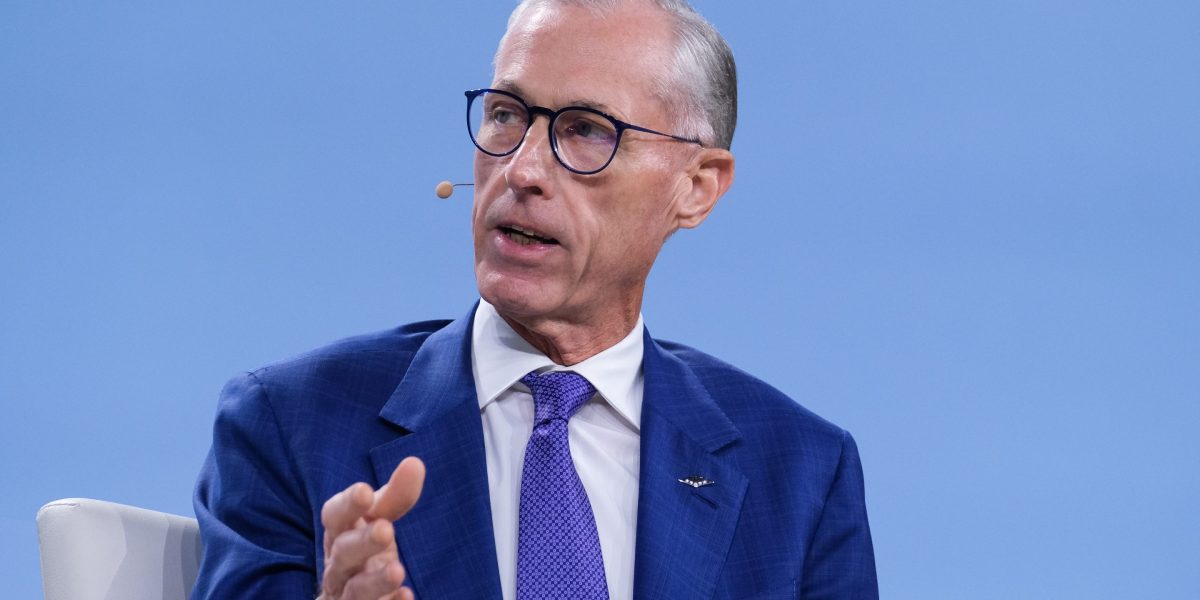
Petrochemical price spikes and shortages from the Iran war likely will cause inflationary effects at least through the end of the year on construction materials, consumer goods, the automative and aerospace industries, and much more, the CEO of Dow chemical said.
While much of the global supply shock focus is on oil, natural gas, fertilizer, and even helium for semiconductors, almost 20% of the global petrochemical capacity is blocked from the effective closure of the Strait of Hormuz chokepoint by Iran, said Dow chairman and CEO Jim Fitterling.
“The die is being cast for the rest of the year for what’s going to happen in the markets,” Fitterling said at the CERAWeek by S&P Global conference in Houston. “It’s like the unwind we saw on supply chains during COVID.
“You could be in the 250- to 275-day [range]. This is not going to be an instantaneous rewind.”
The supply shock will not only exacerbate the so-called K-shaped economic trends, he said, but also create greater haves and have nots between the Western and Eastern hemispheres.
Commodity petrochemical plants in the West—led by the U.S.—largely rely on natural gas-derived ethane as the chief feedstock, which is not directly affected by the war. In Asia, and much of Europe, they use crude oil-based naphtha as the building block. And almost half of Asia’s naphtha supplies flow through the Strait of Hormuz, Fitterling noted.
Already, many Asian plants are declaring force majeure and drastically cutting production because they can’t get the naphtha, said Kurt Barrow, S&P Global Energy vice president for oil, fuels and chemicals research.
“We’re seeing the force majeure of plants in Asia, but we’re not yet seeing the shortages at Home Depot,” Barrow told Fortune. “But there is that potential. Chemicals go into everything.”
How the supply chains unfold
While 150 vessels typically flowed through the Strait of Hormuz each day, Fitterling estimates only about 15 escorted ships will initially proceed daily when the strait is eventually reopened.
The process will start by prioritizing oil and gas—more than 300 of the roughly 430 stranded vessels are oil tankers—and then likely give secondary priority to fertilizer for agriculture and food supplies.
“Petrochemicals will be somewhere down the list,” Fitterling said, and those ships take four-week trips to Asia. “You have to clear the supply chain out of the Arabian Gulf.”
That’s why the base commodity petrochemical pricing arbitrage between the U.S. and Asia—typically less than $500 per metric ton—has shot up above $1,200, he said. Prices will still rise everywhere.
“We have to navigate a two-speed economy; we have to navigate massive geopolitical disruption,” Fitterling said. “The volatility is off the charts right now.”
On the surface, this is good news for U.S. petrochemical producers. Much of Dow’s growth in recent years is in Texas, Louisiana, and Canada. But Dow, like many other top petrochemical players, is diversified and Dow has major operations in Asia, including large joint ventures in Saudi Arabia.
The petrochemical sector has suffered an industry-wide downturn in recent years, and, in late January, Dow (No. 103 on the Fortune 500) announced a “transform to outperform” plan that aims for $2 billion in savings, including 4,500 layoffs.
Starting with a small industry uptick earlier this year, the Dow announcement, and now a surge from the Iran war, Dow’s stock is up nearly 70% year to date.
But Fitterling isn’t celebrating. He’s bemoaning the volatility.
For instance, he said he was hoping that relatively lower interest rates this year “would stimulate more housing demand,” but the “inflationary impact” of this Iran war could lead to rising interest rates again and less economic growth.
In the U.S., petrochemical plants will run at full capacity to aid market demand and capture higher profit margins, Barrow said.
“The U.S. is in a really advantageous position,” Barrow said. “Those [ethane] crackers are running as hard as they can to supply the market, but the reality is there’s not enough spare capacity in the world to make up that gap.
“We’re going to have the haves and have nots.”
Disclaimer : This story is auto aggregated by a computer programme and has not been created or edited by DOWNTHENEWS. Publisher: fortune.com