

From alpine lakes to fairy‑tale castles and Black Forest panoramas, these eight destinations capture Baden‑Württemberg at its most beautiful, surprising and quietly unforgettable.
Baden‑Württemberg – sometimes shortened to Ba‑Wü – has no shortage of headline attractions.
Europa‑Park draws thrill‑seekers, Freiburg’s old town charms city lovers, Baden‑Baden does spa glamour beautifully and Stuttgart’s festivals and museums are another big draw.
But Ba‑Wü’s deeper appeal arguably lies elsewhere – in landscapes shaped by ice and water, castles straight from storybooks and places where history feels lived‑in rather than preserved.
The attractions listed below follow a loose journey rather than a ranking – from wide, open landscapes to denser forests and uplands, and on into the castles and cultural spaces that help make sense of the state’s history.
Lake Constance (Bodensee)
Lake Constance is one of those places that can immediately alters visitors’ perception of Germany. At 536 square kilometres, it’s the country’s largest lake and, because it also borders Austria and Switzerland, it never feels parochial.
The best way to experience the lake is by boat. Passenger ferries link towns such as Konstanz, Meersburg, Friedrichshafen and Lindau, making it easy to experience medieval streets, lakeside promenades and wide Alpine views in a single day.
Trips to Mainau, the flower island, or Reichenau, a UNESCO‑listed monastery island, feel improbably special for what can start out as a simple weekend outing.
READ ALSO: Five key takeaways from Baden-Württemberg’s state election
Beyond the views, the lake is deeply woven into daily life. Locals swim, sail and paddle in summer, while restaurants serve fresh lake fish, regional wines and the apples that thrive in the mild lakeside climate.
A tourist boat sails past Meersburg on Lake Constance. Photo: picture alliance/dpa | Bernd Weißbrod
Meersburg
If Lake Constance is the stage, Meersburg is one of its most atmospheric performers.
Built into a hillside, the town layers medieval streets above the water. Here narrow lanes are filled with half-timbered houses and every turn offers a new view.
At the top sits Meersburg Castle, often described as Germany’s oldest inhabited castle. It feels satisfyingly solid and defensive, while the nearby New Castle offers a baroque counterpoint.
Meersburg also happens to sit in the heart of a small but serious wine region. Vineyards climb the slopes behind the town, and places like the Museum Vineum Bodensee offer an insight into how wine has shaped the local culture.
READ ALSO: Eight German wines you have to try
Blautopf, Blaubeuren
Few places in Ba‑Wü produce such an immediate reaction as the Blautopf. The spring’s turquoise colour – the result of fine limestone particles scattering light – is so intense it’s hard to believe it’s natural.
The story of the “Beautiful Lau”, a water spirit who learned to laugh here, adds a fairy‑tale layer that suits the setting perfectly.
But the real intrigue lies beneath the surface. The Blautopf marks the entrance to an extensive cave system under the Swabian Alps and is Germany’s second‑largest karst spring (a natural discharge point where groundwater flows to the surface).
Ongoing renovation work creates some inconvenience, but the spring itself remains as mesmerising as ever. The area is due to fully reopen at the end of 2026.
Feldberg summit
At 1,493 metres, the Feldberg in the Black Forest is Baden‑Württemberg’s highest peak. For anyone not inclined to hike, it can be reached in comfort via the Feldbergbahn cable car.
What makes Feldberg particularly appealing is its inclusivity. Pushchairs, wheelchairs and dogs are all welcome on the cable car, making this a rare “high‑point” experience that genuinely works for mixed groups.
From the summit, views stretch across the Black Forest ridges to the Vosges and, on clear days, even the Alps. The nearby Feldberg Tower amplifies the sense of scale, while the surrounding nature reserve reveals a gentler side through barrier‑free paths and short walks.
READ ALSO: Eight of the most unusual monuments in Germany you need to visit
Triberg Waterfalls
Picture water thundering down 163 metres, breaking into seven separate cascades as it cuts through dense Black Forest woodland – and all of it unfolding just a few minutes’ walk from Triberg’s town centre.
A network of clearly marked trails lets you choose how you want to experience the falls. You can stick to short loops that lead directly to the main viewpoints. Or you can take longer paths that follow side streams and quieter forest sections.
Come back after dark and the mood shifts entirely. Every evening, the waterfalls are illuminated until 10pm, creating a rare example of an attraction that genuinely rewards two visits on a single day.
Hohenzollern Castle
Ask someone to imagine a German castle, and chances are they’ll picture something like the Hohenzollern. Rising alone above the Swabian landscape, it feels deliberately theatrical – towers, battlements and dramatic approaches included.
The current structure dates from the mid‑19th century, when the castle was rebuilt in neo‑Gothic style as a statement of dynastic power.
Inside, richly decorated rooms and the glittering crown of Wilhelm II underline its role as an emblem of Prussian history.
Even so, it’s the setting that leaves the strongest impression. On a clear day, views can extend for up to 100 kilometres, making the climb – or shuttle ride – well worth the effort all on their own.
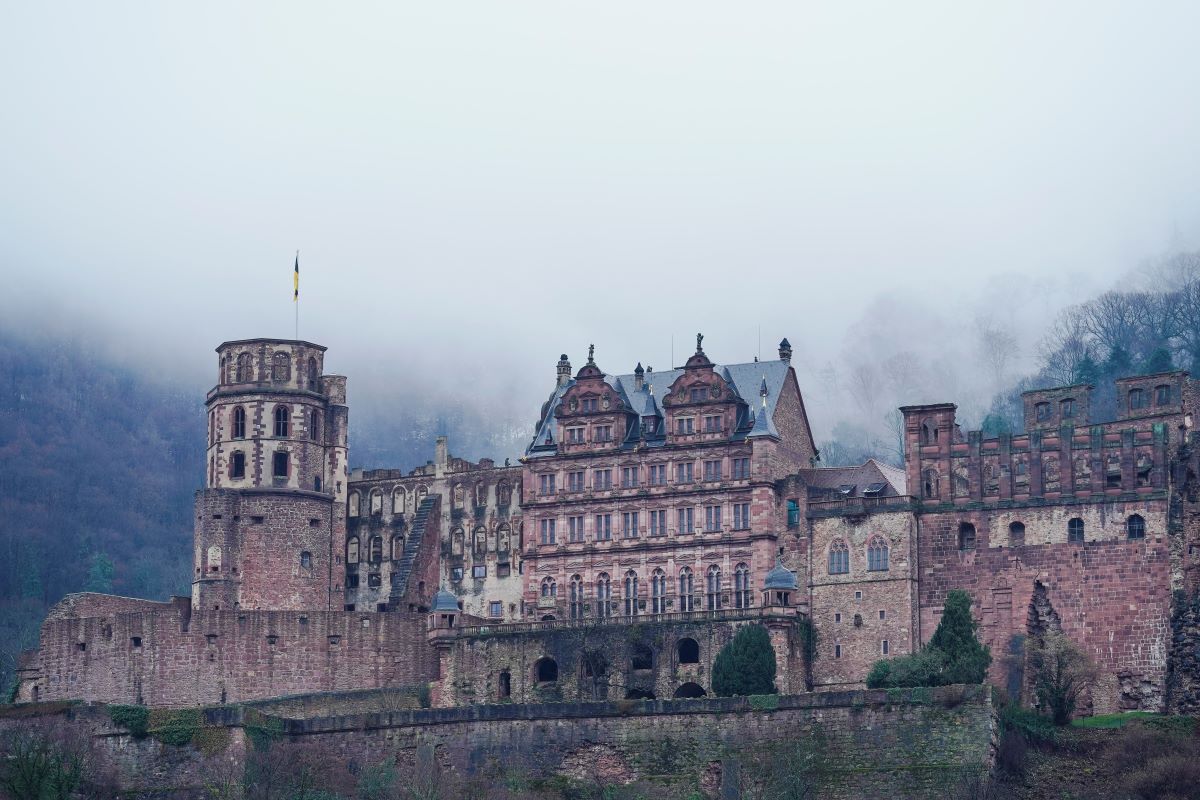
Rain clouds hang over Heidelberg Castle. Photo: picture alliance/dpa | Uwe Anspach
Heidelberg Castle
If Hohenzollern is spectacle, Heidelberg Castle is atmosphere.
Its partially ruined state gives it a softness that intact palaces sometimes lack, and its position above the Neckar valley is one of the most recognisable scenes in Germany.
Architecturally, the castle is a patchwork of styles from Gothic elements to confident Renaissance façades. Inside, elements including the Great Barrel – capable of holding 220,000 litres of wine – lend the castle a slightly eccentric note.
Seasonal events, particularly the summer castle illuminations, turn the ruins into a focal point for the entire city. It’s a place that rewards repeat visits at different times of year.
READ ALSO: Where can you go by direct night train from Stuttgart?
Vogtsbauernhof Open‑Air Museum, Gutach
The Vogtsbauernhof in Gutach brings rural history to life through fully furnished farmhouses and outbuildings painstakingly relocated from across the Black Forest region.
Walking through the site feels less like visiting a museum and more like stepping backwards in time. Paths wind gently between gardens, fields, steep-roofed barns and homes with smoke-blackened kitchens.
Traditional farm animals also roam the grounds.
Daily craft demonstrations – including basket weaving, milling and broom making – add a final flourish of life and movement.
Disclaimer : This story is auto aggregated by a computer programme and has not been created or edited by DOWNTHENEWS. Publisher: thelocal.de



