The confirmation that Iran’s new supreme leader, Mojtaba Khamenei, was injured in the first wave of Israeli attacks underlines how desperate the Islamic Revolutionary Guards Corps (ICRG) was to ensure their wounded choice was elevated to high office, and how confident it is that the wartime machinery can operate almost on automatic pilot without him.
The full scale of Khamenei’s injuries and speed of his recovery remain unclear, but a broken leg and facial injuries are the minimum. It is not a medical bulletin on which the authorities are seeking to dwell, although Ali Larijani, the secretary of the supreme national security council, chose his words carefully in saying “his condition has not been reported as critical”, a phrasing that suggests he has not personally seen him.
In a bid to show the government was functioning in line with its constitution, he added: “Despite this incident, he continues to provide full authoritative guidance and oversight of the operations, and all actions and attacks are carried out with his direct permission and orders.”
But it now looks as if some of the delay around his election was not just a technical issue of assembling in wartime the assembly of experts, the 88 strong body of clerics that elect the Supreme leader, but also over doubts about Khamenei’s capacity and willingness to take on the job.
That he could have survived the attack on the supreme leader’s office entirely unscathed seemed implausible given his father, Ayatollah Ali Khamenei, his mother, his wife Zahra Haddad-Adel, and one of his sons had also been killed. He also lost his sister, brother in law and a niece. His mother died three days after the attack from her injuries. The entire supreme leaders office was incinerated. At minimum, it would have left an indelible emotional if not physical mark.
Opposition groups in the diaspora have claimed that Khamenei is in coma and is being treated in great secrecy in hospital, ignorant of both his elevation to the post of supreme leader and the devastating damage suffered by his family.
The failure of the government communications machine to publish a single photograph, video or even text from Mojtaba three days after his elevation led to the inevitable speculation that the Assembly of Experts, wittingly or unwittingly, had elected a corpse or cardboard cut-out to run the country.
The Israeli foreign ministry had little doubt about his health, printing a carboard cut out photograph of him alongside the caption: “You can run, you can hide but cardboard regimes fold”.
The lack of a public appearance or even a sound recording undermined the sense of continuity engendered by his election, and led to claims on social media that the IRGC had knowingly pressed the candidacy of a dead man. Not even the sense that his hideaway needed to be protected from circling Israeli bombs seemed a sufficient explanation.
One Iranian journalist insisted: “Iran’s leader can lead without appearing in public. There is no need for him to be on the street or in a religious centre. The important point is the management of the country.”
Loyalists published a photograph of him that could have been AI generated, and claimed he had chaired a meeting of top IRGC commanders.
The handling of the episode was all the more strange since, despite the Iranian media being heavily censored, it started to speculate about the welfare of their silent new leader.
On Tuesday, local media in Iran asked Esmail Baghaei, the spokesperson of Iran’s foreign ministry, if Khamenei had taken charge and assumed his new role as the country’s top religious and political figure and the commander in chief of armed forces. Baghaei avoided a direct answer, saying: “Those who have to receive the message have received the message.”
Instead, confirmation he was injured came almost in passing in a telegram post by Yousef Pezeshkian, the temperamentally open son of the president, in which, along with a passing reference to news of snow in Tehran, he revealed that he heard Mojtaba had been injured but that he was healthy and there was no problem.
Inevitably Mojtaba’s appointment, already denounced by regime opponents including some in Evin jail as a disgraceful IRGC puppet show, will be seen as a sign that they were desperate to install their man, regardless of his health. The IRGC is not just an army, it is a business empire with investments spread through the economy
Maryam Alemzadeh, associate professor in history and politics of Iran at St Antony’s College, Oxford, argues the system is robust, having been intentionally designed to have a very easily replaceable leadership.
“The resilience has relied on this semi-formal network of IRGC, Basij and other state services that have fulfilled multiple roles, including service provision, surveillance and repression. Decapitation does close to nothing to affect this network. If anything it creates a limited rally round the flag effect amongst this particular group, but not the larger population,” Alemzadeh said.
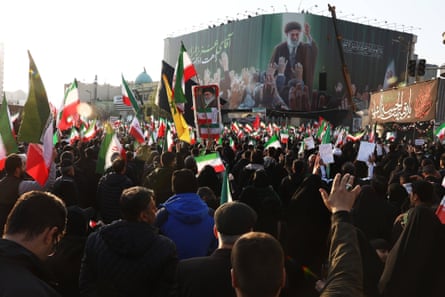
Alex Vatanka, senior fellow at the Middle East Institute, said it might anyway take as long as four years for Khamenei, at age 56, to establish himself personally just as his own father struggled for authority at the outset. “The office does not give you power It’s the personality of the occupant of the office. It takes time.”
Overall, the military strategy has been set, and the conduct of the war is on autopilot, to try to maximise the external economic costs on Iran’s opponents by conducting an asymmetrical war in which there are no limits. At present Iran does not need a new leader – dead, alive or injured – to update the IRGC target base. It instead can watch Donald Trump tie himself in knots daily explaining what he is trying to achieve. What will matter more is if he is needed to help decide if and when the conflict can end. But for the moment if there is one country in this war that is rudderless, it is not Iran.
Disclaimer : This story is auto aggregated by a computer programme and has not been created or edited by DOWNTHENEWS. Publisher: theguardian.com