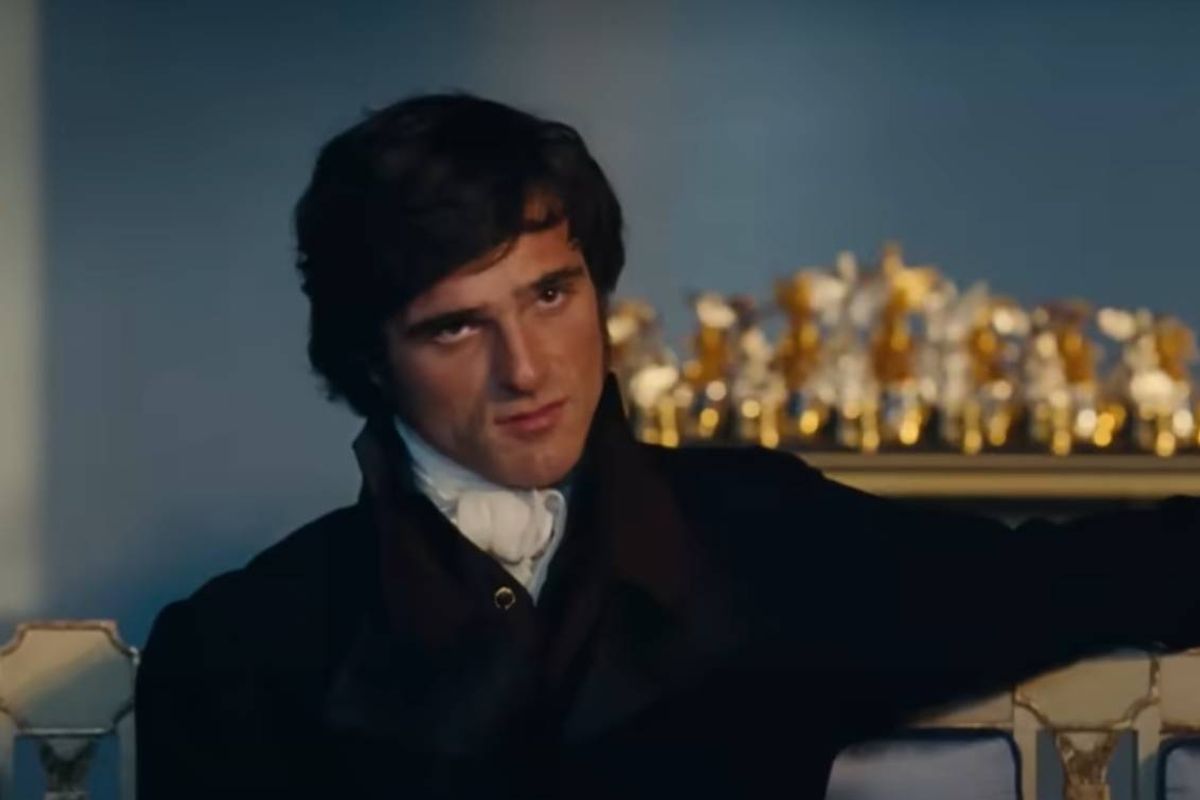
Emerald Fennell’s adaptation of “Wuthering Heights” turns Brontë’s original literary incel into a sanitized romantic lead, trading gothic horror for hollow edge-lord sex scenes
Wuthering Heights’s Heathcliff is the original literary incel, and in Emerald Fennell’s adaptation “Wuthering Heights” the evil character is neutered beyond all recognition.
The crux of incel culture is this: that men feel that they are unjustly denied romantic and sexual relationships with women. Enter: Emily Brontë’s Heathcliff, a man who spends generations hating Cathy for marrying another man. Is this the greatest love story ever told – or is it a chronicle of abuse and all consuming hatred?
Having read the classic work of literature by Brontë ahead of the screening of Emerald Fennell’s take on the story, I can confirm: the two aren’t in the same stratosphere. Brontë’s a gothic story, where ghosts haunt Heathcliff and he digs up Cathy’s body from her grave. Somehow from this blueprint, Fennell arrived at a sexless horn-fest.
READ MORE: ‘I’m a Bronte expert and Wuthering Heights film is a daddy issues sex romp failure’READ MORE: ‘Wuthering Heights is an epic love story – the film must capture one unforgettable thing’
From the opening credits, the tone is set: quickening squeaking and rasping breath gives the illusion of masturbation. But when the scene is revealed: a crowd has gathered to watch a public hanging. The condemned struggles to hold on for dear life, gasping for air. He is not dead yet, so he must be sexualised. This is an Emerald Fennell film after all. ‘He’s got a stiffie!’ some peasant boys heckle at him.
These cheap ‘naughty’ gags are draped in edge-lord tactics. Case and point: when the moment of death arrives, the nun, who is overseeing the hanging, rolls her eyes back into her head as if in a moment of sexual climax.
Fennell has been going viral on Tiktok. “The thing for me is that you can’t adapt a book as dense and complicated and difficult as this book,” Fennell told Fandango. I think that Greta Gerwig and her stellar adaptation of Little Women would probably want a word.
And that is the crux of why this film doesn’t work. The source material is not “dense” or “difficult”. The problem with this film is that it does not know what it wants to be, precisely because Fennell thinks the text is dense. For example, in an early scene, a young Cathy (played by Charlotte Mellington) is yanked under the bed by young Heathcliff (played by Adolescence star Owen Cooper). Like a tacky horror movie, the audience jumped at the monster pulling the innocent child under the bed.
Meanwhile, the Wuthering Heights house is a Disney-ified hellscape. Set on the Yorkshire moor’s heathy landscape, the building itself nestles into the sharp drop of a cliff. (I don’t think I need to say it, but the house between Heath and Cliff as a metaphor is… well, moronic.) And that’s to say nothing of the technicolour acid-trip fairy-tale version of Thrushcross Grange.
Heathcliff, played by a Yorkshire accent-attempting Jacob Elordi, has been cause for much consternation with literature fans and people with ears alike. The accent is garbled, and stands out against the suitably bog-standard English accents portrayed by the rest of the cast.
In the original Wuthering Heights, Heathcliff is a symbol for “the Other”. He is a man of colour in the text – but in Fennell’s imagination, he is white. Yet in “Wuthering Heights”, the Yorkshire accent is the only modifier that separates Heathcliff as ‘Other’. I wish this was a commentary on class divisions in modern Britain, but that would be giving undue credit. It is at best lazy, and at worst white-washing.
Glistening abs and breasts bursting out of corsets abound in “Wuthering Heights”. It is unnecessarily horny, yet totally sexless. In one scene, Heathcliff says to Cathy: “We are not children – I cannot play with you” before licking his lips and looking her up and down. Heathcliff has been boiled down to a walking ick, instead of the fiery wrecking ball he is in the book.
Sloppy liquid imagery is used throughout to evoke the interconnected nature of the sexual and the domestic. Bread dough is slapped around on the table as it is kneaded. The sound took me back to high-school in 2006 when teenage boys would pull their cheeks to make a crude ‘slapping’ sound. Cathy is so taken with this noise and the thoughts of Heathcliff’s sweaty body that she runs off to the moors to masturbate. Heathcliff spots this and licks her fingers. Then there are the close up shots of Heathcliff pawing at egg whites.
This movie plays with the erotic – but never quite gets it right. The reason for this is Wuthering Heights is not a vehicle for sexual fantasies. Fennell’s “Wuthering Heights” has all the porno tropes: choking; quickies in the back of a car (or in this case, a carriage); dirty talk. There’s even a peeping tom scene as Cathy ventures into voyeurism as she watches through the floorboards as two servants do the deed. One says to the other: “Have you been a bad girl?” as his amour walks through horse bridles, before it is placed on her head.
Yet there is one sexualisation of the text that sits very uncomfortably with me. Heathcliff in the original text murders dogs for the hell of it. He imprisons and rapes Isabella (played by Alison Oliver). He is a character of untold evil, brooding for literally years over his hatred at Cathy’s rejection of him. Yet, his treatment of Isabella is portrayed as a dominant/submissive relationship. He climbs in Isabella’s window and tells her exactly what he will do: he will not love her. He will hurt her. Throughout he asks: “Do you want me to stop?” Isabella nods her consent.
This act of consent neuters the evil that Heathcliff is known for. Brontë’s text shows his acts as calculated, deliberate, and completely abhorrent. Yet, in Fennell’s “Wuthering Heights”, this evil is boiled down to a kink.
Young viewers, who may not have read the text, may understand Heathcliff as Fennell shows him to be: a romantic hero striving at all costs to be with his one true love. When they eventually pick up Brontë’s Wuthering Heights, will they read his sadism as acts of love to be tolerated? Incel culture and misogyny is on the rise. We could do without translating it into something to be doe-eyed about.
Disclaimer : This story is auto aggregated by a computer programme and has not been created or edited by DOWNTHENEWS. Publisher: mirror.co.uk