
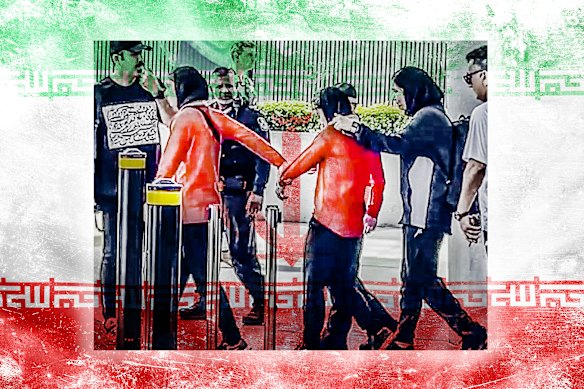
Amid the fear, amid the doubt, the emojis gave them hope. As the Iranian soccer team’s final match of the Women’s Asian Cup approached on Sunday night, the Iranian diaspora’s efforts to communicate with the players went into overdrive. Nothing focuses the mind like a deadline, and they don’t come any more serious than this. Time was running out to bypass the oppressive presence of their Iranian handlers and convince the players that, if they chose to do so, they would be supported if they wanted to seek asylum in Australia.
But first the diaspora had to get to the team, known as the Lionesses. They worked every possible angle they could think of, both online and off.
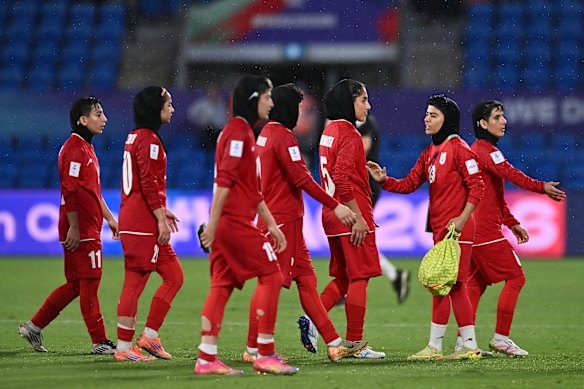
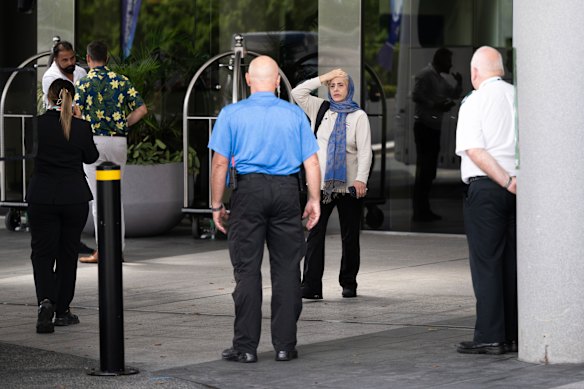
Supporters travelled to the Gold Coast from as far away as Sydney, booking rooms at the Iranian team’s hotel: the RACV Royal Pines Resort.
The five-star hotel boasts a golf course, tennis courts, pool, as well as eight bars and restaurants. But the amenities were beside the point. Proximity to the players was the name of the game. The supporters knew that if they could chat, even briefly, to the players in the lobby or over breakfast then they could help them understand their options and make an informed decision.
Lawyer and human rights advocate Sara Rafiee put her legal knowledge to use.
“Because the players have been closely monitored by officials and effectively treated as prisoners and impossible to reach directly, concerned members of the community asked me to record a voice message so it could somehow reach them.” Rafiee says.
“In that message, I simply explained that they are on Australian soil, they have legal rights here, and if they choose to seek protection there are lawyers, various Australian community organisations and ordinary Australians ready to support them.”
Most of the players were also active on social media, opening up another avenue to reach them. Advocates sent direct messages to the players on Instagram, aware the players would probably be too scared by the threat of surveillance to type out a reply. But the love heart emojis some of the players used showed they were reading the messages and absorbing the information.
It gave the supporters hope that some of the women may be willing to try to break free.
Tina Kordrostami, whose family moved to Australia from Iran when she was 5, testified to parliament last month about the risk of Iranian regime officials travelling to Australia as part of the team’s entourage. But the tournament opened up an opportunity, as well as a danger. Here was a golden chance to provide the women with an alternative to life in authoritarian, theocratic Iran – a nation with a dire human rights record that is now at war with Israel and the United States.
Kordrostami, a councillor in Sydney’s northern suburbs, says supporters had a secret weapon in their arsenal. A former Iranian player living in exile in Turkey knew some of the women personally and had earned their trust. She acted as an indispensable intermediary between the players and advocates in Australia, as well as their families in Iran.
“She has been our key conduit to the players,” Kordrostami said. “They knew they could trust her.”
These were players well accustomed – as much as a person can be – to existing under state duress.
With all 26 of the squad born after the 1979 revolution, life had never been any other way.
Since arriving in Australia – in spite of the chaos unfolding back home after the US-Israeli assassination of supreme leader Ali Khamenei – the players put on a calm public front. They did only mandatory media and only discussed football matters, and they joked and laughed in training on the Gold Coast.
The only clear signs of what lurked underneath came via the silent national anthem before kick-off against South Korea last Monday, and 21-year-old squad member Sara Didar’s breakdown during Wednesday’s press conference when conveying worry for her uncontactable family in Iran.
The players’ decision not to sing the national anthem made the question of returning to Iran even more fraught.
Iranian state television presenter Mohammad Reza Shahbazi accused the team of dishonour, branding them “wartime traitors” who must be “dealt with more severely”. The prospect of the women facing persecution after returning to Iran was real, and terrifying.
At the 2022 World Cup in Qatar, the Iran men’s national team refused to sing the anthem before their opening match against England. It was a sign of solidarity as protests raged back home following the death in morality police custody of 22-year-old Kurdish-Iranian woman Mahsa Amini, who was alleged to have breached the strict Islamic dress code.
Such a stark, public betrayal of the regime incited threats from Tehran against the players, who were threatened with imprisonment and torture of their families should they not behave themselves in their next match against Wales. They duly sung the anthem.
The Women’s Asian Cup is organised under the auspices of FIFA and its continental subsidiary, the Asian Football Confederation. Yet the football authorities did not uphold their responsibilities to intervene “whilst the team was locked down and effectively kept hostage”, as Craig Foster told the ABC.
“In the absence of that,” said the former Socceroos captain and current human rights activist, “the Australian government has been able to put themselves in a position where at least five women were able to access advice and make that decision.”
On Sunday afternoon, with the Lionesses’ final game drawing closer, Iranian diaspora leaders wrote to Home Affairs Minister Tony Burke pleading with him to take action.
The advocates had “serious concerns that Islamic Republic officials accompanying the team are closely monitoring the players and are intimidating them, including providing them with misinformation they would be sent to offshore detention to a ‘deserted island’ if they attempted to seek asylum in Australia”.
“Given these circumstances, we respectfully urge the Australian authorities to speak with the players individually and privately, in a private setting away from Islamic Republic officials or security personnel, to ensure they are aware of their rights and the protection pathways available.”
Burke’s office was limited in what it could say publicly at the time. Ideally, the government wanted no publicity about the possibility of Iranian players seeking asylum. Given it was inevitable the media would cover the story, they stressed that any specific coverage about what the government was doing could blow up the whole operation.
Australian Federal Police officers and Department of Home Affairs officials were at the RACV Royal Pines Resort, meeting individually with the players as the diaspora leaders requested. The prospect of some of the players seeking asylum seemed so imminent that Burke caught a flight from Sydney on Sunday to the Gold Coast so he could help process any emergency visa applications.
But it was too soon. Burke flew back to Sydney on Monday morning.
On Sunday night, supporters surrounded the team’s bus after their final match, which they lost 4-nil to the Philippines.
Those on the footpath kept flashing the SOS symbol, a hand open and closed, thumb tucked in. Through the tinted windows of the bus, as some of the players filmed the crowd on their phones, one woman formed a love heart with her hands.
Another, tentatively, raised her hand, open, and closed it. SOS.
That day, Beau Busch, head of FIFA’s local player’s union, was lamenting the fact that the football authorities appeared to have failed to protect the players’ safety. “There’s a lot to be learned from where we ended up here, and there’s a lot that needs to be improved,” he said.
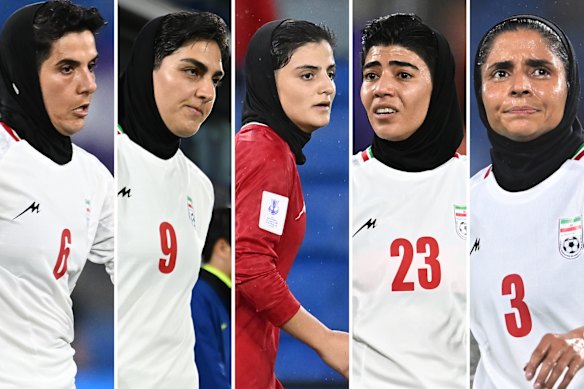
By Monday evening, though, five of the players had resolved to make a break for freedom: Captain Zahra Ghanbari, a 34-year-old forward from Kermanshah in the west of the country; Fatemeh Pasandideh, 21, also from Kermanshah; Zahra Sarbali, 32, born in Tehran and midfielder for the Gol Gohar team; Atefeh Ramezanizadeh, a 33-year-old from Baft; and Mona Hamoudi. Assurances from relatives in Iran that they had their backing to flee helped them take the plunge.
A source familiar with the escape operation said, as far as the players were concerned, it was an “orderly” affair, aided by the heavy presence of police officers.
“There was no altercation, no chaos,” the source said, speaking on condition of anonymity to discuss sensitive matters.
“There are forces of control that disappear once the AFP show up and say, ‘Do you want to come with us’.”
The long and fearsome arm of the Islamic state had been evaded.
Burke hot-footed it back to Queensland, arriving in Brisbane at 9pm Monday night to meet the players in a secret, safe location. All this, it should be stressed, unfolded hours before US President Donald Trump had taken to social media to demand Australia offer asylum to the players. By 1.30am, Burke had given the five players humanitarian visas allowing them to legally stay in Australia.
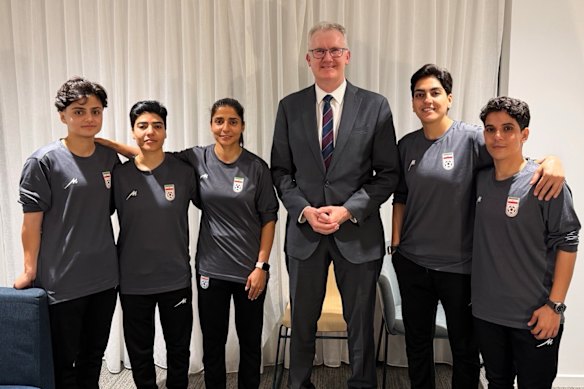
Many members of the Iranian diaspora involved in the effort didn’t sleep for a minute that night, so intense was the adrenaline.
“We’ve been planning for this since the first game,” Iranian-Australian Ara Rasuli, who helped the rescue effort, said. “The women were very fearless and that’s something to be proud of.” The five Lionesses had escaped the clutches of the national team, but in doing so they lived up to their name. Their courage paid off. A new life in Australia is about to begin.
For the rest of the team, the drama continues.
Cut through the noise of federal politics with news, views and expert analysis. Subscribers can sign up to our weekly Inside Politics newsletter.
Disclaimer : This story is auto aggregated by a computer programme and has not been created or edited by DOWNTHENEWS. Publisher: www.smh.com.au


