The EU is hoping to urgently reboot talks on the “reset” of relations with the UK as negotiations are in danger of foundering before a planned July summit.
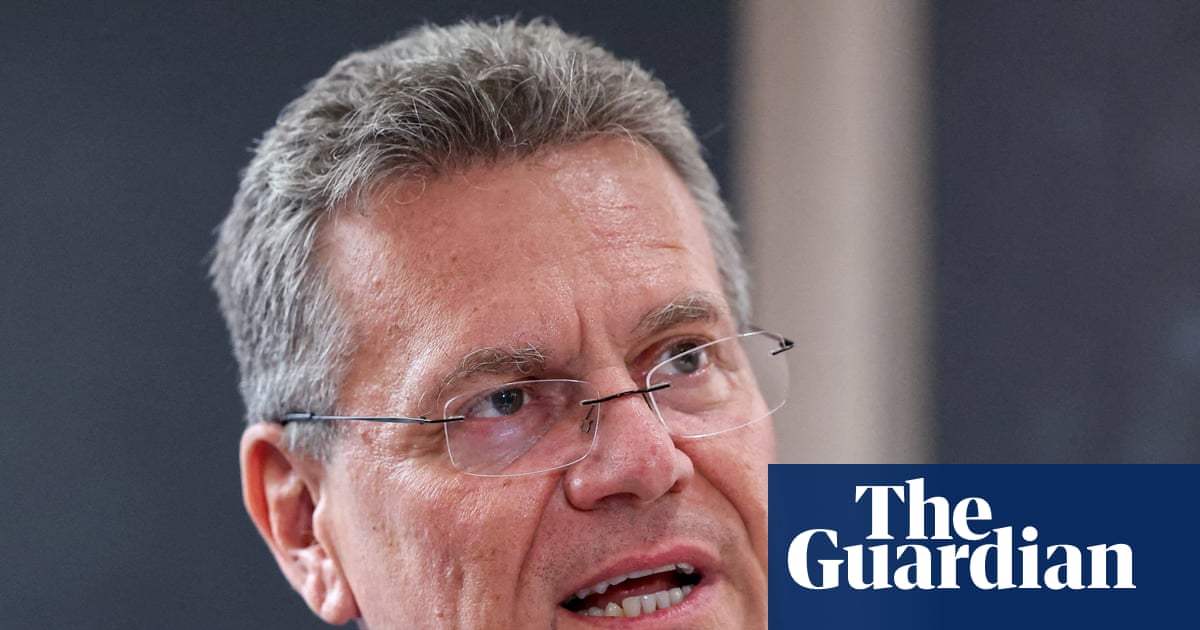
At a public meeting of the EU-UK parliamentary partnership assembly in Brussels, the European Commission vice-president and trade commissioner, Maroš Šefčovič, said both sides had to “change gears” now to ensure the deal got over the line.
Deadlock over the tuition fees EU citizens would pay in a proposed youth mobility scheme is a major challenge, he said, while the UK’s trade minister, Chris Bryant, said that talks on a sanitary and phytosanitary (SPS) agreement was tricky because of the amount of legislation needed in the British parliament.
Šefčovič told the MPs and MEPs on Monday that finding agreement before the next summit – pencilled in for early July – was “very ambitious”.
But he added: “We need to change gears and work through complexities.”
He repeatedly called for a compromise on tuition fees, the first time he has spoken publicly on the issue since a so-called “common understanding” or formal agenda for a reset between the EU and UK was signed off last May in Lancaster House.
Keir Starmer, the prime minister, has put agreeing a new deal with Brussels at the centre of his economic and foreign policy, and is hoping to announce a number of agreements at the summit this summer.
While talks on SPS and on emissions trading rules are well advanced, the two sides are deadlocked over whether EU students should be charged the same fees as British ones rather than the higher international ones, which they currently have to pay.
“To come to an agreement on the youth experience scheme, we will need a solution of tuition fees,” said Šefčovič.
The disagreement threatens to scupper not only the planned summit but also the broader plans to realign with the EU, which the chancellor, Rachel Reeves, will highlight in a speech on Tuesday as central to her growth agenda.
Officials have told the Guardian that Nick Thomas-Symonds, the Cabinet Office minister in charge of negotiations with Brussels, is already working on which other parts of the economy would benefit from following EU regulations.
Thomas-Symonds has instructed officials to conduct a “scoping exercise” to find out where companies are already complying with EU rules and so it no longer makes sense to apply separate UK ones. In return the two countries could then remove border checks on those goods.
It is understood that the government believes all sectors apart from financial services and some hi-tech industries such as artificial intelligence might benefit from this approach.
Brussels sources said the UK is looking to draw up an agenda for the 2026 and 2027 reset, with a deal on touring artists, mutual recognition of professional qualifications and the elimination of costly dual regulation of chemicals high on the UK’s priorities.
At the parliamentary assembly Šefčovič also revealed one element of the 2020 trade and cooperation agreement signed by David Frost that had failed – a deal to allow people servicing equipment and machinery in the UK to have work visas for up to 180 days.
“Only 49 visas were granted in 2025. That is a very low number of visas and shows the scheme does not work,” he said.
Attempts for a wider realignment are likely to be put on ice, however, if the two governments cannot find a way past the student fees issue.
Šefčovič said EU student numbers in the UK had collapsed and it was vital in “this very turbulent world” that relations between future generations were fostered through education in each other’s countries.
“We should avoid the situation where we would be depriving our young generation from the common knowledge, common history.
“I know that it is challenging, it is difficult, but I believe that on both sides of the channel there is a strong wish from elected representatives of the people that we should solve this problem,” he said.
EU students before Brexit represented 27% of the student population but the intake for the 2026-2027 academic year is 5%.
The “slow” and methodical nature of talks didn’t help, said Bryant.
“Our system is very slow and let me put it this way, the European Union isn’t much faster. And when you put the two of us together, I don’t think it drives the pace of change that actually all of our voters and our communities really, really want and actually need economically.”
Thomas-Symonds said he took onboard the sense of urgency MEPs and MPs were looking for.
“The message I take from this room very much today is about putting our foot on the accelerator,” he said.
The Labour MP Stella Creasy said the UK was still “marriage” material and hoped that the competing voices in the party leadership, those insisting on red lines and those wishing to move closer to the EU did not stymie a deal.
“It is precisely because we are not yet willing to go bigger that these negotiations are turning out to be so hard.”
Disclaimer : This story is auto aggregated by a computer programme and has not been created or edited by DOWNTHENEWS. Publisher: theguardian.com