Why did Jordan survive the Arab Spring? An account of protests, repression and reforms that helped King Abdullah II contain unrest.
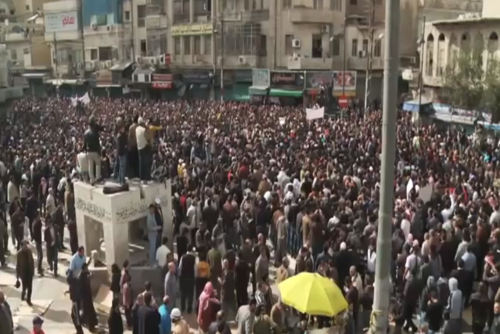
Arab Spring in Jordan. (File Image)
The pro-democracy, anti-government protests and the uprisings, which included armed rebellion in certain places, spread across the Arab world in the early 2010s. What began as a spontaneous response to the self-immolation of Mohamed Bouazizi in Tunisia spread like the proverbial prairie fire that also engulfed Libya, Egypt, Yemen, Syria and Bahrain. Though many rulers were deposed, those of Jordan escaped the ire of the people to some extent because King Abdullah II gauged the people’s frustration and took some steps and agreed to reform the economic and political systems to get the accumulated steam released.
Arab Spring begins in Jordan
As the Jordanian economy struggled with inflation soaring from 1.5% to 6.1%, the rate of unemployment reached 12%, and 25% of the population suffered below the line of poverty, the people took to the streets on January 14, 2011, demanding the resignation of Prime Minister Samir Rifai. The main opposition party of the Muslim Brotherhood, took the plunge with a call for a general strike on January 26. King Abdullah was not on the receiving end of the people’s wrath, though he was criticised for not tackling the economic issues properly. However, the movement turned serious with the Islamists, secular opposition groups, and some retired army generals joining the people on the streets and demanding substantial political and economic reforms.
Jordan protests
In an attempt to defuse the tension and bring the fragile situation under his control, King Abdullah II met leaders of the Muslim Brotherhood in February. It did not yield the desired results, as the people, including the leftists, poured onto the streets in thousands. The government ordered a crackdown, and the police caned the crowd of more than 2,000 protesters on February 18. The situation worsened, and more than 10,000 protestors gathered in front of the Husseini Mosque in the capital, Amman, after the Friday prayer.
King Abdullah II faces Arab Spring
With no economic and political reforms coming, the frustration deepened further, and the protestors clashed with the supporters of the king on March 28. Two people were killed, and more than a hundred were injured in the street clash. Another such clash between the two forces occurred on April 15, when eight civilians and 85 policemen were injured. The situation hit rock bottom with a never-before-seen attack on King Abdullah, who was pelted with stones and water bottles in the city of Tafileh on June 13. The demonstrations continued across the country.
Muslim Brotherhood leads Jordan protests
Known for being loyal to the king, former prime minister Ahmad Obeidat led over 2000 people in a march outside the Grand Husseini Mosque in central Amman on October 7. Marches were also held in the cities of Karka, Tafileh, Maan, Jerash, and Salt. In October, a memorandum signed by 70 out of 120 lawmakers was presented to the king, demanding the sacking of the entire cabinet, including the prime minister. It was followed by sporadic riots in many cities in November. The protests continued.
King Abdullah II sacked the government on February 1, 2012, and appointed retired army general Marouf al-Bakhit to form a new cabinet. The new government did not last long. Three prime ministers quit one after the other. King Abdullah II dissolved the parliament on October 4, 2012, and ordered early elections. He appointed Abdullah Ensour as the new prime minister.
Disclaimer : This story is auto aggregated by a computer programme and has not been created or edited by DOWNTHENEWS. Publisher: dnaindia.com