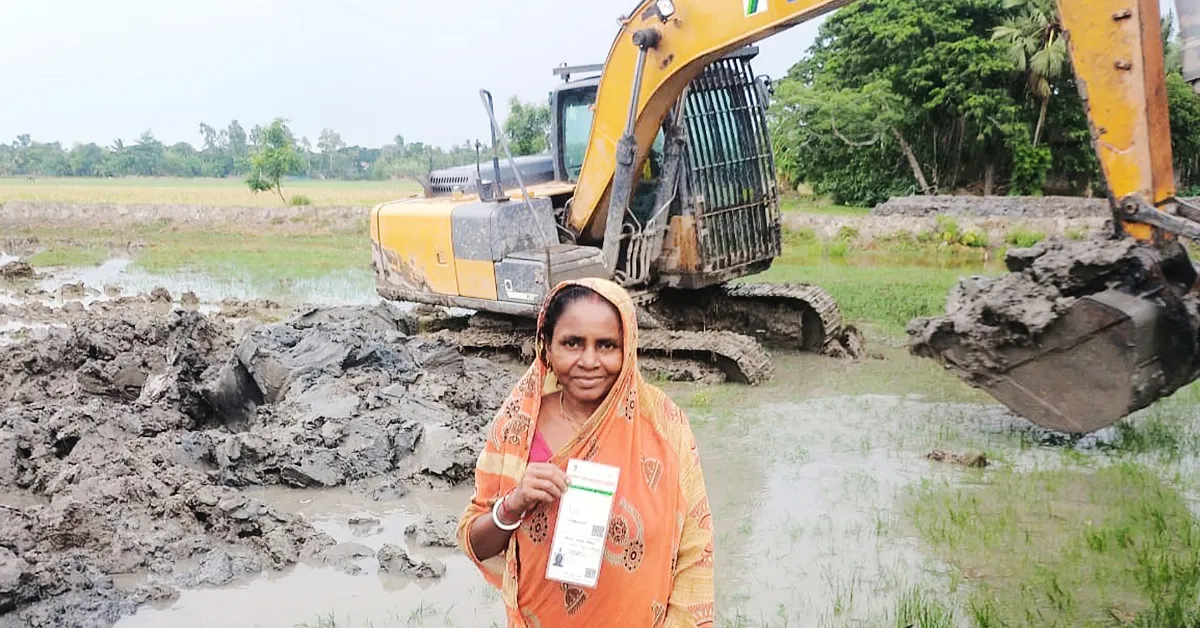
In May 2024, farmers in Jeliakhali gave up parts of their farmland.
They dug into their fields to create ponds that could hold rainwater, a decision shaped by years of watching water arrive with the monsoon and fade soon after. The ponds were meant to store rain for irrigation and reduce pressure on drinking water sources once the dry months set in.
This experience reflects a larger reality across the Indian Sundarbans.
Here, water shapes everyday life. It determines which crops survive beyond the rains, how long farming continues through the year, and whether families have enough drinking water during summer. As salinity increases, sea levels shift, and freshwater sources shrink, these decisions grow heavier. Most households depend on fishing and farming, and once the monsoon recedes, crops rely on sweet water (fresh, non-saline water) that often falls short.
Jeliakhali sits in Sandeshkhali Block-II, about 72 kilometres from Kolkata. Four saltwater rivers surround it: Betnai, Dasha, Kalagachi, and Raimangal. Salinity makes these rivers unsuitable for irrigation. Over time, farmers turned to submersible pumps, which steadily lowered groundwater levels. Eventually, even drinking water became difficult to access during summer.
/filters:format(webp)/english-betterindia/media/media_files/2026/02/11/featured-img-2026-02-11-19-35-26.png)
The village covers 576.7 hectares. Of this, 488.7 hectares are agricultural land. Yet around 463.9 hectares remain unirrigated, with only about 24.8 hectares receiving water from other sources. Jeliakhali, home to 5,084 people and 1,254 houses as recorded in 2009, reflects conditions shared by nearly 1,100 villages across the Sundarbans.
This was the setting in which the idea of storing rain began to take shape.
How the idea took root in weekly meetings
The change did not begin with machines.
Gram Samriddhi Foundation (GSF), a Kolkata-based organisation, holds weekly meetings with farmers to discuss income generation, farming practices, and ways to reduce cultivation costs. Over time, these conversations began to focus on rainwater harvesting.
Farmers spoke about what happened every monsoon. Heavy rain washed fertile soil down sloping fields and into canals, carrying nutrients away with it. During these discussions, they learnt that ponds dug along slopes could help retain soil. The excavated soil could later be reused on farmland, while the stored rainwater could support vegetable cultivation and reduce dependence on groundwater.
/filters:format(webp)/english-betterindia/media/media_files/2026/02/11/featured-img-2026-02-11-19-38-42.png)
/filters:format(webp)/english-betterindia/media/media_files/2026/02/11/featured-img-2026-02-11-19-33-12.png)
As these meetings continued, ponds began to look less like lost land and more like a way to protect both soil and water.
With GSF’s support, farmers began digging ponds to store rainwater on their own land. The intention remained practical. Stored water could irrigate crops during the dry months and ease pressure on drinking water sources.
Between May 2024 and June 2025, around 1,950 small-scale farmers took part. Together, they dug 319 ponds. Each pond stores about 4,000 cubic feet of water during the monsoon, which equals 113,280 litres (one cubic foot equals 28.32 litres). In total, the village now stores 136,790,852 litres of rainwater every year.
Giving up land, one decision at a time
Agreeing to give up land required careful thought.
Agriculture in the Sundarbans depends heavily on rainfall, and using drinking water for farming places additional pressure on limited resources. Many farmers who already had ponds had left them undredged for years because of financial constraints. Others had never considered ponds as a way to retain water.
/filters:format(webp)/english-betterindia/media/media_files/2026/02/11/featured-img-2026-02-11-19-41-42.png)
/filters:format(webp)/english-betterindia/media/media_files/2026/02/11/featured-img-2026-02-11-19-42-52.png)
Training sessions and repeated discussions gradually changed this view. Farmers with existing ponds agreed to dredge them for rainwater collection. Those without ponds began offering portions of their land for excavation.
GSF supported the process and assured farmers that fruit saplings would be provided for planting on the excavated soil. This helped farmers see how a pond could serve several purposes at once: rainwater storage, fish farming, vegetable cultivation, soil preservation, and income from fruit grown along the edges.
In the first phase, 103 ponds were dug. Over the following year, another 216 were added.
/filters:format(webp)/english-betterindia/media/media_files/2026/02/11/featured-img-2026-02-11-19-47-22.png)
/filters:format(webp)/english-betterindia/media/media_files/2026/02/11/featured-img-1-2026-02-11-19-26-03.png)
Each pond was dug using a JCB machine, usually within a few hours. “Our average pond size is 20 feet by 20 feet and 10 feet deep,” says Archana Agarwal, Secretary of Gram Samriddhi Foundation. “Landholdings in West Bengal are small. If a farmer offers more land, the pond can be 30 to 40 feet wide. Farmers still need land for crops.”
The cost of digging each pond is about Rs.6000. GSF contributes Rs.5000, while the farmer contributes Rs.1000.
All ponds in Jeliakhali are used for fish farming. Farmers choose the fish varieties and quantities themselves.
When drinking water became the priority
As the ponds filled, their impact became most visible in daily water use.
“The main purpose of digging ponds is to improve drinking water storage,” says Biplab Mondal, a progressive farmer and village-level member of GSF. “Earlier, our tube wells dried up during summer. We had to fetch water from deep-set tube wells contaminated with arsenic, which affected our health.”
GSF conducts regular surveys to assess outcomes. Earlier, villagers relied on submersible pumps even for bathing, which consumed large volumes of groundwater. Now, pond water meets daily needs, and submersible pumps are no longer used for bathing or farming.
/filters:format(webp)/english-betterindia/media/media_files/2026/02/11/featured-img-2026-02-11-19-29-41.png)
/filters:format(webp)/english-betterindia/media/media_files/2026/02/11/featured-img-2026-02-11-19-49-12.png)
In Sandeshkhali Block, groundwater levels dropped to about 65 feet during the summer of 2023–24. In 2024–25, levels rose to around 55 feet. Farmers see this rise as an indicator that storing rainwater on land is helping stabilise water levels.
Pond maintenance remains the responsibility of individual families. When issues arise, farmers contact the Gram Vikas Shiksikha (village development facilitator) appointed by GSF, who visits households to help with dredging, fish farming guidance, or soil reuse.
Women play a key role in this system. While men spend long hours farming or working as daily wage labourers, women attend village meetings held in the morning or evening. They carry information back to their families, where decisions around water use and farming practices are discussed and implemented together.
The impact of water on farming and income
Water availability also reshaped what went into the soil.
From early 2023, GSF began encouraging farmers to adopt organic compost instead of chemical fertilisers. Farmers learnt to prepare compost at home using cow dung manure, amrit jal (a natural microbial solution), gokripa amrutam (a traditional organic mixture), kitchen waste, and dry leaves and twigs.
Farmers were advised to begin with small trials on one or two Kathas (a local unit of land measurement) or in kitchen gardens. As results became visible, adoption spread. During household visits, facilitators found compost drums filling up. Farmers shared their experiences in village meetings, encouraging others to follow.
/filters:format(webp)/english-betterindia/media/media_files/2026/02/11/featured-img-2-2026-02-11-19-27-57.png)
Around each pond, farmers planted vegetables, fruit-bearing plants, and trees. Coconut, betel nut, mango, guava, lemon, and G9 banana now grow along pond edges, even in saline-affected areas. This has helped families earn through the monsoon months, when income usually dips.
“We encourage fruit plantation because paddy cultivation requires labour every season,” says Archana. “Fruit trees need effort once and give returns year after year.”
Gopal Mondal, a 35-year-old farmer, describes the shift simply. “We eat fish from the pond and earn from fish farming. We save money because we grow vegetables and fruits along the pond.”
Today, Gram Samriddhi Foundation works across four blocks in the Sandeshkhali area and plans to expand gradually to 15 blocks over the next three years, with a focus on sustained engagement.
Jeliakhali still lacks higher education institutions and advanced healthcare facilities. Those gaps remain.
What has changed is how water stays on the land. It now supports crops beyond the monsoon, reduces pressure on drinking water sources, and allows families to plan for the months ahead. In a region where water usually arrives and disappears quickly, that shift continues to shape everyday life.
Disclaimer : This story is auto aggregated by a computer programme and has not been created or edited by DOWNTHENEWS. Publisher: thebetterindia.com