
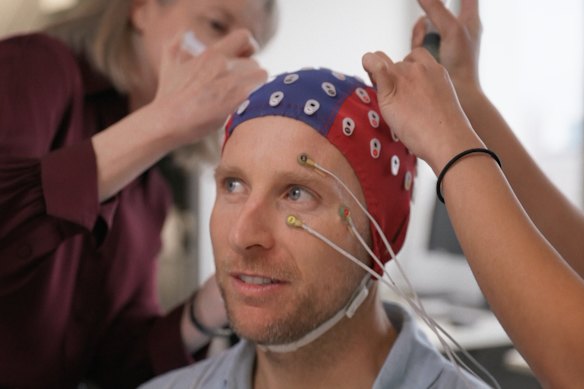
When Hamish Macdonald made headlines for quitting social media in 2021, he was, in many ways, ahead of the game. Back then, when Macdonald deactivated his Twitter and Instagram accounts due to the online bullying he received while hosting Q+A, it was seen as a highly unusual move.
“I left social media when I was doing Q+A for different reasons,” says Macdonald. “But it was a pretty full-on experience, and it was a bit unusual at the time to do that. I remember there being press inquiries. I didn’t say anything to anyone.
“It wasn’t a dramatic mic drop moment or anything, but I remember the following week, the comms department asking me, ‘There were journalist inquiries – is it true that I shut down my accounts?’ – And it was quite a strange thing at that time to do, but I definitely have lower screen-time usage, definitely do more reading.”
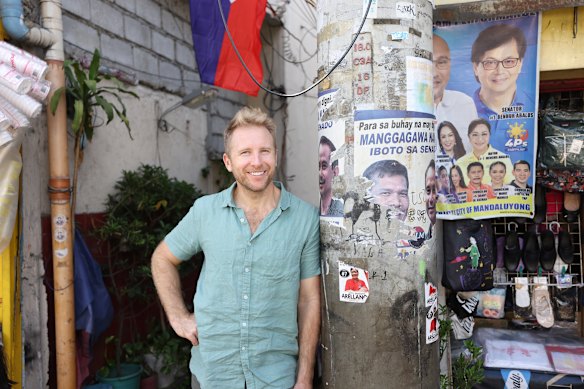
But that doesn’t mean he got off his phone. In the first episode of his three-part ABC documentary The Matter of Facts, Macdonald admits to about six hours of screen time on his phone a day.
And while a lot of that is to do with work – Macdonald hosts mornings on ABC Sydney radio, as well as co-hosting Global Roaming on ABC Radio National with Geraldine Doogue – it is still a substantial amount of time. He is not alone. The average Australian adult is, apparently, spending anywhere between two and six hours a day on their phone, while junior high schoolers are averaging up to nine hours a day.
(When we talk just after his morning radio shift, Macdonald is pleased to report his screen time for the day so far is only one hour and 37 minutes, but he has been on air for three hours. He also admits to still being on LinkedIn, but only checks that “once in a blue moon”.)
Our addiction to screen time, and the discombobulating effect it has on our brains, is one piece of the puzzle Macdonald is trying to unknot in The Matter of Facts. However, it’s not just a simple matter of screen time is bad – and it almost certainly is – it’s about the flow of disinformation that is constantly coming through our devices. Sure, it can be something as simple as a funny AI cat video on Instagram, but there is also the more insidious spread of bogus health cures on TikTok or propaganda posing as fact on Facebook. Knowing right from wrong isn’t as simple as it used to be.
“Over time, [I’ve had] the increasing awareness that facts are being challenged and undermined, that we’re living in this environment of post-truth,” says Macdonald. “My job is to cover the news day to day and talk to audiences, listening to audiences, and I see more and more people expressing doubt in what broadcasters do and what the ABC does and what newspapers do.
“So it tells me that there’s something bigger, broader going on. My background as a foreign correspondent has, I guess, given me the opportunity to piece different parts of this puzzle together. I really reflect a lot on what it was like being in Egypt at the start of the Arab Spring and seeing how powerful the sowing of doubt is.
“In these autocratic regimes, where the message was heavily controlled, where people didn’t believe what they saw or read, you see the fracturing of society that that creates. And I guess, for different reasons and through different timelines, I think that’s started to happen more profoundly in the democratic world. And I think it’s the absence of agreed facts, or at least having some ability to coalesce around a set of facts or ideas upon which you can then base problem-solving, that poses a real challenge for all democratic societies.”
So, what, exactly, then is a fact?
“That’s a profound question,” says Macdonald. “At a very basic level, as a journalist, if you can see something happening in front of you, do the very basic reporting work, and describe to someone what you’ve seen, then I feel comfortable in saying I’m reporting facts.
“But I think there’s a lot of things happening in the world today that are harder to see, harder to touch, and then you rely on second-, third-hand sources. Perhaps a conflict is unfolding in a place that no one is allowed into, so then you rely on two sides to give you their versions of facts, and then you’re left to try and parse through that information and deliver it as accurately as you possibly can.”
Macdonald filmed the three-part series during most of last year, squeezing in filming at home and abroad between his full-time radio shifts, “flying out overseas on a Thursday afternoon, filming Friday, Saturday, flying back Sunday”.
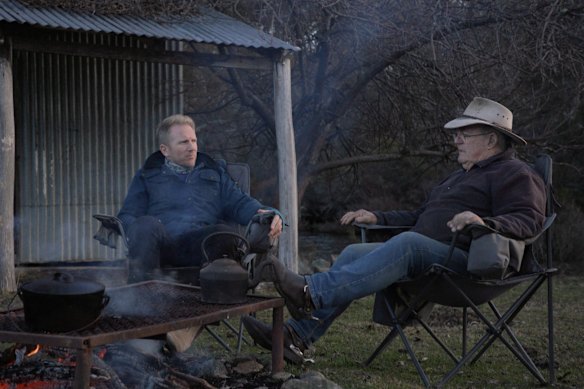
And while he travelled to Poland, Paris, Taiwan and the Philippines for the series, he starts the first episode close to home, in Jindabyne, which sits on the edge of the NSW Snowy Mountains. The town where he grew up has been divided by the decision to cull wild brumbies in Kosciuszko National Park, with both sides mounting fierce arguments across social media.
It’s the perfect microcosm of a wider problem – no “agreed set of facts”, the spread of disinformation and a community torn apart – and Macdonald patiently listens as both sides passionately defend their position.
“We have to see that we’re all in this together,” he says. “We have to see the common humanity. We have to see that all sectors of the community are being harmed, really, by the fracturing that’s occurring through social media.
“There are lots of great things about a more disaggregated media landscape, you know, more opportunity for different voices to emerge. You can argue that’s a really great thing, but at the end of the day, when we have common problems and challenges, we’re going to have to figure out as local communities – or as countries or as a planet – we’re going to have to figure out how to solve them, and we can’t do that unless we can talk to each other.”
So, where does he feel Australia is sitting at the moment? Are we, too, at risk of democratic destabilisation because of social media?
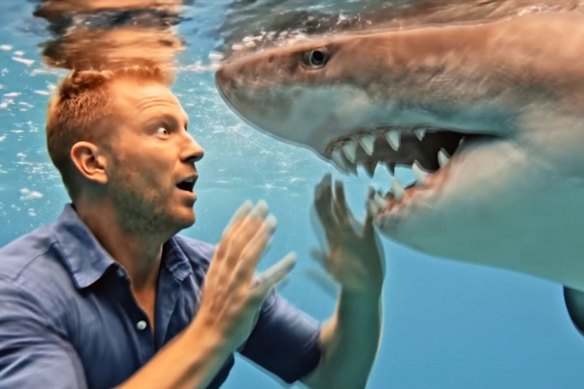
“I think people feel profoundly uncomfortable,” he says. “And I think people feel a degree of nervousness that maybe – I’m in my 40s now – I reckon is different to other times in my life. Maybe people who are older, who might have lived through the tail end of the Second World War, might be more accustomed to that level of conflict. Maybe people would compare it to the Vietnam War period and Australians fighting in a war that was on our doorstep, and the social dysfunction or social disharmony that was created domestically out of that.
“But I do think we’re all experiencing versions of this story today in our own communities, whether it is brumbies in the Snowy Mountains or all the wind farms or migration or strongly held views about war in the Middle East, all of these stories that maybe might have felt a long way away at a certain point in time, are now far more proximate.
“And we’re all kind of experiencing that, and the fracturing of the information ecosystem means that we all experience that in a more acute way.”
It does feel all irretrievably grim, but the genial and curious Macdonald never makes it heavy-handed (even while scaring the bejesus out of you). So, what is his advice? If something doesn’t feel right, what should you do?
“Learning to triangulate information as individuals is really valuable,” says Macdonald. “If you see or read something on social media, and it creates an emotional response in you, go and read the same story somewhere else, in a couple of places. If you read an article in the newspaper and it makes you feel angry, go and find two other publications that have reported on the same thing and read those articles.
“It’s a bit of work … [it’s] not as simple as just saying, ‘I’ve got my one source’ or ‘I saw that on social media, it must be true’. If there’s some little niggling doubt in you about the thing you’ve just seen or read or heard, it means you need to go and find more.”
As for Macdonald, he has changed his behaviour in the simplest of ways: “I’m just really making a concerted effort to sit with books and always have a good book on the go. The world’s pretty heavy at the moment, and I think having some fiction on the bedside table is helpful.”
The Matter of Facts airs at 8.30pm on Tuesdays on the ABC and streams on ABC iview.
Find out the next TV, streaming series and movies to add to your must-sees. Get The Watchlist delivered every Thursday.
Disclaimer : This story is auto aggregated by a computer programme and has not been created or edited by DOWNTHENEWS. Publisher: www.smh.com.au





