
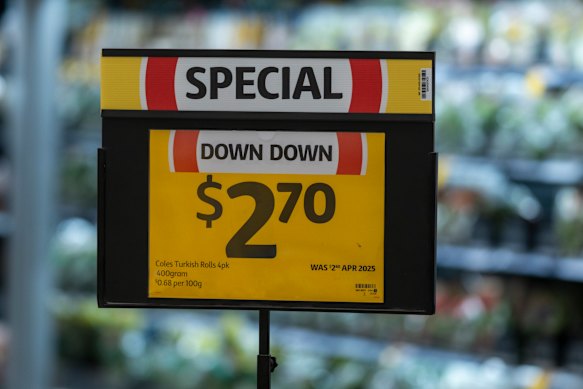

The Federal Court justice hearing the Australian Competition and Consumer Commission’s allegation that Coles misled customers with its “Down Down” promotions has peppered the watchdog’s lawyers over their arguments in the case.
On Wednesday, public hearings resumed in the case that began last week. The ACCC is seeking to prove that Coles’ discounts were misleading by arguing the supermarket giant raised prices on a sample of everyday items ahead of its promotions, so it could then cut them to higher-than-original prices and falsely claim to have put the products on special.
Coles is fighting the claim, arguing price rises were caused by supplier pressure, inflation and market forces, and subsequent discounts offered genuine savings. However, the company’s defence and witness statements of former and current staff last week prompted intense scrutiny of its legal position amid admissions of errors, and concessions that discounts had been orchestrated ahead of time.
This week’s hearing exposed potential holes in the consumer watchdog’s case.
Outlining the ACCC’s closing submissions, its lead barrister Garry Rich SC urged Justice Michael O’Bryan to find that Coles misled consumers on multiple occasions by “promoting products on its Down Down tickets, which we’d submit conveyed a representation that the product’s Down Down price was a genuine discount from its previous regular price”.
“That representation was misleading because the ‘was’ price, where stated, or the unspecified previous price relied on in the ticket implicitly, was not the regular price of the product. Instead, it was a price that had only applied for a short period – too short, in our submission, to become the regular price of the product,” he argued.
‘Doesn’t the Commission’s case have to fail?’
Federal Court Justice Michael O’Bryan
Rich relayed the argument the ACCC has relied upon throughout the case, pointing to three price levels for products: their first, or regular price; their second or “establishing” price at a new higher amount; and then their third “Down Down” price.
Rich said the case hinges on two key questions: “What representation did the Down Down tickets convey to their intended audience?” and “was that representation misleading or deceptive?”
He said that while many of Coles’ customers “are well-educated and commercially astute … many are not”. Most of them want to spend “as little time shopping for groceries as possible”, he said. “It is a chore.”
Customers “see a big red-and-white ticket. They read that the price is ‘Down Down’. They read that the price was much higher. They think they’re being offered a good deal. The price has gone down, they’re told. They think it’s a genuine discount. Many will have no idea that the price was actually lower four weeks ago,” he said.
At this point, O’Bryan interrupted Rich, warning these arguments about a consumer’s thoughts of getting a good deal and that a Down Down price connotes a genuine discount weren’t pleaded by the ACCC and that “neither of those representations have been negatived by the Commission”.
As Rich appeared to be relying on these arguments, “doesn’t the Commission’s case have to fail?” the judge asked.
“I’m just warming up,” Rich replied.
O’Bryan also examined the ACCC’s emphasis on the first price as being the regular price, and the second price not being genuine but only in place to allow for a Down Down discount – which the supermarket’s witnesses acknowledged last week were more compelling for shoppers thanks to Coles’ comparison of the “was” and “is” price to show the size of a discount.
Rich highlighted the lack of transparency on a Down Down ticket about the “was” price.
“The words Down Down themselves connote a reduction from a previous price. In other words, that it’s a past price,” Rich said. “Had these been forward-looking representations in the sense of ‘this is the price you would be paying’, they would be false because all of the evidence shows that Coles had previously agreed with its suppliers that the ‘was’ price, the price two, would only apply for a limited period and would not apply going forward.”
The hearing continues.
The Business Briefing newsletter delivers major stories, exclusive coverage and expert opinion. Sign up to get it every weekday morning.
 Elias Visontay is a National Consumer Affairs Reporter at The Sydney Morning Herald and The Age.Connect via email.
From our partners
Disclaimer : This story is auto aggregated by a computer programme and has not been created or edited by DOWNTHENEWS. Publisher: www.smh.com.au





