
By Ken Haley
PHILOSOPHY
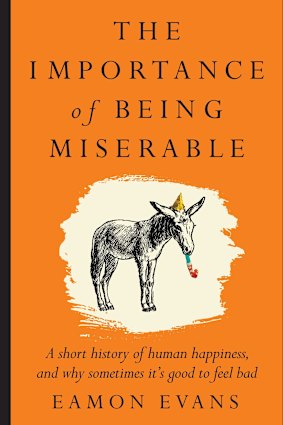
The Importance of Being Miserable
Eamon Evans
Simon and Schuster, $36.99
Melbourne author Eamon Evans has plumbed the shallows of happiness and surfaced with a deep truth: misery and suffering are good for us in the same way that wet weather encourages fruits, flowers and all living things to flourish.
While he would be the first to admit that many others – from the Buddha to the Stoics – reached this epiphany long before him, few books have followed the logic of this premise so thoroughly and entertainingly as The Importance of Being Miserable. In its playfulness, the provocative title is reminiscent of another such work – The Right To Be Lazy – penned by French journalist Paul Lafargue who, in a beautiful irony, was the son-in-law of Karl Marx, the workers’ champion.
That playfulness is reflected in Evans’ chapter headings, which are all song titles followed by witty kickers encapsulating his take on them. Thus, we have Chapter 12: I Still Haven’t Found What I’m Looking For (And why you never will) and six chapters later 9 to 5 (Why work is so much work).
The author wears his erudition lightly as he leads the reader through a litany of cautionary tales from Ancient Egypt and Greece to the present day. His core thesis buys a quarrel with America’s Founding Fathers: the pursuit of happiness is pointless, he argues because if you chase hard enough to trap your quarry, it will quickly elude your grasp and leave you joyless.
But that is prose: Evans, with his unerring talent for the apt metaphor, makes the point poetically, with such epigrams as: “The best meals come when you’re hungry … A warm bed is heaven after a cold, windy day. And beer always tastes best when you’re stressed.”

Eamon Evans writes that misery and suffering can actually be good for you.
He is also a master at liberally sprinkling whimsy throughout the text as he leads us up to the sucker punchline (you won’t see it coming). Surveying Australia in 500 BC, he writes: “Droughts were long, fires tore through the bush and food sources could vanish with a change in the wind. In more positive news, Kyle Sandilands had not yet been born … ” At his best, every word is well-weighted and none superfluous, as in this gem: “Much like the fans of St Kilda Football Club, many medieval Christians actively sought out suffering.”
Your homespun philosopher is an original thinker. He identifies a rarely noticed trait – the all-too-human urge to give advice, particularly when it’s unsought.
He traces the evolution of the self-help book to Samuel Smiles’ 1859 volume, happily titled Self-Help, whose message was simply summed up: “If your life wasn’t going well, the problem was you.”
This is not a book – was there ever one? – without faults. Lincoln and Darwin were both born in 1809, not 1805 as he asserts. And he’s wrong on two counts in saying that Sigmund Freud was “born in turn-of-the-century Vienna”. He was born in mid-century Pribor, now part of Czechia (in 1856, to be exact). But such peccadillos scarcely detract from the appeal a work that deserves bestsellerdom (and, less glamorously, to be added to Philosophy 101 reading lists everywhere).
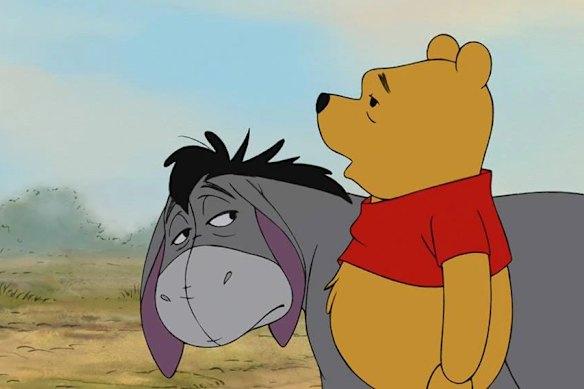
Perhaps the perpetually miserable Eeyore had the right idea?Credit: Disney
Speaking of Freud, he was among the first modern thinkers to take a realistic view of the subject when he wrote that the best therapy could offer was to replace “hysterical misery with ordinary unhappiness”.
Evans’ (and Freud’s) wisdom boils down to an elaboration of a quote from that shy scribe Anonymous: “Comparison is the thief of joy.” Evans’ riffs on this theme stress that the rise of social media with its images of other people looking perfect has made an age-old problem worse. “When everyone online looks like they’re crushing life, your very normal, very reasonable Wednesday can suddenly feel like a failure.”
In the closing chapters, methinks he oversells the alleged virtues of misery, telling us suffering can make us kinder and more empathetic. (Well, it can also embitter.) But it’s hard to disagree with his claim that pain and suffering make for better music (think of Eric Clapton’s Tears in Heaven or Elton John’s Sad Songs Say So Much).
And it’s the music of Evans’ words that provides the best reason of all to acquire his latest title. As he points out, letting tears flow releases intolerable pressure. “So next time you cry, don’t apologise. You’re rinsing the windscreen so you can see the road again. And when the skies clear, step outside. The world always smells better after rain.”
The Booklist is a weekly newsletter for book lovers from Jason Steger. Get it delivered every Friday.
Most Viewed in Culture
Disclaimer : This story is auto aggregated by a computer programme and has not been created or edited by DOWNTHENEWS. Publisher: www.smh.com.au








