

Updated ,first published
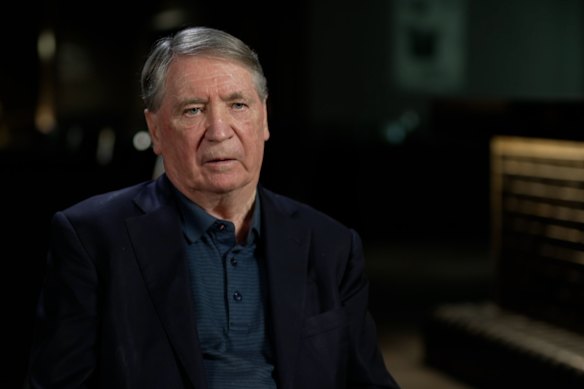
The royal commission into antisemitism has been thrown into crisis by the shock retirement of special adviser Dennis Richardson, who says he came to feel his contributions were unnecessary and he was overpaid for the work he was doing.
The former ASIO boss quit his position just weeks before commissioner Virginia Bell is due to deliver her interim report into the performance of the nation’s intelligence and police agencies in the lead up to the Bondi massacre on December 14 last year.
Bell announced Richardson’s shock resignation in a statement on Wednesday night, surprising peak Jewish community groups who were racing to find out why he had abruptly stepped down.
Richardson’s resignation represents a difficult start for the royal commission, which is scrambling to meet tight deadlines set for it by the government and carving out key areas of enquiry to avoid prejudicing the criminal trial into the massacre.
Richardson, who was originally supposed to write a standalone review on potential intelligence failures, telling Radio National on Thursday morning: “Ultimately I came to the view that I was surplus to requirements”.
Revealing he was paid $5500 a day to advise the royal commission, he told ABC Sydney: “I was being paid very well, so, the question about payment really goes to the fact that, quite frankly, I was being well overpaid for what, for what I was effectively doing.”
He said he was “essentially being employed as a research officer”.
While he praised Bell as a “very fine person” and excellent legal mind, he told Sky News: “The onus was on Virginia Bell and me to sit down and have a hard-headed discussion on day one. And while we did have lots of discussions, I think we both took things forward based upon different assumptions.”
Richardson said the interim report being produced by the royal commission was “a very different animal” to the document he would have produced under his original instructions.
Opposition defence spokesman James Paterson called Richardson’s resignation “a disaster for the royal commission, for its credibility, ultimately for its findings and recommendations”.
“This has to be fixed, and fixed today,” he said.
“The Prime Minister has to get on the phone with Dennis Richardson and ask that he continue his role for the Royal Commission. And he must get on the phone with the Royal Commissioner, Virginia Bell, and ask that she accommodate Dennis Richardson and make sure that he can continue to be part of this royal commission.”
Paterson said a “serious shadow” had been cast over the royal commission, saying: “I do seriously worry that the credibility of the royal commission has been fatally damaged.”
The Coalition sought to suspend standing orders in the Senate to force Foreign Minister Penny Wong to explain why Richardson had resigned.
Richardson said his resignation was “an embarrassment all around” but denied claims the move shattered the credibility of Bell’s royal commission.
“The royal commission, in terms of its credibility, will be totally vindicated. I have no doubt about that at all,” he told Sky News.
Richardson formerly led the domestic spy agency ASIO, the Defence Department, the Department of Foreign Affairs and served as Australia’s ambassador to Washington.
In her statement on Wednesday night, Bell said: “As I noted at the commission’s initial hearing, Mr Richardson was uniquely well placed to advise on the material to be sought from our intelligence and security agencies in order to assess the effectiveness of their preparedness for, and response to, a terrorist attack.”
Bell, a former High Court judge, said she was grateful for Richardson’s contribution and that thanks to his team’s efforts, “work on the interim report is well advanced”.
Bell said she was confident the report would be delivered in accordance with the royal commission’s letters patent.
Jewish community sources said they were stunned by the resignation because Richardson had held several meetings with peak groups and the process seemed to be on track.
Following the Bondi Beach massacre, during which 15 people were killed and dozens injured at a Hanukkah celebration on December 14 last year, the Albanese government announced Richardson would lead an inquiry into potential failures by intelligence and law enforcement agencies.
Prime Minister Anthony Albanese insisted for several weeks that Richardson was the pre-eminent authority on the nation’s intelligence agencies, and there would be no need for a federal royal commission, as the NSW government had already announced its own.
Richardson’s review was later wrapped into the federal royal commission when Albanese bowed to pressure to hold a wide-ranging probe.
Bell is scheduled to deliver her interim report, covering any potential intelligence and policing failures, by the end of April.
Attorney-General Michelle Rowland said she had been notified about Richardson’s decision.
“The government thanks Mr Richardson for his efforts to date,” she said.
“The government will continue to support the royal commission to deliver its important work, including the delivery of the interim report by April 30.”
Richardson’s role was to conduct interviews and advise Bell, who was tasked with writing the interim report and its final version.
Bell announced on the opening day of the royal commission that the decision to wrap Richardson’s inquiry into the royal commission had complicated the process.
“Perhaps inevitably, the absorption of an administrative inquiry into this royal commission has led to some delay,” Bell said last month.
Delays in obtaining materials, Bell said, make it unlikely that her interim report will form a definitive judgment on the adequacy of the security arrangements at the Bondi Hanukkah event and the effectiveness of information sharing between ASIO and the police.
That will have to wait until her final report.
There are also delays to whistleblower immunity laws that the government wanted to rush through parliament earlier this month, so former and current intelligence officers could testify at the commission without breaching security provisions. The legislation has been referred to the parliamentary joint committee on intelligence and security for review, after Coalition and crossbench senators insisted national security laws couldn’t be rubber-stamped without scrutiny.
Cut through the noise of federal politics with news, views and expert analysis. Subscribers can sign up to our weekly Inside Politics newsletter.
 Matthew Knott is the foreign affairs and national security correspondent for The Sydney Morning Herald and The Age.Connect via X, Facebook or email.
From our partners
Disclaimer : This story is auto aggregated by a computer programme and has not been created or edited by DOWNTHENEWS. Publisher: www.smh.com.au


