
Updated ,first published
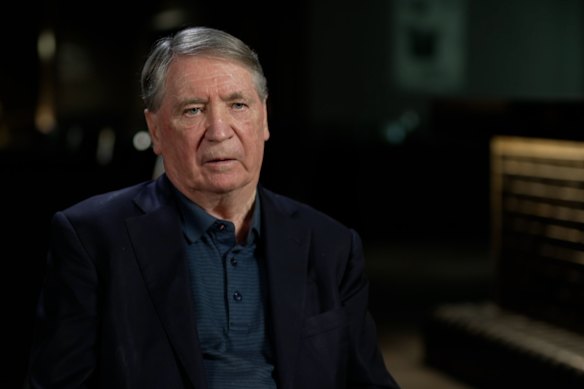
Former ASIO boss Dennis Richardson has quit his position as special adviser to the antisemitism royal commission, just weeks before commissioner Virginia Bell is due to deliver her interim report into the performance of the nation’s intelligence and police agencies.
Bell announced Richardson’s shock resignation in a statement on Wednesday night, surprising peak Jewish community groups who were racing to find out why he had abruptly stepped down.
Richardson’s resignation represents a difficult start for the royal commission, which is scrambling to meet tight deadlines set for it by the government and carving out key areas of enquiry to avoid prejudicing the criminal trial into the massacre.
“As I noted at the Commission’s initial hearing, Mr Richardson was uniquely well placed to advise on the material to be sought from our intelligence and security agencies in order to assess the effectiveness of their preparedness for, and response to, a terrorist attack,” Bell said.
“Thanks to Mr Richardson and the senior members of his team, Tony Sheehan, the former Commonwealth Counter-Terrorism Co-ordinator and Deputy Director-General of ASIO, and Peter Baxter, a former Deputy Secretary at the Department of Defence and Director-General of AusAID, work on the Interim Report is well advanced.”
“Mr Sheehan and Mr Baxter will remain with the Commission to support preparation of the Interim Report, which I am confident will be delivered in accord with the Letters Patent.”
Jewish community sources said they were stunned by the resignation because Richardson had held several meetings with peak groups and the process seemed to be on track.
Following the Bondi Beach massacre, which killed 15 innocent people at a Hanukkah celebration on December 14 last year, the Albanese government announced Richardson would lead an inquiry into potential failures by intelligence and law enforcement agencies.
Prime Minister Anthony Albanese insisted for several weeks that Richardson was the pre-eminent authority on the nation’s intelligence agencies, and there would be no need for a royal commission.
His review was later wrapped into the royal commission when Albanese bowed to pressure to hold a wide-ranging federal probe.
Bell is scheduled to deliver her interim report, covering any potential intelligence and policing failures, by the end of April.
Bell, a former High Court judge, said she was “grateful to Mr Richardson for the valuable contribution he has made to the Commission”.
Richardson formerly led domestic spy agency ASIO, the Defence Department, the Department of Foreign Affairs and served as Australia’s ambassador to Washington.
Richardson was contacted for comment.
Attorney-General Michelle Rowland said she had been notified about Richardson’s decision.
“The government thanks Mr Richardson for his efforts to date,” she said.
“The government will continue to support the Royal Commission to deliver its important work, including the delivery of the interim report by 30 April.
“The royal commission, which is independent of government, will provide more updates in due course.”
Richardson’s role was to conduct interviews and advise Bell, who was tasked with writing the royal commission’s interim report as well as its final version.
Bell announced on the opening day of the royal commission that the decision to wrap Richardson’s inquiry into the royal commission had complicated the process.
“Perhaps inevitably, the absorption of an administrative inquiry into this royal commission has led to some delay,” Bell said.
Delays in obtaining materials, Bell said, make it unlikely that her interim report will form a definitive judgment on the adequacy of the security arrangements at the Bondi Hanukkah event and the effectiveness of information sharing between ASIO and the police.
That will have to wait until her final report.
There are also delays for whistleblower immunity laws the government wanted to rush through parliament earlier this month – so that former and current intelligence officers could testify at the commission without breaching security provisions. The legislation has been referred to the parliamentary joint committee on intelligence and security for review, after Coalition and crossbench senators insisted national security laws couldn’t be rubber-stamped without scrutiny.
 Matthew Knott is the foreign affairs and national security correspondent for The Sydney Morning Herald and The Age.Connect via X, Facebook or email.
From our partners
Disclaimer : This story is auto aggregated by a computer programme and has not been created or edited by DOWNTHENEWS. Publisher: www.smh.com.au