Fashion
Saina Babaee, founder of the fashion brand Ilái Sarái, on refinement, restraint, and reconnecting with her roots.
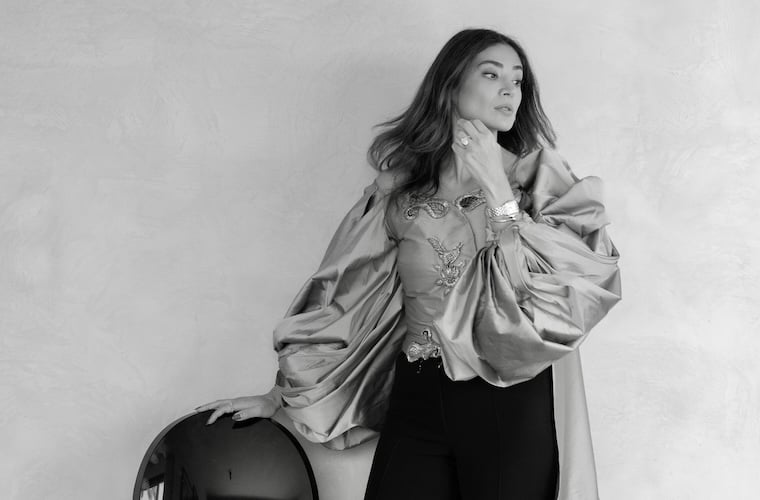
It was during the final days of December, when Dubai felt slower and peaceful as the city edged toward the New Year, that I met Saina Babaee, the founder of the brand Ilái Sarái, at an outdoor cafe. Sitting relaxed in a black billowy top and oversized khaki trousers from her own collection, she elegantly embodies the visual aesthetic her brand is quickly cornering. That of quite refinement, framed within an exploration of volume, drape and layering. Babaee sees this expansion of her brand – which was born in the lifestyle and homeware space – as a new avenue she can harness to craft a modern sartorial narrative out of her rich Persian heritage. “I always tried to make my own clothes to wear my culture,” she says. “But it ended up feeling costumey. Big. Pufly. I kept asking myself, how can I wear my culture on a daily basis without being too crafty and literal?” She recalls how her wedding was a Persian celebration filled with music and poetry – and that generated so much buzz that the couple started hosting Yalda and Nowruz parties at The Arts Club Dubai. From there, her eye for curation was used to create other events, guide artisans, and finally craft meaningful clothing. But it was after having children that Babaee felt particularly disconnected and experienced a profound sense of pain. “They don’t speak the language. They’re not familiar with the culture,” she said about that time in her life. That lack of connection to her heritage and collective found Babaee turning to the world of fashion to find a way back to herself. And it was through the launch of her clothing line that she began a journey of self-discovery and transformation that ultimately led her to an even deeper understanding of her culture. What makes the llái Sarái label so compelling right from its inception is this idea of design as architecture for identity. The clothes translate culture into daily wear and steer clear of feeling too ceremonial or theatrical. Persian references appear in a subtle way in the choice of silhouettes, the way the clothing moves, and the proportions of each piece. And all of it comes as a result of a conversation over dinner at Rami Al Ali’s table with Business of Fashion’s Imran Amed, which led her to connect with sisters Shiva and Shirin Vaghar of the LVHM Prize Finalist label Vaqar. The duo would eventually come on board to execute her vision for Ilái Sarái.

As she grows her brand, Babaee still holds a senior management position at Siemens Energy as vice president of control systems and digitalisation. With a background in mechanical engineering, she approaches the label with the same sort of structure and intent. “I have a lot of ideas, but I’m a mechanical engineer,” she says. So as she brought vision and structure to her brand, she turned to the Vaghar sisters to run point on the design and technical execution. “For example, I told them I want pants like my grandfather used to wear,” she says. “The colour, the ease, but in a modern way.” The name reflects that intention. Ilái means name. Sarái means home. The word exists across Persian, Turkish, Arabic, and Hindi languages. “We didn’t want la maison or house of,” she says. “Sarái felt honest. It’s about home, in every sense.” The brand’s philosophy is built around what Babaee calls “the art of becoming,” inspired by the Persian poem Conference of the Birds, by the Sufi poet Attar of Nishapur. It frames identity as movement, not arrival.

“When I look at a person, it’s not about how or where they were born or what their story originally was – it’s how they become,” explains Babaee. The logo of the brand follows the same logic. Calligraphy shaped into an infinity form. The clothes? Designed to be versatile and move frictionlessly from one occasion to another. “I wear the white version when I do breathe work,” she says. “I wear it to the office. To a party. To the beach.” The overarching energy of the llái Sarái brand is one of restraint. After an initial booth placement for its homeware collection at THAT Concept Store, Babaee decided that the brand felt closer in line with art galleries rather than conventional retail spaces. Today, it sits inside the Third Line gallery and Montroi in Alserkal Avenue. “We don’t want to get too big too fast,” she says. “We want to find the one perfect thing, then grow from there.” Artisans also play a quiet but critical role in Babaee’s vision for her brand. She works closely with them, often pushing for an elevated presentation and narrative she can then channel into her clothing. When asked why this is important, she says, “Craft deserves context. It belongs in galleries, not hidden in markets.” Babaee runs lái Sarái with the same rigour she applies to engineering: trackers, timelines, contingency plans. “I’ve always been very left-side brain dominant. I’m driving creatives with structure,” she says. “Excel, planners, production trackers. But the vision doesn’t change.” Entrepreneurship and the brand-building process have also helped her realise that sometimes imperfection leads to success. “However, the reason I started Ilái Sarái was to purely dream and be creative.” As a mother and an astute career woman, how does she find time to balance it all? “I’m beyond organised, and I allocate slots to everything. On a daily basis, I prioritise things based on the vision I have.”

The importance of self-care and mental health practices like sound healing, breathwork and energy work helped her in her personal growth and self-discovery journey, which was instrumental in the brand’s launch and early success. “As the pressure builds up, if you don’t have the capacity and vessel, you burn out. A didn’t want to burn out.” But at its core, it is the community that holds the brand together. “Iái Sarái was born at tables,” Babaee says. “None of this would happen if we were not in Dubai.” When asked who her mentors were, the names she mentions are familiar within Dubai’s creative circles: Rami Al Ali, Prem Prahlad, Zeina El-Dana, Dima Ayad, Imran Amed, Kate Barry, Wael Al Fatayri, Enrique Hormigo, Sunny Rahbar, and more are some of the key figures who have provided guidance and support. This strong sense of community was also evident at the launch party – an intimate gathering where movement replaces the runway and Persian music fills the space. “What’s the point of stiff models,” she says, “when the clothes are meant to move with you?” Her latest collection draws from Kurdish stripes in Iran. Linear. Functional. Designed for repeat wear. “My mood board? It was Dana Hourani. Every single piece we would design, I would picture it on Dana.”
– For more on luxury lifestyle, news, fashion and beauty follow Emirates Woman on Facebook and Instagram
Images: Supplied
Disclaimer : This story is auto aggregated by a computer programme and has not been created or edited by DOWNTHENEWS. Publisher: emirateswoman.com