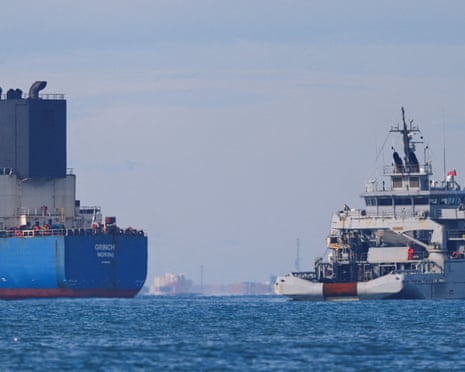
France released a tanker suspected of being part of Russia’s sanctions-busting “shadow fleet” called “Grinch” after its owner paid a fine of several million euros, a minister said in comments reported by AFP.
French forces and their allies boarded the oil tanker last month between Spain and Morocco after it started its journey in Russia, before escorting it to a port outside the southern city of Marseille.
“The tanker ‘Grinch’ is leaving French waters after paying several million euros and enduring a costly three-week immobilisation in Fos-sur-Mer,” foreign minister Jean-Noël Barrot said on X.
“Evading European sanctions comes at a price. Russia will no longer be able to bankroll its war with impunity through a shadow fleet off our shores,” he added.
… and on that note, it’s a wrap for today!
-
Several European countries are reportedly present at the Russia-Ukraine talks in Geneva today, brokered by the US in a bid to make progress in ending the war (9:51, 10:03, 10:40, 11:18, 14:09, 14:48, 15:50).
-
Meanwhile, the European Commission has confirmed plans to adopt the new, 20th, round of sanctions against Russia by 24 February, the fourth anniversary of the full-scale invasion on Ukraine (12:41).
-
France released a tanker suspected of being part of Russia’s sanctions-busting “shadow fleet” called “Grinch” after its owner paid a fine of several million euros, the country’s foreign minister said (13:20).
-
Ukrainian president Volodymyr Zelenskyy has just confirmed that 2,000 Ukrainian children forcibly abducted by Russia “have been brought home” as part of his campaign to “Bring Kids Back Ukraine” (16:57).
-
The head of Sweden’s military intelligence said Russia has stepped up its hybrid threat activities and seems willing to take greater risks in the area surrounding the country (13:08).
And that’s all from me, Jakub Krupa, for today.
If you have any tips, comments or suggestions, email me at jakub.krupa@theguardian.com.
I am also on Bluesky at @jakubkrupa.bsky.social and on X at @jakubkrupa.
Ukrainian president Volodymyr Zelenskyy has just confirmed that 2,000 Ukrainian children forcibly abducted by Russia “have been brought home” as part of his campaign to “Bring Kids Back Ukraine.”
“Each of these returns was made possible thanks to the daily efforts of our people, civil society organizations, and international partners. We are grateful to everyone who has contributed to this fight for the future of our children, our country, and the entire free world.
The road ahead remains long and difficult. Thousands of Ukrainian children are still held captive by Russia, becoming victims of its crimes every day. But we will not stop until every Ukrainian child is back home.”
in Berlin
In other news, the Jewish descendants of a German motorbike manufacturer that was forcibly relinquished by the Nazis have voiced their repulsion at the appropriation of the vehicle by far-right populists.
Members of the family, whose ancestors were forced to flee Germany in the 1930s, say they consider the use of the bike’s name by the anti-immigrant Alternative für Deutschland (AfD) as a “mockery of our history”.
The origins of the Simson moped go back to 1856, when brothers Löb and Moses Simson founded the company in Suhl, Thuringia – now an AfD stronghold.
It was the most popular form of two-wheel mobility during communism, when cars were hard to come by. It gave many teenagers in particular their first taste of freedom.
Since the fall of the Berlin Wall in 1989, the moped has increasingly become something of a cult lifestyle item in the former communist east, and has been taken advantage of by the AfD.
The party’s Thuringia leader, Björn Höcke, is often to be found riding the Simson, accompanied by fans and followers, during activities to promote the party.
Höcke has said the “Simson outings” help promote camaraderie among party members. He has teasingly touted it as an alternative form of transport to the cargo bike, often viewed as a mainstay of Green party supporters.
At the height of its production during the GDR, up to 200,000 mopeds left the Ernst Thälmann factory in Suhl every year. In total, about 6m mopeds were produced. Today, secondhand models sell for between €2,000 and €4,500. The factory permanently closed in 2002.
The AfD has integrated the moped into its election posters and general promotional material, saying it stands for “freedom, independence and individuality”. It has also pressed in several east German state parliaments for the motorcycle to be protected as “intangible cultural heritage”, submitting motions to back its campaign.
A spokesperson for the Simson family, who now live in the US, has delivered a plea via German media for the appropriation to cease.
“We find any connection with the AfD repulsive and an insult to our name,” Dennis Baum, a descendant speaking on behalf of the rest of the family, told the news agency DPA. “My family and I firmly reject extremist ideologies and will not accept the AfD’s appropriation of our name.”
He said the family was offended by the fact that the moped’s name was increasingly viewed as synonymous with a party “which is overwhelmingly extremist”. “The name must not under any circumstances become a symbol of the AfD,” he added.
Ukrainian drones have struck nine oil refineries across Russia since the start of the year, the commander of Kyiv’s drone forces said in comments reported by Reuters.
In a statement released on Telegram as Ukrainian and Russian negotiators sat for their latest peace talks in Geneva, Robert Brovdi said the refineries were among 240 facilities in Russia and Russian-occupied territory hit by Ukrainian forces.
Several European countries are reportedly present at the Russia-Ukraine talks in Geneva today, according to the Italian press.
La Repubblica and Corriere della Sera reported that national security advisers from France, Germany, Italy and the UK are “following the third negotiating session,” and are expected to meet with the Ukrainian and US delegations later today.
Sam Jones in Madrid and Rory Carroll in Dublin
In other news, the Spanish government will ask prosecutors to investigate the social media companies X, Meta and TikTok to determine whether they have committed criminal offences by allegedly allowing their AI to generate and disseminate child sexual abuse material.
Spain’s socialist prime minister, Pedro Sánchez, said his government had taken the decision in order to protect “the mental health, dignity and rights of our sons and daughters” and to end the “impunity” of huge social media platforms.
The government said it was taking action on the basis of an expert report that had analysed “the potential criminal liability of increasingly widespread practices in the digital environment, such as the generation and dissemination of sexual content and child sexual abuse through deepfakes and the manipulation of real images to create others with explicit sexual content, thereby undermining the dignity of the victims”.
The report warned of the potential involvement of social media firms in these acts because they allow “their massive dissemination with a speed and opacity that greatly hinders detection and prosecution, while also facilitating the formation of networks that produce, share, and monetise this content”.
The move, agreed by the cabinet on Tuesday, was announced as the Sánchez administration prepares a series of measures that will include a social media ban for under-16s and legislation to hold tech companies responsible for hateful and harmful content.
It also comes less than a month after the European Commission launched an investigation into Elon Musk’s X over the production of sexually explicit images and the spreading of possible child sexual abuse material by the platform’s AI chatbot, Grok.
On Tuesday, Ireland’s Data Protection Commission (DPC) – which monitors tech companies with European headquarters in Dublin – said the “large-scale” inquiry will focus on the generative artificial intelligence functionality associated with the Grok large language model.
Russian and Ukrainian negotiators on Tuesday began US-brokered talks in Geneva seeking to end the four-year war, AFP just reported, via the two delegations.
Greenlandic prime minister Jens-Frederik Nielsen is back in Nuuk today and answering some questions on his return from the Munich Security Conference.
But as the Danish broadcaster DR reports, he is taking them not from journalists, but… from local kids.
Many of their questions relate to the ongoing crisis in relations with the US, with one student asking directly if Greenland could be bombarded by US president Donald Trump.
In response, via DR, he said:
“No. … I don’t think there is a very high probability that Trump will do something like that, but I can certainly understand that you are worried. It may all sound very worrying, but we should not be afraid in this country.”
In another response, he also signalled him impatience with the US president, asking – as per DR – “when will he get it … [and] stop saying all these things that cause so much worry and anxiety?” “I don’t know why he still does it,” he said.
Europe environment correspondent
Separately, France has issued red alerts for flooding in three départements as the aftermath of Storm Nils causes chaos across the country.
Flood waters have inundated homes and isolated villages after the Garonne River burst its banks, with hydrologists warning that rain is falling on soils that have hit record-breaking levels of saturation.
Météo France said red flood alerts would remain in place on Wednesday in Gironde, Lot-et-Garonne and Maine-et-Loire but the number of counties under orange alert would fall from 14 to 12.
Monique Barbut, minister for the ecological transition, said a state of emergency – necessary to fast-track insurance claims – would be declared once the floods had ended.
“People who follow climate issues have been warning us for a long time that events like this will happen more often,” she said on Tuesday, the day after visiting the flood-stricken Gironde region, in comments to TV news channel LCI. “In fact, tomorrow has arrived.”
Lucie Chadourne-Facon, director of Vigicrues, France’s flood monitoring service, said the succession of rainy disturbances had been “exceptional” and that soils were so full of water that as little as 20-30mm of rainfall could trigger floods.
“We are dealing with two parallel phenomena,” she told broadcaster BFMTV at the weekend.
“The fact that it is territorially widespread means … all the little rivers that have reacted are flowing into big rivers and everything swells by propagation,” she said. “And at the same time, we’re still getting rain that is reactivating the flooding.”
Vigicrues said “damaging flooding” was under way on the Garonne River downstream from Agen and was significant in the Marmande and Gironde regions. Although water levels had been slowly receding after weekend peaks, they were rising again on the lower Garonne.
Officials expect major flooding on Tuesday afternoon on the Maine River – including the city of Angers – and during the night on the Loire River in the Ponts-de-Cé area. Water levels are expected to keep rising throughout Wednesday.
France’s floods come after a series of storms have battered Portugal and Spain, leaving at least 16 dead and forcing thousands to flee their homes.
France released a tanker suspected of being part of Russia’s sanctions-busting “shadow fleet” called “Grinch” after its owner paid a fine of several million euros, a minister said in comments reported by AFP.
French forces and their allies boarded the oil tanker last month between Spain and Morocco after it started its journey in Russia, before escorting it to a port outside the southern city of Marseille.
“The tanker ‘Grinch’ is leaving French waters after paying several million euros and enduring a costly three-week immobilisation in Fos-sur-Mer,” foreign minister Jean-Noël Barrot said on X.
“Evading European sanctions comes at a price. Russia will no longer be able to bankroll its war with impunity through a shadow fleet off our shores,” he added.
Meanwhile, the head of Sweden’s military intelligence said Russia has stepped up its hybrid threat activities and seems willing to take greater risks in the area surrounding the country.
“Russia has, in certain cases, stepped up actions and increased its presence – and perhaps with a greater risk appetite – in our vicinity,” Thomas Nilsson, head of Sweden’s Military Intelligence and Security Service (MUST), told AFP.
He added that he believed Moscow would “unfortunately” continue doing so – regardless of whether it succeeds in areas such as Ukraine or not.
“A certain desperation can set in, where you push even harder to reach your goals,” Nilsson said.
Nilsson spoke as the agency presented its yearly threat review on Tuesday.
He said Sweden’s security situation had continued to deteriorate, as it has in previous years, particularly since Russia’s 2022 invasion of Ukraine.
Russia is the main “military threat to Sweden and Nato,” the review stated, warning the threat was likely to grow as Russia increases resources for its armed forces.
Disclaimer : This story is auto aggregated by a computer programme and has not been created or edited by DOWNTHENEWS. Publisher: theguardian.com