Updated ,first published
Former foreign minister Bob Carr has lamented the Albanese government’s strong backing for the United States and Israel’s strikes on Iran, pointing to simmering discontent within parts of Labor about the party’s seeming lack of interest in upholding international law.
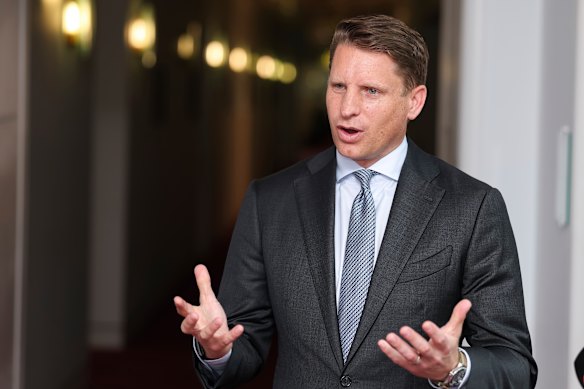
Echoing language by Canadian prime minister Mark Carney, who arrived in Australia for a three-day visit on Tuesday, opposition industry spokesman Andrew Hastie declared the global rules-based order is dead and that force is now the dominant authority in geopolitics.
The comments come as the opposition demanded the federal government do more to support Australian travellers stranded in the Middle East, and Defence Minister Richard Marles flagged “contingency arrangements” were being considered to help evacuate stranded Australians.
Asked about Australia’s position on the conflict with Iran, Carr, who served as Labor foreign minister from 2012 until 2013, told this masthead: “It’s frightening that our voice, for the first time in a long time, is not loudly speaking up for international law.”
The vast majority of international law experts have said that the US and Israeli strikes were illegal because there was no sign of an imminent threat from Iran.
Carr said: “There is a lot to say about the huge breach of international law in the joint US-Israel attacks on Iran, but one observation after the first few days of fighting is that the lie on which the war is based is being exposed. Iran’s feeble response to the assault shows they don’t come close to posing a significant threat to the US and Israel.”
Carr warned that the widening conflict could have “hugely destructive implications” including high civilian casualties, an outflow of refugees to the Middle East and Europe, terrorist counterattacks and a power vacuum in Iran.
“There is a risk Iran will end up with an even worse government than the hardline Islamic regime the US wants to replace,” Carr said.
Former Labor senator Doug Cameron said that Albanese’s rhetorical backing for the strikes “shows that we are completely devoid of acting independently from Trump and Netanyahu”.
“There was a time when Labor pursued peace, not war,” Cameron, a patron of the Labor Against War group.
“That time is long gone. Leadership needed not sycophantic capitulation to militarism.”
Albanese told the ABC’s 7.30 on Monday night: “Australia has had a clear position of supporting this action, and Australia has had a position of abhorrence when it comes to the Iranian regime. And it is up to, of course, the Iranian people now to determine their own future. We hope that what emerges is a more democratic and free Iran.”
Albanese and Foreign Minister Penny Wong have said it is the US and Israel’s responsibility to explain how the strikes comply with international law.
Hastie, a former SAS soldier, told journalists at Parliament House in Canberra on Tuesday morning: “I think the world is governed by power, and I prefer a powerful US reestablishing deterrence, rather than other countries like Russia, you know, using might to advance its national interest.
“It’s nice to talk about, you know, the world that once existed post-World War. The, what do we call it, the global rules-based order. I don’t think that exists any more, and anyone who says it does is living in a fantasy land. This is a new world order.”
The war in the Middle East has rapidly escalated over the course of the three-day assault from the US and Israel on Iran, with the battered nation launching strikes against Israel, Lebanon, the UAE and Kuwait. US President Donald Trump has said the conflict could last “far longer” than his previously implied four- or five-week operation, warning that a “big wave of strikes” was imminent.
Australia’s Al Minhad Air Base near Dubai was struck by Iranian drones over the weekend, Marles confirmed. All personnel at the base were safe.
Carney has used nearly identical language to Albanese on the strikes on Iran, saying:“Canada supports the United States acting to prevent Iran from obtaining a nuclear weapon and to prevent its regime from further threatening international peace and security.”
Carney will address Sydney’s Lowy Institute think tank on Wednesday before delivering an address to a joint sitting of parliament.
He electrified the World Economic Forum in Davos by declaring there was a “rupture” in the international rules-based order and calling for middle powers to work closer together.
Closer co-operation on critical minerals between Australia and Canada is expected to feature heavily during the visit.
In the United Kingdom, Prime Minister Keir Starmer suggested the US and Israeli strikes contravened international law and questioned the viability of Trump’s plan for the conflict.
Starmer’s comments to the UK House of Commons came shortly after Trump said he was “very disappointed” at the prime minister’s decision to withhold access by the American military to British air bases during the initial attack. Starmer has since granted access to British bases.
In a rare diversion from the typically unified UK-Australian foreign policies, Marles said the government was supporting the American position.
“Iran walking down the path of acquiring a nuclear capability flies in the face of the rules-based order … and all the regimes that we have around the world which are about limiting the spread of nuclear weapons,” Marles told Seven’s Sunrise.
Labor ministers have repeatedly brushed off the suggestion of Australian military involvement in the conflict. Hastie, who served in Afghanistan, said all options for Australian involvement should remain open, but questioned the conflict’s timeline and whether regime change was a reliable expectation.
“President Trump said the end state is we’re going to strike Iran and then leave it up to the Iranian people to do regime change in four and five weeks time. What’s going to be left of a functioning government? At least in Iraq and Afghanistan, you had coalition troops there to establish some sort of law and order,” Hastie said.
“It’s going to be very messy, and you can just see the rise of another Islamist regime that continues oppressing the Iranian people. So I’m just very circumspect about war as a blunt instrument for regime change. It’s very, very difficult, and having done nation building at gunpoint myself, that’s why I’m very circumspect about this whole thing.”
As key air travel corridors over the Middle East remain closed, Marles flagged the government was looking into unspecified “contingency arrangements” to support heir return, while reiterating the fastest way for citizens to return was if commercial flights returned.
 Matthew Knott is the foreign affairs and national security correspondent for The Sydney Morning Herald and The Age.Connect via X, Facebook or email.
 Nick Newling is a federal politics reporter for The Sydney Morning Herald and The Age.Connect via email.
From our partners
Disclaimer : This story is auto aggregated by a computer programme and has not been created or edited by DOWNTHENEWS. Publisher: www.smh.com.au