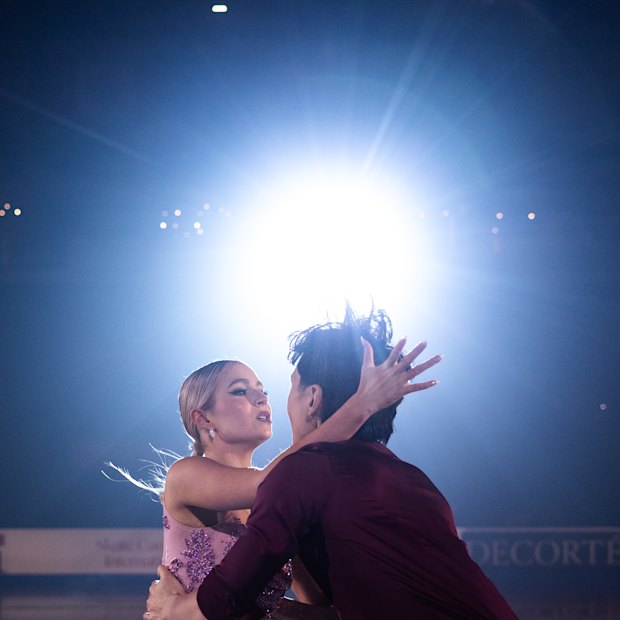
Holly Harris and Jason Chan are carrying Australia back onto the Olympic ice dance stage.
Holly Harris and Jason Chan perform during the gala exhibition at the ISU Grand Prix of Figure Skating in 2022.Credit: Getty Images
Holly Harris has a saying: “Ice is slippery.”
It’s a figure skater’s truism, a reminder that nothing in her sport moves in straight lines, that plans unravel easily, and that falls are inevitable.
Harris learned that early. As a child, her enthusiasm for skating was regularly punctuated by slips, bumps and falls as she tried to master the jumps and spins required of her. It was hard, and that feeling never really went away.
But then, on Mondays and Wednesdays, she escaped into another world.
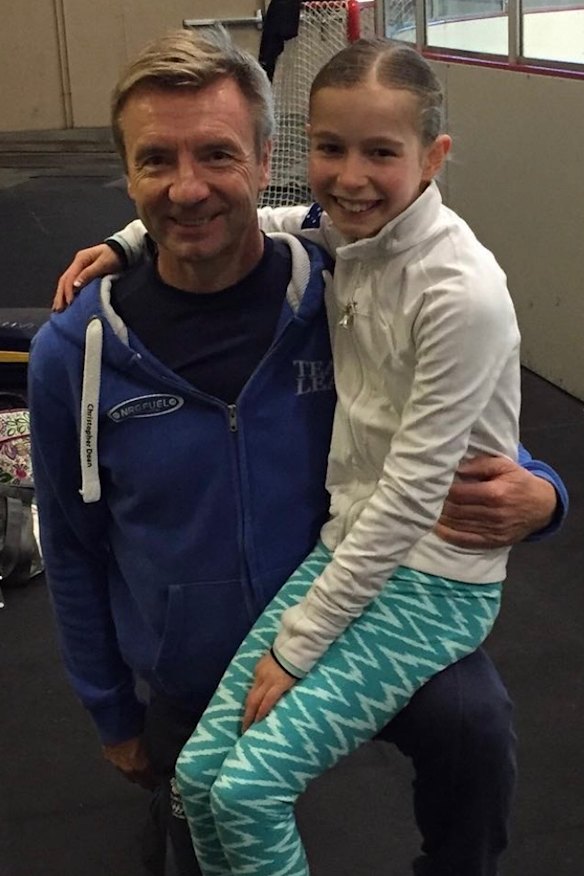
Holly Harris with Christopher Dean, her old coach in Colorado Springs.Credit: Karen Harris
From age nine to 13, she was coached by Christopher Dean – one half of Torvill and Dean, the most famous skating partnership in history. Which is a bit like doing one-on-one lessons with Lionel Messi or Michael Jordan.
“That would kind of be my fun time. He would help me to switch off,” she said.
“I’d come to his lessons crying sometimes, or having fallen, slightly injured. He was just super caring and funny and sweet. I would bake on the weekends – that was one of my hobbies growing up – and then I would bring him in some sweet treats during the week.”
Those delicacies – cookies, mostly, but sometimes puddings, cakes and trifles – came in a jar.
“So this is my jar,” Dean said to Holly, the first time she brought it to the rink, sitting it down in front of him and staring at it.
“You know the good thing about a jar? I can give it back to you, and you can refill it.”
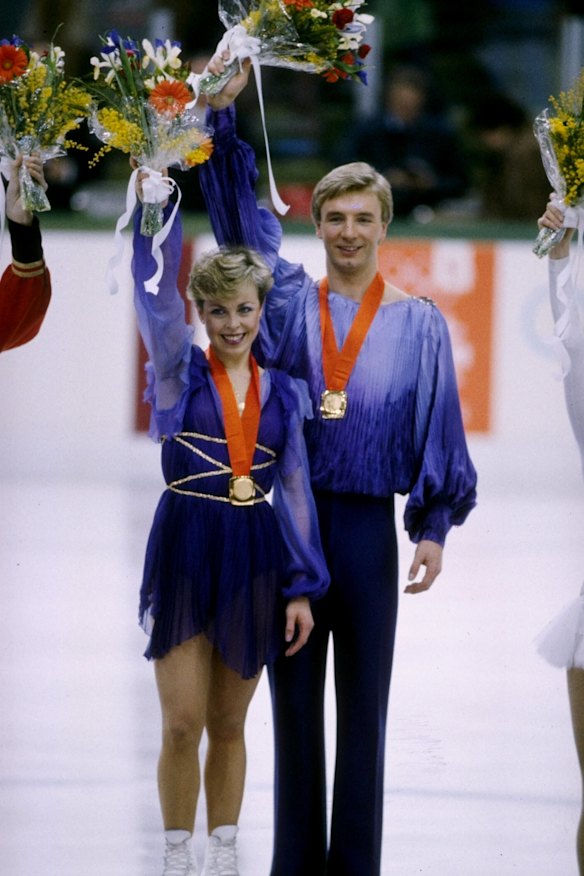
Jayne Torvill and Christopher Dean celebrate their gold medals in 1984.Credit: Getty Images
Torvill and Dean won gold for Britain in ice dance at the 1984 Winter Olympics in Sarajevo – the same discipline Harris is about to compete in at Milano Cortina, though not the one she had her heart set on back then.
She was determined to be an individual skater, like her mum.
Harris was born and raised in Sydney to a family that would regularly travel abroad to ski. On one trip, she spotted an outdoor ice rink and was immediately enchanted. Her mother, Karen, a former national-level skater who performed with Torvill and Dean on their first tour of Australia, told her that if she went to ski school every day, and was well-behaved, she’d take her there.
“It was super easy for her, and I didn’t understand why, because I didn’t know that she skated,” she said. “I was just like, what the hell? So I was trying really, really hard. I would not let her help me. And I just got hooked. I was really determined to get good at it – and from then, I just kept skating.”
When she first came into Dean’s orbit, the Harris family were spending a lot of time in Colorado Springs, in the United States. Dean, who was based there at the time, could see in Holly someone who was determined to master her craft – but also someone who was growing tired of the physical toll of singles skating, and who might have more fun if she changed disciplines.
“She was a really artistic single skater to begin with,” Dean said.
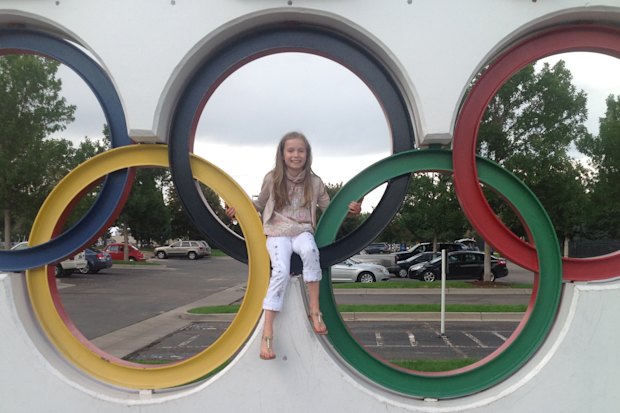
A young Holly Harris dreaming of the Olympics. Credit: Karen Harris
“You could tell she had movement and style … but I don’t think she liked the falling as much. And you’ve got to do a lot of falling in single skating to get the jumps right. So, as a bit of fun, I suggested: ‘Why don’t you do a little bit of dance with me, and just to improve your skating skills and at the same time, still enjoy skating?’”
She did, and loved it. But she was having none of his attempts to coax her into full-time ice dancing.
“He was always trying to convince me to do ice dance,” Harris said. “Telling me I would be a great ice dancer: ‘Why don’t you just forget about all of this and go and enjoy skating? Do what you love, and do ice dance.’ And I was always like: ‘No, no, no. I’m a singles skater. Like, I’m never doing ice dance. Thank you, though’.”
“I think you can credit me as being the instigator … She was made to be an ice dancer.”
Christopher Dean
The next time Dean saw her, a decade or so later, she was competing in ice dance for Australia.
“I think you can credit me as being the instigator,” he laughed. “She left the dark side and found the bright side. She was made to be an ice dancer.”
‘I was scared to jump and hit my head again’
The path from promise to fulfilment was anything but smooth.
Harris’ journey to Milano Cortina has been punctuated by repeated concussions. The first came when she was about 13. She was still an individual skater but training with a younger, more inexperienced ice dance team.
“They weren’t really watching what they were doing,” she said. “I was skating backwards, doing some jumps consecutively … they were skating forwards, so they should have seen, and they just rammed into me and I smacked down and hit my head.
“I didn’t really know the protocol, didn’t really understand how serious it was to treat it early on. I was in Detroit for choreography, I took a day or two off, and I went back to skate so that I could finish my program, make the most of the time there. It started to get better – then I went back to Colorado Springs to train, and a coach had me do some jumps, and it just got way worse.
“It took two months to recover, and the protocol at the time was like, no light, dark room, no mental stimulation – so no reading, no electronics. I don’t even know what I did for two months. It was hard. I was lucky that my grandma was there with me in America, but eventually, I recovered.”
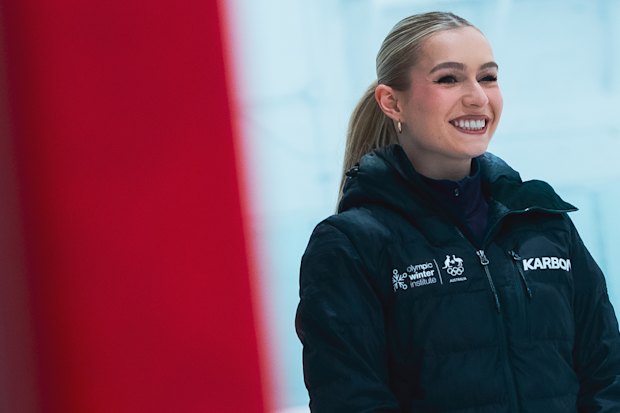
It’s been a long, hard road to the Olympics for Holly Harris.Credit: Karim Fall
These experiences partially influenced her decision to go into ice dancing, where the risk of injury is generally lower because it does not require the repeated high-impact jumps that define singles skating.
“It wasn’t the main reason. It was a factor,” Harris said. “I was scared to jump and hit my head again. Jumping just became a bit of a mental block for me. There were a lot of stresses that accumulated to cause that block.”
Ice dance did not just offer Harris a safer way to skate. It also set her on a path toward the partnership that would eventually take her to the Olympics.
That partner is Jason Chan, a Canadian-born skater who first met Harris in 2019 at the Ice Academy of Montreal, the world’s top training centre for ice dancers, and an environment that has produced many Olympic and world champions.
Chan had been skating for Canada, but his partner retired, while Harris had also split with hers, and so both were on the lookout for someone new.
“I knew that I wasn’t done with the sport, and I wanted to continue,” Chan said. “And how it kind of works in ice dance is that you go on little speed dates. You try it with different people, and then you see if you mesh well in terms of body lines, your goals, personality … we had a little tryout, and the rest is history.”
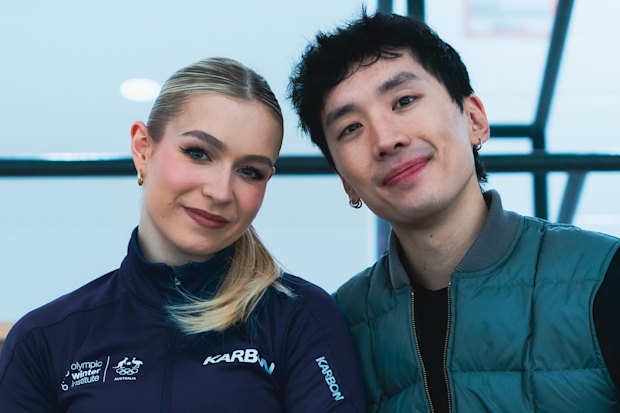
Holly Harris and Jason Chan, Australia’s Olympic ice dance team.Credit: Karim Fall
Chan, 29, was determined to keep skating internationally. The best way to do that, given Canada’s enviable depth in the sport, was to switch allegiances. Thanks to the Australian Olympic Committee and Australia’s Olympic Winter Institute, the process was expedited – though he still had to meet the truncated residency requirements.
He did that during COVID, when movement in Australia was comparatively free to the rest of the world. In 2019, at their first attempt, they won gold at the Australian championships.
“If you told me 10 years ago that I would let alone go to Australia, but become an Australian citizen, I’d be like, ‘Oh my God, you’re just crazy,’” he said. “But in the world of ice dance, there’s so few [available] partners at that high level, so sometimes you try to look outside to different countries. At that point, it just made the most sense.”
Importantly, he is not just an Australian on paper. “I like Vegemite toast,” Chan laughed. “I mean, the beaches in Sydney are amazing, and the coffee culture and just the food culture in general is like, second to none. The whole vibe is pretty amazing.”
Yin and yang
As a general rule, Australia does not produce Olympic ice dancers, a field dominated by the sport’s traditional powerhouses in North America and Europe. Like most winter sports, we have neither the tradition nor the facilities to consistently produce skaters of the highest level. Australia has never come close to an Olympic medal in any figure skating discipline; only twice before – in 1988 and 2014 – has Australia qualified a team in Olympic ice dance, with Monica MacDonald and Rodney Clarke finishing last in a field of 20 in Calgary, and Danielle O’Brien and Gregory Merriman 20th of 24 teams in Sochi.
Harris and Chan missed out on qualification for Beijing 2022 – a long shot – but were always aiming for the following Games. At last year’s Olympic qualifying event, they finished inside the top 19, a result that would ordinarily be enough to secure an automatic berth. But because larger nations are permitted multiple quota spots, those places were absorbed elsewhere, and they were forced down the repechage road.
“I remember the lead up to worlds for months, just thinking, ‘OK, I need to come top 19’. And I was super specific with my goal,” Harris said.
“I would say it in my head all the time: ‘It’s 11:11, make a wish’. That was my wish: place top 19 at worlds in Boston, 2025. And it came true. It just didn’t exactly pan out, and I didn’t realise that the rules were written that way. It’s kind of made to favour the strong federations instead of the individual athletes, which is a hard pill to swallow when you’re that individual athlete from a smaller federation – and obviously, our biggest goal is to put Australia on the map in ice dance and figure skating.
“Then people are like, ‘Oh, but the rules are written really grey. You should like ask a lawyer about it because it’s not super clear, blah, blah, blah’. Everyone’s telling you all these things.At the end of the day, it is how it is. When you’re finding that out, it’s devastating. Your whole world is crumbling, and you just cannot believe it.”
There are two components to competitive ice dance: the rhythm dance, where skaters must choose music that fits a prescribed theme set by the sport’s governing body, and the free dance, where they are free to choose their music and shape the program as they wish. Harris and Chan’s advisers immediately sprung into action after missing out at the world titles, urging them to keep their free dance for Skate to Milano in September, the final Olympic qualification opportunity, so they could narrow their focus. Their program is choreographed to Clair de lune, which is French for moonlight, and represents how they bring out the best in each other: Harris is a meticulous planner, whereas Chan is a bit more of a free spirit. It took them a while to find their respective wavelengths.
An idiot’s guide to ice dance
Figure skating vs ice dance: what’s the difference?
Figure skating is an umbrella term that covers several disciplines:
- Singles: men’s and women’s events with jumps and spins (Think: I, Tonya)
- Pairs: big throws, overhead lifts and jumps in unison (Think: Blades of Glory)
- Ice dance: no big jumps, no throws – it’s all about rhythm, edges and connection (Think: Torvill and Dean)
How ice dance works
Ice dance competitions have two elements:
- Rhythm dance: A tightly structured routine built around a prescribed theme set each season. Music must fit the theme, and skaters must perform specific required elements.
- Free dance: Skaters choose their own music and have greater freedom to tell a story, blending difficulty with artistry.
Key moves you’ll hear about
When commentators mention the following buzzwords, you can explain what they mean to your mates:
- Twizzles: Fast-travelling spins performed on one foot. Ice dancers often do them side by side, perfectly in sync.
- Lifts: Short, controlled lifts; no overhead throwing like pairs skating. The emphasis is on smooth entry, exit and balance, not height.
- Step sequences: Intricate footwork patterns that show control, speed and unison. This is where ice dancers really separate themselves.
- Edges: How cleanly and deeply skaters carve the ice. Good edges look effortless; bad ones look scratchy.
- Transitions: The skating between the big moments. The best teams make the difficult parts almost invisible.
“Our idea was to kind of represent the yin and the yang – the moon and the sun, the dark and the light,” Chan said. “Because we grew to appreciate our differences. Initially, it was hard, coming into this new partnership and not knowing each other. We clashed a bit on certain aspects because we didn’t really understand where each one was coming from. But I think we wanted to show on the ice how these differences make us better as a team, and how without one another, we wouldn’t be able to be Holly and Jason, right? There would be no Holly and Jason without Holly and Jason.”
This season, which includes Milano Cortina, the rhythm dance theme is, officially: “The Music, Dance Styles and Feeling of the 1990s”. Chan is the mastermind behind this one, in which they perform to a medley of Jennifer Lopez’s Waiting for Tonight and If You Had My Love, and Anastacia’s I’m Outta Love – a trio of bangers dripping with pure So Fresh compilation CD energy. In previous seasons, they’ve skated to ABBA, Madonna, Labrinth’s score to the popular HBO series Euphoria, and in a nod to Australia, three classic Kylie Minogue numbers: Can’t Get You Out Of My Head, Slow, and Spinning Around.
“There’s a lot that goes into it. I would say we’re pretty picky,” Harris said. “I mean, everyone is, but it usually takes us time. We had J-Lo in mind, and then finding the final piece to really bring it together was the challenge, so for a while we were like trying to find that, and we stumbled upon this remix from Anastasia … it’s really fun, everybody knows the song, super catchy.“
At Skate to Milano, Harris and Chan placed second in the rhythm and free dance, behind Lithuania’s Allison Reed and Saulius Ambrulevičius. In retrospect, they see what happened to them as a blessing in disguise, which forced them to work harder to elevate their performances.
“It really helped us become better versions of ourselves, and better athletes,” Harris said. “And I am grateful for the experience, because when it did finally happen, it was just so special, probably the best moment of my life.”
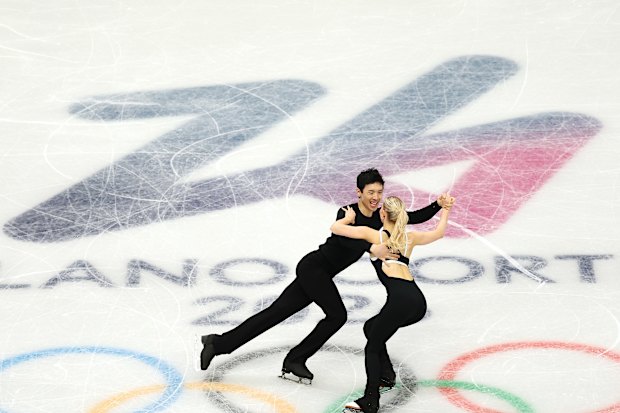
Holly Harris and Jason Chan train at the Milano Ice Skating Arena on Thursday.Credit: Getty Images
Art versus science
A couple of months before they sealed their Olympic debut, Harris’ journey came full circle. In June, she and Chan performed as part of Torvill and Dean’s 50th anniversary tour shows in Australia, just like her mum once did.
”One night I was taken aback, because they were announcing us, and the lights weren’t even on, and the cheers were the biggest of the night,” Harris said. “I was like, ‘Oh my God, they know who we are. I’m shocked’. I went for one of the jumps in the start of the program and I tripped a little cause I was so excited, but I was like, ‘OK, I have to compose myself, because I’m not about to embarrass myself here’. It ended up being fine. It was a great experience. We learned a lot and it was just such an honour to perform with them.”
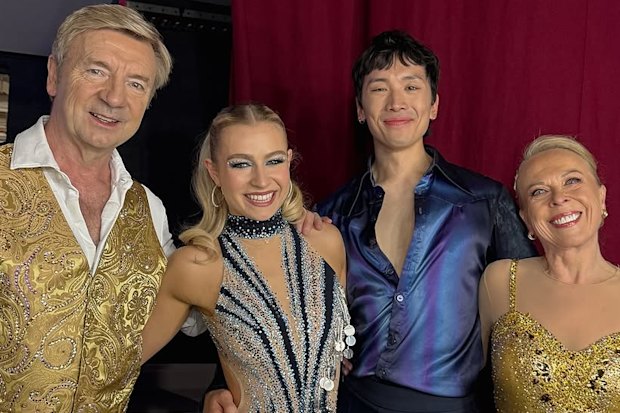
Christopher Dean and Jayne Torvill with Harris and Chan during the British pair’s tour of Australia last year. Credit: Instagram
Dean was thrilled to see how far she’d come. Like Harris and Chan themselves, he is realistic about where they sit in the global pecking order.
“They’re finding their stride, their unison, togetherness,” he said. “They’re early on in their career, so I would imagine, maybe not this Olympics, but the next Olympics go-round, that they could be in the top 10. In ice dance, there’s never a revolution. You’re not suddenly at the top. It’s evolution, and you just have to put your time in, let’s say. That’s what they’re doing. ”
To the untrained eye, the differences between Harris and Chan and the expected medal contenders are practically imperceptible. Even Harris, in her early days, couldn’t quite see what separated one team from another. Now, she can feel it.
“You need to look perfect at all times. If you make a mistake, it’s over,” she said. “If there’s a moment that you’re brought out of the performance, that’s what makes a difference when you’re watching the best teams: they’re going to draw you into the performance for that whole four minutes, and at the end, you’re going to be left with like feeling of, ‘Wow, there wasn’t a second where they were out of it or shaky’. We’re working so hard the whole four minutes to make it look super easy.”
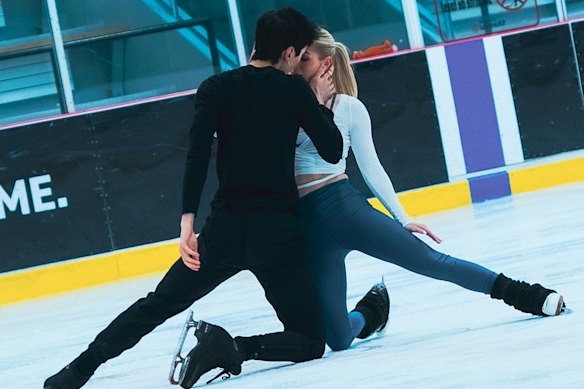
Holly Harris and Jason Chan aren’t considered to be a medal chance at Milano-Cortina, but this is only the start of their Olympic journey together.Credit: Karim Fall
Figure skating is, of course, judged by humans, who make mistakes and have biases, and the sport is prone to controversy. Each program is scored against a prescribed set of technical requirements, with judges weighing both precision and performance. Dean fears that those requirements have become more like checklists, and is saddened that ice dance has moved in that direction, where he feels some of the art has been replaced with science.
“From when we skated to what they’re doing now, it looks a different sport,” he said. “Before, it was about a grand picture that we used to have to present, and I think that had more creativity and diversity. A lot of people remember us through skating to Bolero, and its emotional connection to the audience, and I don’t know whether you have that as much these days.“
Harris and Chan are not expected to come close to contending for a medal at Milano-Cortina, but they are happy just to be there, to be on the trajectory that they are, and to have Australia behind them.
“We’re not there yet,” Harris said. “That doesn’t mean it’s not a goal we will have one day. But obviously, ice is slippery. We will just see how far we can get.”
The Winter Olympic Games will be broadcast on the 9Network, 9Now and Stan Sport.
News, results and expert analysis from the weekend of sport sent every Monday. Sign up for our Sport newsletter.
Most Viewed in Sport
Disclaimer : This story is auto aggregated by a computer programme and has not been created or edited by DOWNTHENEWS. Publisher: www.smh.com.au