
Josh Frydenberg’s speech at Bondi Beach this week did not sound like anything produced by the Australian political system in a long time. That was its power.
It came outside of parliament, after office, after many years of offering caution. It was the most important moment of his public life because it stripped everything else away.
What remained was anger, grief and a refusal to sanitise reality.
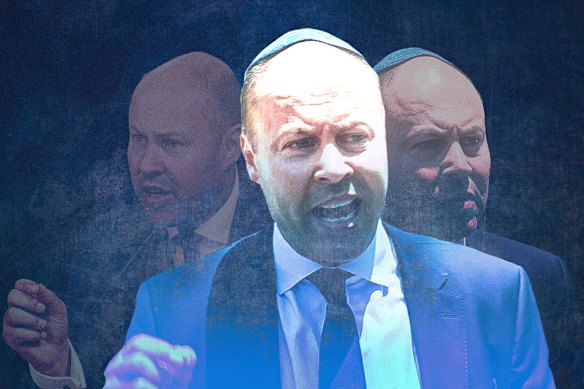
Josh Frydenberg spoke passionately at Bondi.Credit: Matthew Absalom-Wong
There’s no shortage of people ready to reduce Frydenberg’s intervention to political calculation. A former treasurer who lost his seat in 2022’s landslide against the Morrison government. A potential return to public life. A moment of national grief. The cynicism is familiar — and tempting. It is also, as even his most hardened critics this week believe, grossly uncharitable.
What set Frydenberg’s address apart was not just its bluntness, but the fact that it came from someone speaking as a parent and as a Jew before speaking as a politician. During his 12 years in parliament no one ever called Frydenberg a conviction politician, but here he spoke with the type of moral clarity now rarely heard in public life. That distinction mattered — and it was audible.
He spoke not in abstractions but from lived experience. As a father raising Jewish children in Melbourne where their schools and synagogues now need armed guards and families calculate risk before attending public celebrations. This was not borrowed outrage. It was personal fear, publicly expressed. Unscripted and pointed.
“We, as a Jewish community, have been abandoned, and left alone by our government. Our governments have failed every Australian when it comes to fighting hate and antisemitism,” he said. “Our prime minister, our government, has allowed Australia to be radicalised on his watch.”
He did not speak delicately. He accused governments of moral failure — of hiding behind euphemisms, of refusing to name Islamist extremism, of indulging antisemitism under the cover of balance and process. His charge was blunt: if leaders cannot say what is driving the violence, they cannot stop it.
That directness was jarring precisely because it is now so rare. It left MPs on all sides in Canberra wondering why no one else could manage the same cut-through.
Labor MP Mark Dreyfus, a former attorney-general, Jewish, and a political opponent of Frydenberg, was invited by ABC radio to address claims that Prime Minister Anthony Albanese must accept some responsibility for the increasing number of violent attacks on Jewish communities, culminating in Sunday’s massacre. Dreyfus handled it deftly.
“There are many people speaking out now who are reflecting the anger and the pain and the grief that is being felt, and that’s understandable,” he said. “I say again, this has been an extraordinarily distressing event for the Australian Jewish community, for all Australians.”
He went on to say that more must be done to combat antisemitism, flagging many measures the federal government would announce the following day.
“Blame is not a very useful sentiment,” Dreyfus said. “What we need to do now is work with each other. And I’ve said from the start, we can and should do more. We’ve got to do everything that we can.”
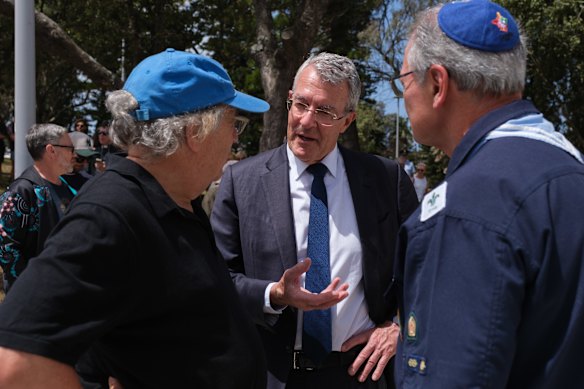
Labor MP Mark Dreyfus (centre) at Bondi Beach the day after the massacre. Credit: Oscar Colman
Like Dreyfus, Frydenberg’s authority on this issue does not derive from identity politics, but from history. He is the most senior Jewish cabinet minister Australia has produced. He is also the product of a postwar nation that integrated Jewish refugees successfully and confidently, without apology and without fear. Their parents’ survival, and their own careers, were evidence that Australia once understood how to manage difference without surrendering cohesion.
Frydenberg, now unbridled by political office, issued a warning that this inheritance is being squandered. That argument will be uncomfortable for Labor, particularly for a party struggling to manage elements of its own base.
Frydenberg made no effort to soften that discomfort. Like John Howard after Port Arthur, he argued, leadership means confronting your own side first.
On arrival in Bondi, he had planned to say only a few words to mourn the dead, but in the end, he admitted he “let rip”, unsure if he would finish or break down. He told The Nightly on Thursday he’d so far shielded his own young children from news about the attack because he did not want them to be “fearful living in Australia as proud Jews”.
Frydenberg did not speak this way on matters affecting the nation when he sat in cabinet. Power disciplines language. Ambition can sharpen it. He told the ABC’s Sarah Ferguson that he was “deeply offended” by suggestions that his speech was politically motivated. But neither fact diminishes the substance of what he said.
Australian politics has developed an unhelpful reflex: when a speaker might benefit politically, their argument is treated as suspect by default. Motive becomes a substitute for engagement. That reflex is especially convenient when the subject is uncomfortable.
Preselections won’t be dealt with in Victoria for the next federal election until after next November’s state election. Those close to Frydenberg genuinely don’t know if he will try to return to parliament. Their best guess is the Liberals’ current fortunes would dramatically have to rise if he were to throw in his new life in corporate Australia and run again.
Frydenberg told journalist Latika Bourke he was in no rush to make a decision.
“What the events of October 7th and its aftermath here in Australia have underlined to me, and I hope have underlined to every Australian, is that leadership or the lack of leadership really matters. It can be the difference between life and death, and so politics is more than a job,” he said.
This week was not a policy blueprint. It was a moral accusation. Frydenberg’s charge was that current leaders had seen the warning signs and chosen equivocation. In trying to manage tensions, they allowed something far more dangerous to metastasise.
Some say Frydenberg spoke too harshly. But history is rarely kind to leaders who confuse restraint with virtue when the foundations are under attack.
Cut through the noise of federal politics with news, views and expert analysis. Subscribers can sign up to our weekly Inside Politics newsletter.
Most Viewed in Politics
Disclaimer : This story is auto aggregated by a computer programme and has not been created or edited by DOWNTHENEWS. Publisher: www.smh.com.au





