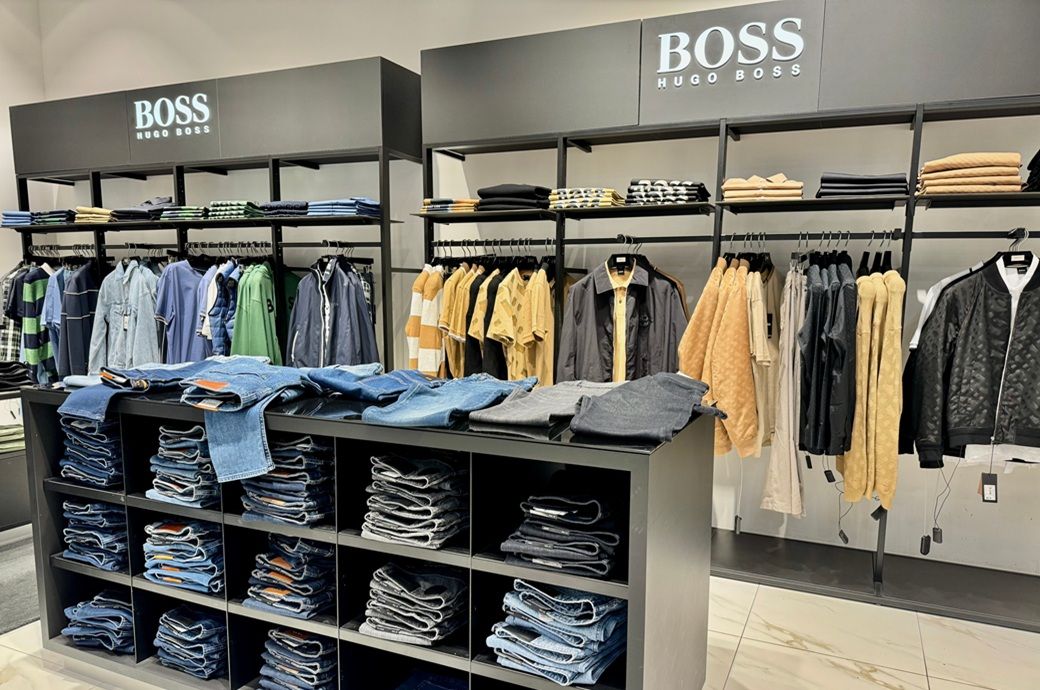
German designer fashion company Hugo Boss has recorded group sales of €4.27 billion (~$4.95 billion) for fiscal 2025 (FY25), slightly down 1 per cent year on year (YoY) in reported terms but up 2 per cent on a currency-adjusted basis. The performance came amid a challenging environment shaped by geopolitical tensions, economic uncertainty and weaker demand in parts of Asia.
The operating profitability improved during the year, with EBIT rising 8 per cent to €391 million (~$453.56 million), while EBIT margin increased by 80 basis points (bps) to 9.2 per cent. Net income grew 16 per cent to €259 million, and earnings per share rose 17 per cent to €3.61.
Regionally, Europe, the Middle East and Africa (EMEA) recorded 2 per cent currency-adjusted growth, supported by strong demand in key European markets including Germany and France. The Americas grew 3 per cent, reflecting improving momentum in the US and double-digit gains in Latin America. In contrast, Asia/Pacific sales declined 5 per cent, largely due to subdued consumer demand in China, Hugo Boss said in a press release.
By brand, Boss Menswear remained the strongest contributor, with sales rising 3 per cent currency-adjusted during the year.
The company highlighted brand initiatives such as global campaigns, the Beckham x Boss collections and the Boss fashion show in Milan.
Meanwhile, Boss Womenswear and Hugo recorded declines of 5 per cent and 4 per cent respectively, as the company streamlined assortments and refined distribution to improve long-term brand positioning.
Channel-wise, brick-and-mortar retail sales remained broadly stable YoY, reflecting softer store traffic in markets such as China and the UK. Wholesale sales increased 2 per cent, while digital revenues rose 7 per cent, driven largely by strong performance from digital partner platforms.
The gross margin declined slightly to 61.5 per cent, down 20 bps from the previous year, due to currency effects, promotional market conditions and channel mix changes. However, Hugo Boss managed to offset some of these pressures through improved sourcing efficiency and lower freight costs.
Operating expenses fell 3 per cent, improving to 52.4 per cent of sales, reflecting the company’s focus on cost discipline and productivity improvements across sales, marketing and administrative functions.
The company also strengthened its balance sheet during the year. Inventories declined 10 per cent currency-adjusted, helping reduce inventory as a share of group sales to 21.5 per cent. Capital expenditure (capex) dropped 32 per cent to €195 million, following major investments in prior years.
Meanwhile, free cash flow before leases reached €499 million, broadly stable compared with €497 million in 2024. Hugo Boss ended the year with a net financial position of €48 million excluding lease liabilities, improving significantly from negative €78 million in the previous year.
Fourth quarter (Q4) sales rose 7 per cent currency-adjusted, with reported revenues increasing to €1.281 billion from €1.249 billion in the same period of 2024.
Growth was supported by improvements across several business channels. Brick-and-mortar retail returned to growth, rising 2 per cent, supported by a successful holiday season and strong consumer response to brand campaigns and product launches.
Brick-and-mortar wholesale recorded strong growth of 14 per cent, partly due to higher deliveries to selected partners and a timing shift of some shipments originally planned for early 2026. The digital business grew 12 per cent, benefiting from stronger performance from digital partners.
Regionally, EMEA delivered strong growth of 9 per cent in Q4, while the Americas increased 6 per cent, supported by a solid US performance and strong demand in Latin America. Asia/Pacific remained slightly negative at 1 per cent, although this represented a sequential improvement compared with earlier quarters as Southeast Asia and Pacific markets helped offset weaker demand in China.
EBIT in Q4 rose 22 per cent to €154 million, while EBIT margin increased to 12.0 per cent, up from 10.1 per cent a year earlier. However, gross margin declined 160 bps to 60.8 per cent, mainly due to increased promotional activity in the wholesale channel aimed at improving inventory levels.
The company said 2026 will be a transitional year, as it executes a deliberate brand and distribution realignment under its Claim 5 Touchdown strategy. These measures include selective store closures, a more targeted distribution approach, and further streamlining of product assortments, particularly for Boss Womenswear and Hugo.
As a result, currency-adjusted group sales are expected to decline in the mid-to high-single-digit range in 2026, while EBIT is projected between €300 million and €350 million.
Daniel Grieder, chief executive officer of Hugo Boss, said, “2025 once again highlighted the rapid transformation of our industry, shaped by technological innovation, evolving consumer preferences, and ongoing macroeconomic and geopolitical uncertainty. At Hugo Boss, we focused on what we can actively shape—further strengthening our brands, elevating our products, and deepening our global consumer engagement.”
“2026 will be a decisive year of targeted brand and channel realignment. While these deliberate actions will temporarily impact top- and bottom-line development, they are essential to position Hugo Boss for long-term success. I have absolute confidence in the strength of our brands, our strategy, and our global team as we unlock the full potential of Hugo Boss and take the company to the next level,” added Grieder.
Fibre2Fashion News Desk (SG)
Disclaimer : This story is auto aggregated by a computer programme and has not been created or edited by DOWNTHENEWS. Publisher: feeds.feedburner.com