
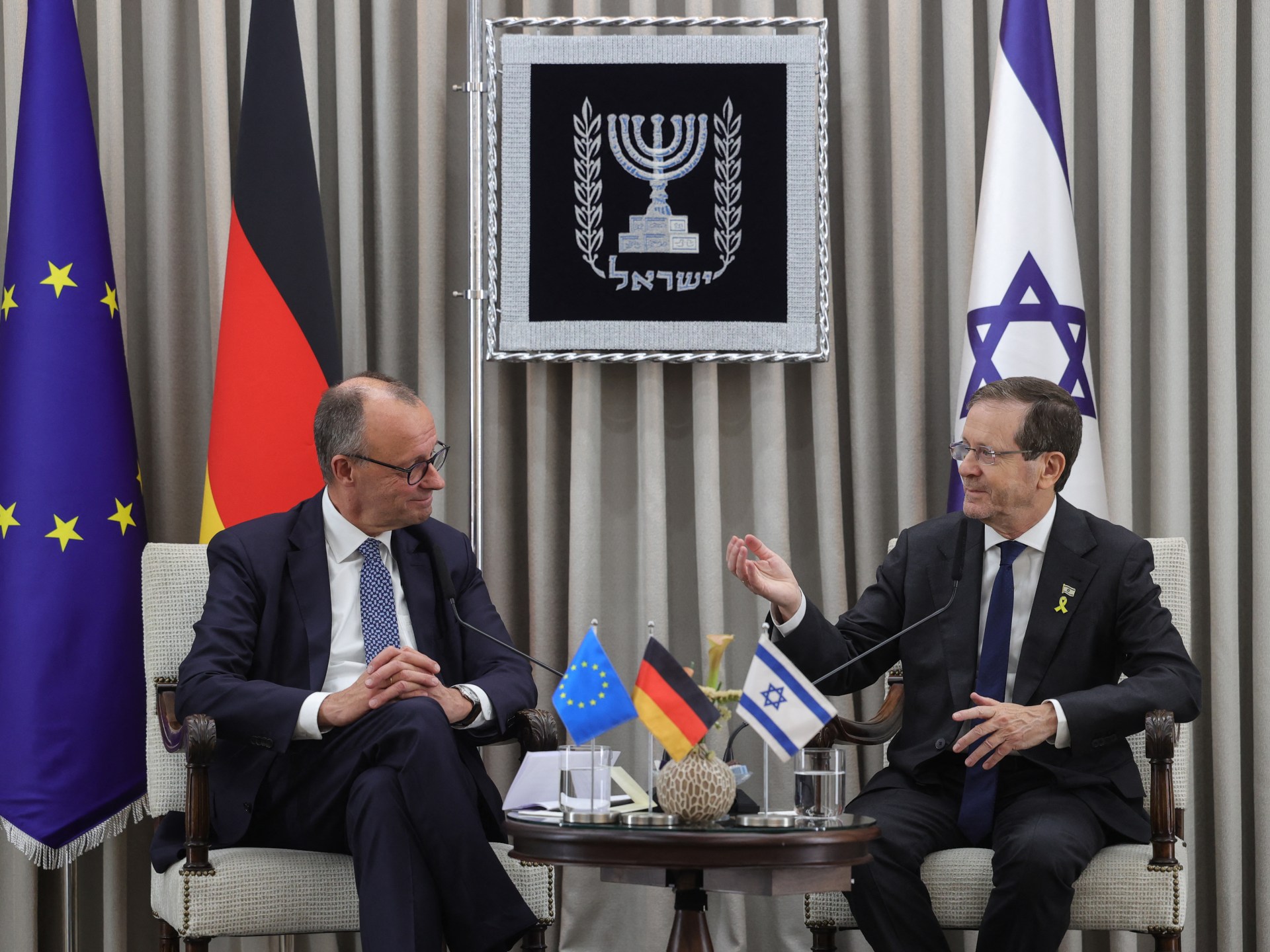
The two countries’ traditionally strong ties have been tested amid Israel’s genocidal war on the people of Gaza.
German Chancellor Friedrich Merz has arrived in Israel for his first visit since taking office in May, aiming to reaffirm the traditionally strong ties between the two countries, which have been shaken over the course of Israel’s more than two-year genocidal war on Palestinians in Gaza.
After a brief stop in Jordan, Merz landed just before 8pm local time (18:00 GMT) on Saturday at Tel Aviv’s Ben Gurion airport, where he was met by Israeli Foreign Minister Gideon Saar, who called him “a friend of Israel” and said Germany was “an important partner”.
Recommended Stories
list of 3 itemsend of list
Merz also met Israeli President Isaac Herzog in Jerusalem later on Saturday.
The German chancellor earlier held talks with Jordan’s King Abdullah II and told reporters they had mostly discussed Israel’s genocidal war on Gaza.
Merz urged more humanitarian aid to flow into Gaza and for Hamas fighters to lay down their weapons. He said Jordan and Germany both remain committed to a negotiated two-state solution.
In Jerusalem on Sunday, Merz is scheduled to visit the Yad Vashem Holocaust memorial before meeting Prime Minister Benjamin Netanyahu.
Given the dark legacy of Nazi Germany’s industrial-scale murder of Jews, German leaders have long seen unflinching support for Israel as a bedrock of the country’s foreign policy.
But Israeli-German ties have become increasingly shaky since October 2023.
Merz has repeatedly criticised Israel’s relentless military campaign, which has killed more than 70,000 Palestinians.
In August, he also moved to restrict sales of weapons for use in Gaza.
Advertisement
Since the United States-backed ceasefire came into effect in October – which Israel has violated on a near-daily basis – Germany has lifted those export restrictions.
Despite the ceasefire, more than 350 Palestinians have been killed in Gaza, according to local health authorities, as well as three Israeli soldiers.
The United Nations also warns that Israel is still not allowing enough aid into Gaza.
Before leaving Berlin on Saturday, Merz spoke with Palestinian Authority (PA) President Mahmoud Abbas.
A spokesperson said Merz underscored German support for a two-state solution, but urged Abbas to push through “urgently necessary reforms” of the PA in order to play a “constructive role” in the post-war order.
Gil Shohat, head of the Tel Aviv office of the Rosa Luxemburg Foundation, which is affiliated with Germany’s far-left Die Linke party, sharply criticised Merz for the trip.
“Netanyahu is a wanted war criminal and is under suspicion of corruption,” Shohat was quoted as saying by the AFP news agency. “Going there now and legitimising him is a fatal sign of normalisation in a situation that must not be normalised.”
Despite the close ties between the countries, German officials have said there are currently no plans to invite Netanyahu, who faces an international arrest warrant for war crimes in Gaza from the International Criminal Court (ICC), to Berlin.
Merz this year pledged to invite the Israeli leader and told him he would not be arrested.
Any tensions have also not disrupted key military ties. Germany last week put into operation the first phase of the Israeli-made Arrow missile defence shield.
The $4.5bn deal was reportedly the largest arms export agreement in Israeli history, and Berlin has also turned to Israeli firms for help in drone defence.
Disclaimer : This story is auto aggregated by a computer programme and has not been created or edited by DOWNTHENEWS. Publisher: aljazeera.com





