
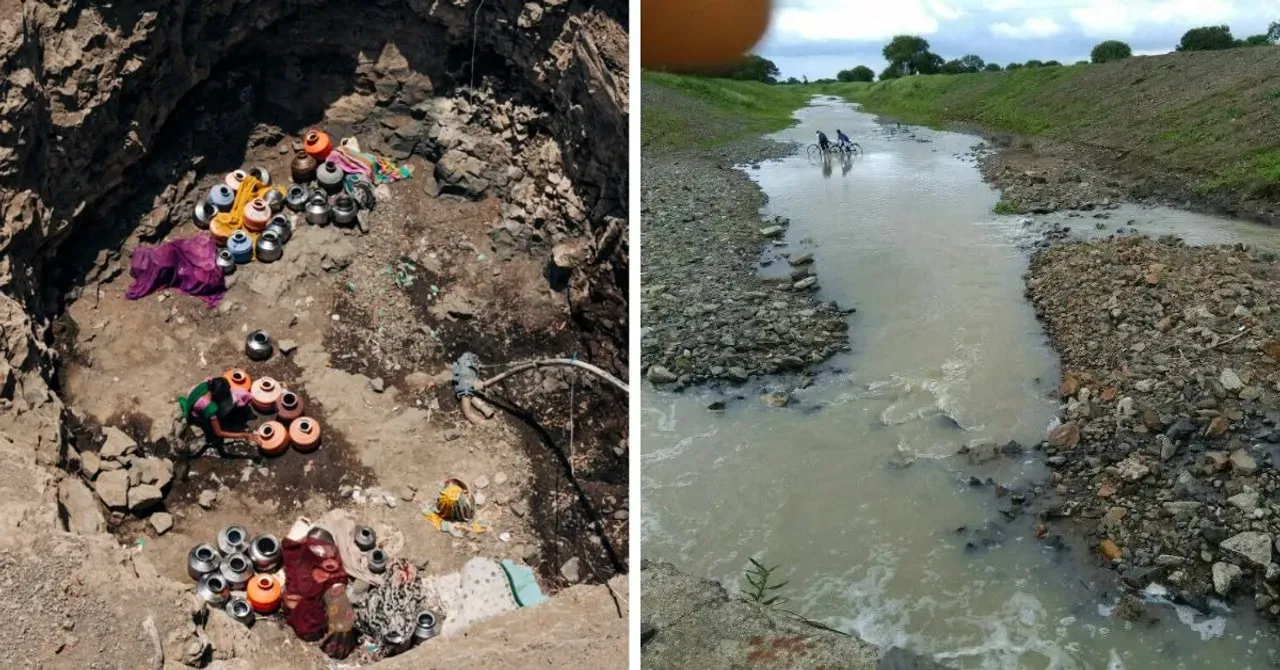
Water has a way of revealing what a place is living through. You see it in dry wells, delayed crops, shrinking ponds, and in the long detours people begin to take just to get through an ordinary day. But you also see it in the people who decide that waiting for things to improve is no longer enough.
This week’s edition brings together stories that remind us how water can return when people decide it must.
After Years of Fighting Over Tankers, Marathwada Villagers Came Together to End Its Water Crisis
In Bansawargaon, summer once meant waiting for tankers and bracing for conflict. Water scarcity had reached a point where daily life revolved around shortage. Then the village began treating water as the first problem it had to solve. Canals were widened, bunds repaired, recharge work taken up, and water use tracked more carefully. Over time, the village became tanker-free, groundwater levels improved, and farming revived.
Read how Bansawargaon rebuilt its future, one careful water decision at a time.
‘The Solution Was Simple’: How an IAS Officer’s Idea Revived Varanasi’s Water Table
When IAS officer Himanshu Nagpal looked at Varanasi’s falling groundwater levels, he saw a simple gap: water was being extracted, but not returned. His response was to turn public buildings into recharge points through rooftop rainwater harvesting. Schools, hospitals, colleges, and offices became part of a larger effort to restore water security. Today, around 1,000 public buildings in the district have these systems, and revival work has also helped improve groundwater levels in places like Pindra block.
Read how a simple, scalable idea helped a city think differently about water.
This Couple & 400 Villagers Revived 11 Dead Water Bodies in Drought-Prone Anantapur
In one of Andhra Pradesh’s driest regions, IFS officer Vineet Kumar and conservationist Rupak Yadav worked with more than 400 villagers to revive and create 11 water bodies. Through the Ananta Neru Sanrakshanam project, neglected land and old dumpsites were slowly transformed into spaces that could hold water again. The work addressed siltation, poor soil, and long-term ecological damage, while also creating more support for local livelihoods and biodiversity.
Read how this community effort helped bring water back to one of India’s driest regions.
IAS Officer Turns Farmer, Shows How to Grow Paddy Using Just 25% Water
Punjab’s groundwater crisis has made one question harder to ignore: can farmers keep growing paddy the same way and still protect what lies underground? Retired IAS officer Kahan Singh Pannu believes the answer lies in changing the method. Through Seeding of Rice on Beds, he has shown that paddy can be grown using just 25 percent of the water usually required. That matters in a state where irrigation places enormous pressure on groundwater.
Disclaimer : This story is auto aggregated by a computer programme and has not been created or edited by DOWNTHENEWS. Publisher: thebetterindia.com






