Gun controls first proposed three decades ago will take several months to introduce, says Home Affairs Minister Tony Burke, as his promised national firearm crackdown faces a political test from Coalition MPs who declared the reforms a distraction from the government’s failings on antisemitism.
Experts warned this year that the rising numbers of guns would lead to tragedy, and called for tighter controls to reduce the 4 million legally owned firearms in the community.
A National Firearms Register was first proposed in 1996, following the Port Arthur massacre in which 35 people were killed, but the states only agreed to create one in 2023. After the Bondi terror attack, the nationwide record of all firearms will now be fast-tracked, as Burke said it “beggars belief” that someone living in suburban Sydney required six guns.
Now questions are being asked about why governments have not made faster progress over the past three decades to modernise clunky state-based regimes, where paper and pen registers or inaccessible records can prevent effective information sharing between intelligence agencies and police forces.
The National Firearms Register was slated to be operational in 2028, and Burke conceded on Tuesday the federal element of it would take until the second half of 2026 to complete.
National cabinet also agreed to examine sweeping changes to existing laws, including limiting the number of guns an individual is permitted to own, restricting the types of guns deemed legal, and making Australian citizenship a prerequisite for gun licences.
The federal opposition was sceptical of the proposed gun reforms and attacked Prime Minister Anthony Albanese over his response to recent antisemitic incidents.
Nationals leader David Littleproud said gun law reform was a “distraction” from the government’s failure to tackle the rise in antisemitism.
“The existing gun laws work – it is how they are used … This isn’t a gun problem, it’s an ideology problem,” Littleproud told this masthead.
Former Liberal prime minister John Howard, who led the 1996 gun reforms, dismissed the government’s push to reform gun laws following the Bondi terror attack as a “big attempt at a diversion” and blasted the government for failing to combat antisemitism, But he refused to say if he thought the laws needed to be reformed further.
Nationals Senate leader Bridget McKenzie said the Port Arthur massacre was not the same as the Bondi tragedy and criticised the prime minister’s “abject” failure on curbing antisemitism.
“The shocking crime at Bondi was not Port Arthur, which was the action of a madman that brought around our national firearm agreement,” McKenzie said.
Opposition home affairs spokesperson Jonno Duniam said the opposition would “see the detail” of proposed gun controls before it took a position.
However, Burke said on Tuesday that better collaboration between police forces and intelligence agencies to monitor gun licensing was a crucial element of a raft of reforms agreed by national cabinet following the Bondi attack.
All states and territories signed in 1996 the National Firearms Agreement, to institute nationwide regulations including a 28-day waiting period for licences, uniform testing of guns and safety training.
An Australia Institute report card on gun control released in January this year found every jurisdiction failed to meet the minimum standards set by the agreement and said regulations have been applied unevenly across the country.
Tim Quinn, president of Gun Control Australia, said at the time that Australia’s gun laws were not keeping pace and “putting our community at risk”.
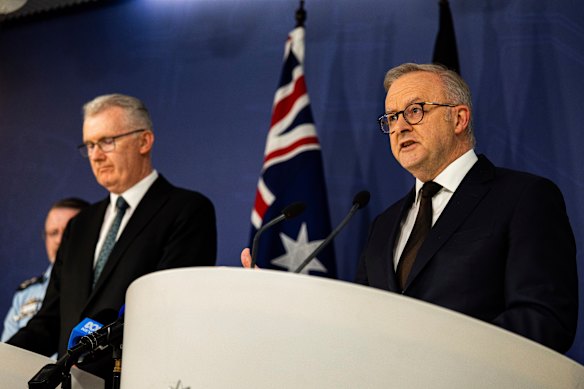
Home Affairs Minister Tony Burke and Prime Minister Anthony Albanese on Monday.Credit: Ben Symons
The report said Western Australia is the only state that puts a cap on the number of guns a person can own, and two people in inner Sydney legally owned more than 300 guns each.
NSW had the most guns, with 1,125,553 registered firearms, and a third of those were registered to someone living in a major city. It is the only state that reports the geographic breakdown of firearms data, so people can see how many guns are in their neighbourhood.
Tasmania and the Northern Territory had the highest per capita rate, with one firearm for every four people.
No states prohibit the use of firearms for under-18s, and only Tasmania and NSW have made blueprints for 3D-printed guns illegal.
Australia Institute research director Rod Campbell said governments and communities had become complacent about the proliferation of legal firearms since Port Arthur.
“This is not a country that’s serious about limiting gun violence when we don’t even share the data,” Campbell said.
“I think we started to believe the hype that Australia’s gun laws were world-leading, without realising that gun numbers were on the increase.”
National cabinet on Monday agreed to work on creating better links between firearms licensing and criminal intelligence.
“There’s certainly issues in terms of connecting intelligence that we might have to gun licenses … not only going to the individual, potentially going to other family members, and those issues using criminal intelligence to underpin the licensing of firearms is one of the things that national cabinet agreed to work on yesterday,” Burke told ABC Radio National.
NSW Premier Chris Minns said on Tuesday he is seeking a change to state laws to make them the strongest in the country.
“One aspect of gun law reform that is essential in NSW, and it will be controversial, is for police to use criminal intelligence, not just a criminal record, in determining whether someone should keep a gun licence.”
NSW Police Commissioner Mal Lanyon said on Tuesday that Bondi shooter Sajid Akram’s licence was approved in 2023, not 2015 as police had said earlier. Akram held an A and B licence, which applies to firearms such as air rifles and shotguns.
The Greens support the proposed reforms, but have called for additional measures including a national buy-back scheme for high-powered guns and the removal of recreational hunting as a reason for holding a firearm licence.
The Shooting Industry Foundation of Australia said the government’s focus on gun law reform was creating a politically “convenient scapegoat” that did not address “complex and uncomfortable societal challenges” at the heart of Sunday’s attack.
More coverage on the Bondi terror attack
Our Breaking News Alert will notify you of significant breaking news when it happens. Get it here.
Most Viewed in Politics
Disclaimer : This story is auto aggregated by a computer programme and has not been created or edited by DOWNTHENEWS. Publisher: www.smh.com.au