When more than 300 victims and families of the October 2023 Hamas attack filed a federal lawsuit against Binance, the world’s largest crypto exchange at its peak, and its founder Changpeng “CZ”

Updated: December 19, 2025 3:46 PM IST
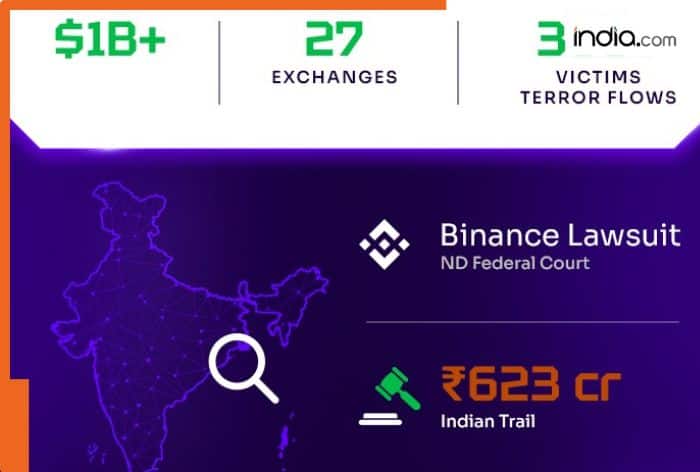
When more than 300 victims and families of the October 2023 Hamas attack filed a federal lawsuit against Binance, the world’s largest crypto exchange at its peak, and its founder Changpeng “CZ” Zhao, they accomplished something regulators have struggled to do for years. They transformed the citizens into global enforcers of financial accountability. The lawsuit alleges more than one billion dollars in terror-linked flows, and it highlights that some of this activity continued even after Binance’s high-profile settlement with the United States Department of Justice, a case in which the exchange admitted to failures in anti-money-laundering and sanctions compliance. If the court accepts this framing, the role of an exchange will fundamentally change. It will no longer be viewed as a neutral platform. It will be treated as a liable financial intermediary.
This moment forces the crypto and digital assets industry to confront an uncomfortable truth. The problem is no longer limited to bad actors. The problem now lies in the architecture of the systems that allow anonymity to scale faster than accountability. The world requires a new category of infrastructure that prevents such failures at the protocol level.
This is where the idea of permissioned rails becomes relevant. Permissioned rails are blockchains or networks where participants are known, activity is auditable and rules can be enforced at the protocol level. Once this foundation is clear, the role of solutions such as Kalp and Kwala becomes easier to understand. They show how identity, auditability and automated enforcement can become natural parts of the ecosystem instead of optional add-ons.
A Lawsuit That Reaches Far Beyond Binance

The 284-page filing submitted in North Dakota federal court is one of the most detailed public mappings of alleged terror financing through a major cryptocurrency exchange. The plaintiffs claim Binance enabled flows involving Hamas, Hezbollah, PIJ and Iran’s IRGC, along with transactions tied to Venezuelan gold smuggling and Gaza-based money exchangers. They also argue that some of this activity continued even after Binance announced compliance reforms following its settlement with the United States Department of Justice, a settlement that required the exchange to correct past failures in anti-money-laundering controls.
The legal significance is substantial. The case invokes the Anti-Terrorism Act and the Justice Against Sponsors of Terrorism Act, statutes usually applied to banks and state actors. If the court accepts that a cryptocurrency exchange can “knowingly” support illicit activity through insufficient controls, then the crypto and digital-asset industry enters a new phase. Aggrieved citizens could pursue civil claims directly, and ignorance would no longer serve as a defense.
The Architectural Weakness That Creates Systemic Exposure
This lawsuit comes at a time when the limits of permissionless crypto systems are becoming harder to ignore. These open networks, such as Bitcoin and Ethereum, allow anyone to transact without identity checks. Wallets are the basic tools people use to store assets and send funds, but they do not contain any identity layer. As a result, users can create many wallets without revealing who they are and move money through long chains of transfers that quickly break the transaction trail.
The problem is global. India recently reported that roughly six hundred and twenty-three crore rupees were laundered across twenty-seven exchanges, according to investigations published by The Indian Express and the Financial Express. The pattern was the same. There was no reliable screening before transactions, no automated detection of multi-step movements and no clear point where accountability began or ended.
As Tapan Sangal, Chief Visionary of Kwala, explains, “You cannot run a national scale financial system on rails that were designed without accountability in mind. The architecture itself must enforce responsible behavior.”
Building the Infrastructure That Can Withstand This New Era
If the industry is to avoid repeating these failures, compliance must shift from human effort to built-in logic. The future depends on systems that enforce rules before a transaction is completed rather than waiting for teams to intervene afterward. Several companies are now exploring this direction by building networks where identity, auditability and enforcement are part of the protocol itself.
As Mrityunjay Prajapati, Chief Technical Officer at Kalp, explains, “Permissioned systems allow us to link participants to verified identities and create environments where transactions can be audited without relying on manual oversight.”
Kwala approaches the same problem from the compliance side. Its programmable layer is designed to screen wallets, detect multi-step movements and identify sanctioned participants before funds move. According to Tapan Sangal, Chief Visionary at Kwala, “We have moved past the era in which teams enforce rules manually. The rails themselves now need to enforce them.”
The Binance lawsuit signals a turning point: showing that in crypto, accountability can now come from the courts as much as regulators.
By Kwala
Also Read:
Disclaimer : This story is auto aggregated by a computer programme and has not been created or edited by DOWNTHENEWS. Publisher: india.com