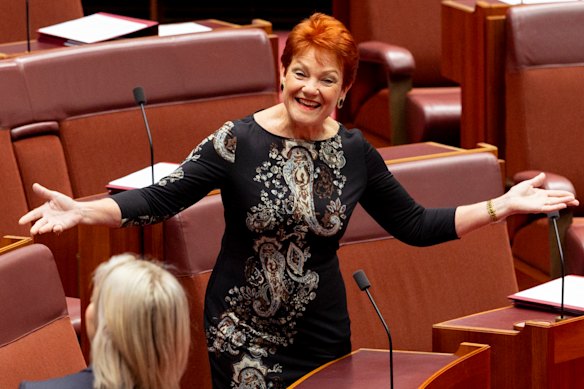

Pauline Hanson has set a trap, and the Coalition are falling for it.
She is drawing more support than ever in her decades in public life. But this past week is an example of why she remains a fringe player, and why a Coalition wanting to form government should be wary of following her lead.
Last week, Hanson said the quiet bit out loud and, from all indications, it was quite deliberate: “I’m sorry, how can you tell me there are good Muslims?” she asked during an appearance on Sky News After Dark.
The firestorm of criticism in response came from all sides. It was correct, entirely predictable and, arguably, gave Hanson exactly what she wanted: more attention in an age where outrage and algorithms dominate politics.
For 30 years, Hanson has gone out of her way to divide Australians into two groups of people, broadly speaking: “real” Aussies (usually those who agree with her) and people who aren’t and who fail her arbitrary test in some way.
Her targets have changed. When she started out in politics, it was Asian-Australians and Indigenous Australians. More recently, and especially since returning to the Senate in 2016, Hanson has had it in for Muslim Australians. She has fallen foul of the law for some of her remarks.
She lost a defamation case to Greens senator Mehreen Faruqi for racially charged tweets in 2022, while the federal police say they are looking to see if Hanson broke any laws with her comments last week.
Yet Hanson’s party is polling like never before. The latest Resolve Political Monitor showed One Nation’s primary vote, 23 percentage points, as equal to the Coalition’s. In other polls, it has moved ahead of the opposition.
What is not clear is when or if One Nation has peaked, or why Hanson chose to go lower than she arguably ever has before with her “good Muslims” comment?
Has the One Nation leader judged that politics is now so fractious that, like Donald Trump, Nigel Farage, Giorgia Meloni and their respective movements, the time is ripe for a genuine re-shaping of the conservative political landscape in Australia? And that the more extreme her comments, the more she wins over new supporters?
Is she spooked because in Angus Taylor, the Coalition now has a more conservative leader who could appeal to and even win back former Liberals who have defected to One Nation?
Or did she just over-egg her comments and, rather than walking them back, the 73-year-old decided to dig her heels in?
In a perceptive essay, Liberal Foundations, by former MP Keith Wolahan, the former member for the Melbourne seat of Menzies examines in detail the demographic and educational shifts that are re-shaping Australian politics and society.
Wolahan points out that in 1996, 23 per cent of Australians were born overseas compared to 32 per cent today. For those with at least one parent born overseas, the number jumps to more than 50 per cent of Australians.
“Of the top 50 seats by any migrant background, the [Liberal] party now holds only two,” Wolahan writes, while noting that One Nation’s primary vote in Australia’s major cities is not as strong as in the regions – and that no matter how well One Nation is polling, it would struggle to win any seat in which Labor is competitive, meaning almost every metropolitan electorate.
“We must clearly distinguish ourselves on migration from One Nation on both policy and tone,” Wolahan writes.
He is correct. The path back to government for Taylor and his team runs not through the regions and outer suburbs – Peter Dutton tried that in 2025, and it was an abysmal failure – but rather through Australia’s major cities.
Hanson was correct when she recently said no party could ever be tougher than One Nation when it came to immigration. She, unlike leader in waiting Barnaby Joyce, doesn’t care which communities she offends or how insulting and wrong her rhetoric might be in her unseemly race to win as many votes as possible.
But in a nation of migrants, many of them recent, there is a hard ceiling that will limit Hanson’s rise in the polls, especially in the cities. Preferential voting in the lower house also means the party is unlikely to win more than a handful of seats (no wonder she has spoken against that, too). One Nation’s presence as a protest party in the Senate, much like the Greens, looks far more assured.
For Taylor and his team, the path back to political relevance is much more complex. Yes, they have to win back voters on the right who have drifted to One Nation. But that will only go so far.
For the Coalition to have any chance of forming government again, it also has to speak convincingly to the millions of people living in Australia’s cities who are worried about being able to buy a house or pay their rent, enrol their kids in weekend sport or whether Friday night takeaway is too expensive for a stretched family budget.
Treating a government that holds 94 seats as somehow illegitimate, fighting One Nation for a diminishing share of the conservative vote and offering middle Australia little in the way of credible alternative policies is a recipe for disaster – as Dutton found to his cost.
Cut through the noise of federal politics with news, views and expert analysis. Subscribers can sign up to our weekly Inside Politics newsletter.
 James Massola is chief political commentator. He was previously national affairs editor and South-East Asia correspondent. He has won Quill and Kennedy awards and been a Walkley finalist. Connect securely on Signal @jamesmassola.01Connect via X or email.
From our partners
Disclaimer : This story is auto aggregated by a computer programme and has not been created or edited by DOWNTHENEWS. Publisher: www.smh.com.au