The romantic life of turtles has become an unexpected passion for Hayley Shute, chief conservation officer of Aussie Ark. In 2019, the environmental charity on the Central Coast took in 12 endangered Manning river turtles at risk from the ongoing drought and bushfires. It was Shute’s job to convince the reptiles to breed.
“I had to become a turtle,” Shute said. “We had to just live and breathe turtles and figure them out. It was so rewarding when we started seeing courtship behaviour.”
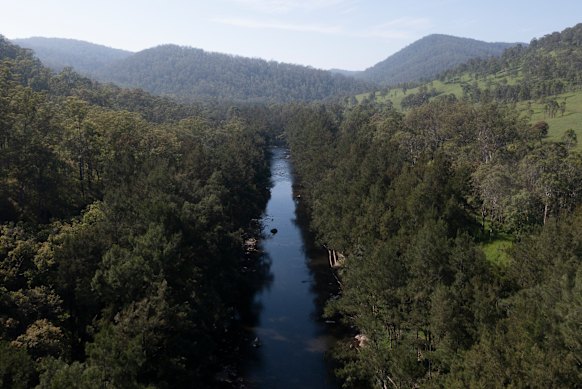
A week ago, Aussie Ark released eight sub-adult turtles hatched in 2020, and 13 juveniles hatched in 2024 and 2025, into a pristine waterhole in the Barrington River, a tributary of the Manning.
On Wednesday, a further 14 tiny turtles will be released as well.
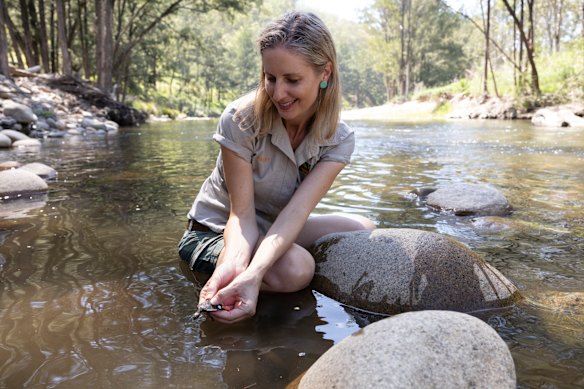
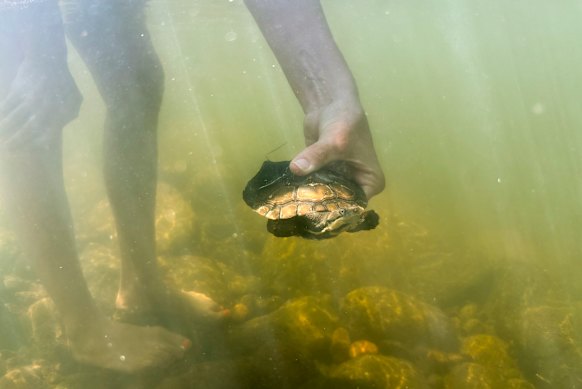
Ricky Spencer, adjunct professor at Western Sydney University, said this was the first time that Manning River turtles had been bred in captivity, and the release would boost the species’ chances of survival.
“If you save one turtle, you’re not only picking up her, you’re actually picking up maybe 2000 of her babies because they live 100 years and produce 20 eggs per year,” Spencer said. “Saving one turtle has a massive impact on the population.”
The release of the young turtles is “bittersweet” for Shute and her team, but it is a huge achievement and the culmination of years of work.
Of the original 12 turtles, one female arrived already pregnant and later laid a clutch of eggs, which hatched in 2020. It took another two years before the turtles started breeding in captivity.
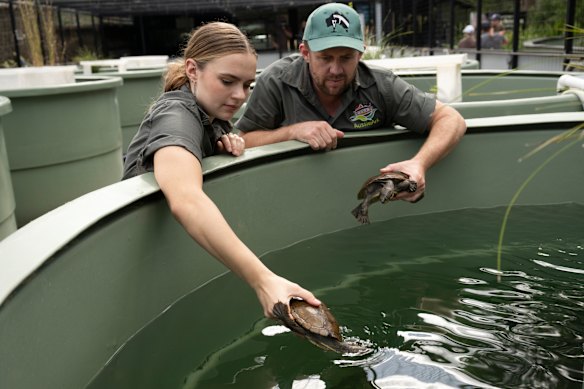
Shute said they had to figure out what the turtles liked to eat, whether the males and females should be separated or together, and when they should be brought together for possible breeding. They eventually realised the turtles should be kept apart for winter and they could introduce the females to the males after emulating spring rains.
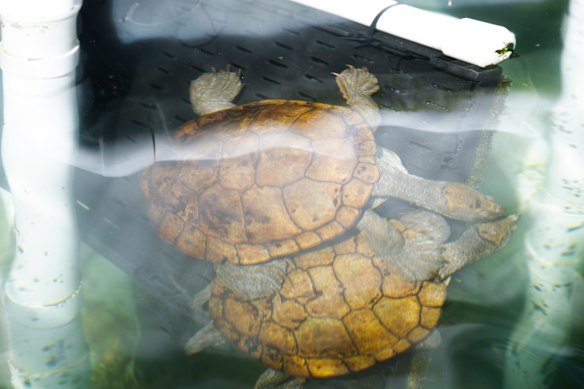
“We started seeing the female sort of swimming past the male, almost seductively, and the male started to follow her around and his head would be right behind hers,” Shute said.
“They started doing this beautiful nosing behaviour – they literally just put their noses together and just sit there for hours and hours. And then the male would start to put his little flippers up to her face and fan her face.
“I just fell in love with that species so much watching that courtship behaviour. Then from there, we saw breeding, which was an incredible feeling.”
Get to the heart of what’s happening with climate change and the environment. Sign up for our fortnightly Environment newsletter.
Manning River turtles are a freshwater species found only in the upper and middle reaches of the Manning River catchment, from the Great Dividing Range to the Mid North Coast of NSW.
Like all freshwater turtle species, they help keep rivers clean by scavenging and eating aquatic plants, but threats include urbanisation and feral animals such as foxes, cats and pigs.
Foxes are the biggest problem, Spencer said, because they destroy 95 per cent of wild turtle nests, and eat eggs, hatchlings and even adult females as they try to lay.
Spencer is also head of community conservation citizen science program 1 Million Turtles, which has the TurtleSAT app for citizen scientists to record turtle and nest sightings, and is pushing landowners to build “biodiversity islands” in dams for turtles and birds.
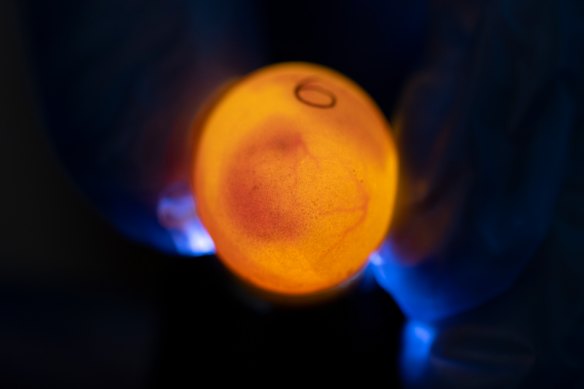
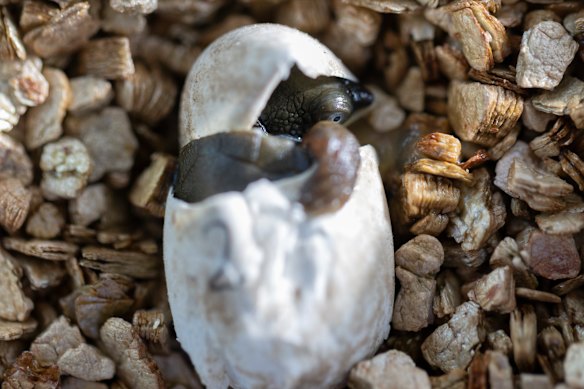
By incubating the eggs and releasing live young, Aussie Ark is removing the alien threat of feral predators and greatly increasing the young turtles’ chances of survival.
“Once they’re in the river, they’re relatively safe,” Shute said. “A kookaburra might take one, or a water dragon might take one, but the foxes and cats, they just eat everything or kill everything, so it’s not a natural cycle whatsoever.”
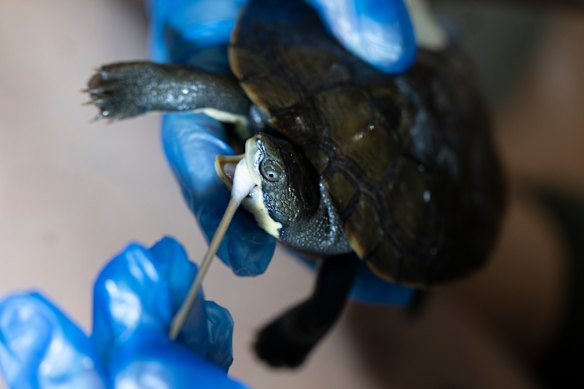
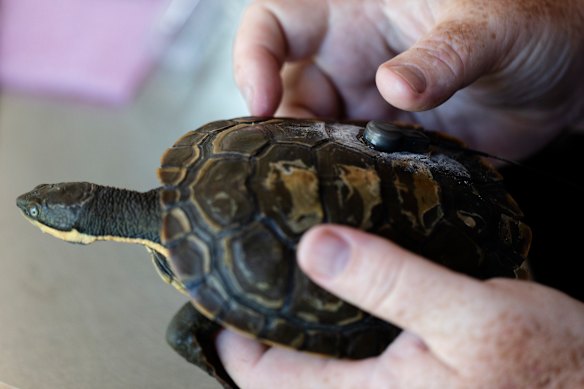
The eight sub-adults were released with VHF transmitters attached, allowing Aussie Ark and Spencer’s PhD student Pham Van Thong to track their movements for two years and measure survival rates. (So far, some are hanging out around the release site, and others have gone a kilometre downstream).
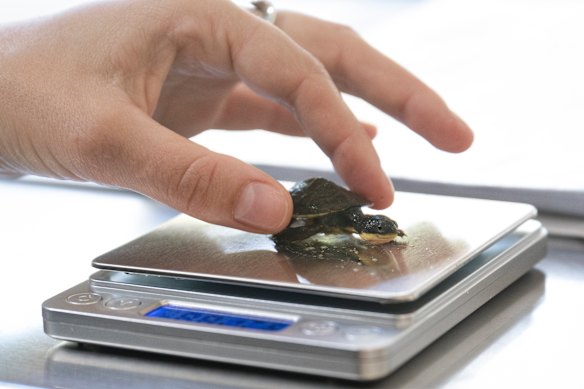
Ten of the 14 smaller turtles to be released on Wednesday will also have tiny transmitters. Tracking turtles of different ages will provide insight into the optimal timing for a wild release, Shute said.
Aussie Ark will retain the original dozen turtles as an “insurance population” and for further breeding.
Andrew Steed, the species coordinator for the Manning River turtle under the NSW government’s Saving our Species program, said this was an important safeguard given a virus wiped out 90 per cent of the wild population of the closely related Bellinger River turtle in just six weeks in 2015.
“Without this sort of program, species such as the Manning River turtle can slowly head to decline because the adults are so long-lived, you don’t notice that the population is missing its very young cohort of turtles,” Steed said.
Disclaimer : This story is auto aggregated by a computer programme and has not been created or edited by DOWNTHENEWS. Publisher: www.smh.com.au