
Conversations on storytelling, legacy, and the perspective that changes everything.
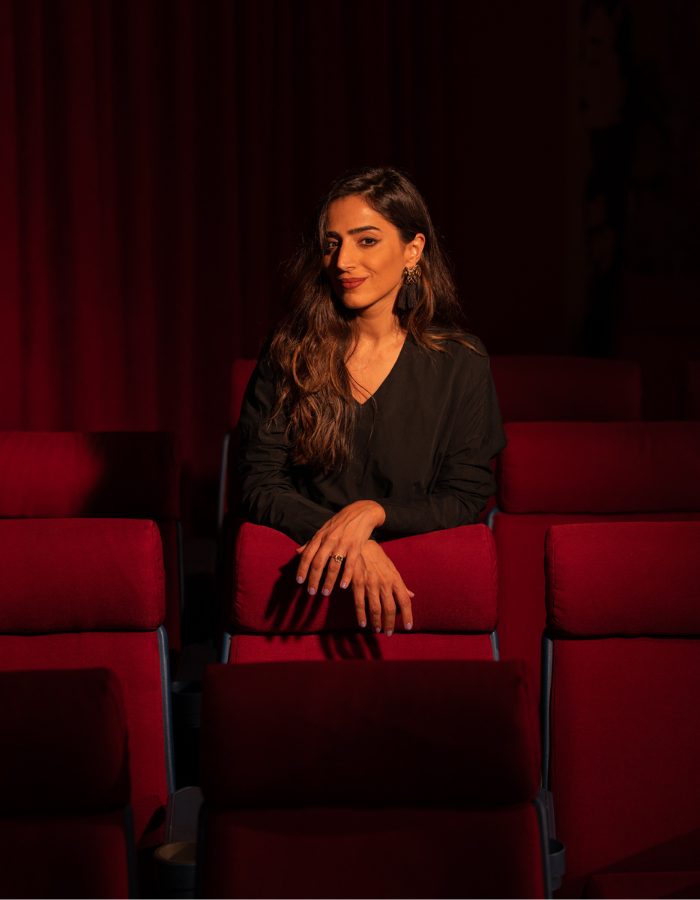
A note from Butheina Kazim, Founder of Cinema Akil
One of my favourite lines in literature is Joan Didion’s opening to The White Album: “We tell ourselves stories in order to live.” I return to it often, not out of reverence, but because it seems to come haunting me through life’s unfolding chapters… the noisy ones, the cosy ones and the abrupt. As the founder of an arthouse cinema, I have always lived under the auspices of the female gaze, walk into our space in Alserkal and Sofiko Chiaureli’s gaze from The Color of Pomegranates meets you in the foyer in protection. This worldview is rooted in my work at Cinema Akil, where programming has always been an exercise in attention, to the crevices and to meeting points… in order to live. For this series of conversations for Emirates Woman in its keen focus on the female gaze, I was less interested in interviews than in encounters, sisterhoods in stories that ebb and flow without hierarchy or performance. Not subject and moderator, but two women meeting through their storytelling. These conversations themselves emerged in the wake of a Ramadan program I curated recently in a garden majlis at dusk, gathering four films by women.
While Suzannah Mirghani, whose work loves the space between history and poetics, met Laila Binbrek, director of the UAE Pavilion at the Venice Biennale in an encounter that lingered in the tension between institution and the fragile, persistent act of storytelling. The women brought together in this series are – each in her own way – storytellers. They take different forms and might have different vocabularies, but they share a persistent instinct… to shape meaning… in order to live.
Suzannah Mirghani is a Sudanese- Russian filmmaker and academic whose work explores the intersection of history, industry, and women’s lives. Her film Cotton Queen tells the story of three generations of women in a cotton farming village. She is joined by Laila Binbrek, Director of the National Pavilion UAE at the Venice Biennale, who has spent her career platforming art and stories from the region.
Aminath Ifasa moderates.
Suzannah Mirghani: Cotton Queen is the story of a family in a cotton farming village in Sudan, told through the eyes of a young teenage girl. It’s about her relationships with the other women in her family. Three generations of women. At the centre of it all is cotton. What it means to industry, and what it means to the people who nurture it, who grow it, who wear it. The women have a much stronger, more intimate relationship to cotton than any male industry could imagine.
Laila Binbrek: Having seen the film, it is so rich in the layers of storytelling. We both try to tell untold stories. Why was it important to use that particular viewpoint – the grandmother and the daughter – to tell this story?
Mirghani: It was important to tell women’s stories from Sudan. We don’t really have a film industry in Sudan. In terms of fiction, there is not enough representation of women on screen. When I was talking about the cotton industry, the colonial industry, I needed the historical perspective. And you cannot get that without an older generation.

Binbrek: There are references to colonialism, but they are subtle. How do you balance those layers without letting them take over the gentleness of the story?
Mirghani: I cannot tell the story of cotton without telling the story of colonialism. All the markers are there. The colonial mansion, deteriorated but there. A reminder of the past. I also touch on circumcision. These issues cannot be divorced from a young girl’s life in that environment. You see a colonial house every day. You have business interests coming in from abroad. The film takes you through a girl’s life and everything she has to experience.
Binbrek: What do you see as filmmaking as a form of research in itself?
Mirghani: My own discoveries about the cotton queen are now communicated through the film. People didn’t know there was such a thing. Young girls exploited not only in their work, but then in their bodies and beauty by a patriarchal industry. I took that title and took it away from being about beauty and exploitation to being about a young girl’s power. To be a queen in the real sense.

Binbrek: Do you feel that the way you conduct your academic research influences the way you construct the narrative on screen? Mirghani: I have two things I do. One is to have a solid foundation. That is the research part. And then to layer on top a kind of poetic imagination, a reimagination of that historical story. I left Sudan when I was a young girl. I have a childlike view of my country, tinged with the mystical, the folk tales. I take a very solid historical foundation and dress it up poetically.
Binbrek: As a filmmaker representing your own culture, do you feel a responsibility to ensure things aren’t misunderstood or sensationalised?
Mirghani: These kinds of questions happen after the film is made. When I write the script, I am alone. The writing process is personal, quiet, lonely. You don’t have an audience in mind. Your first audience is your character. So, you write for them. Only after the film is viewed and debated do these questions come. Now, I think, “I am responsible for a story from Sudan.” But I wasn’t thinking that in my room alone.

Binbrek: How long was this process? Mirghani: Five years from start to finish. I made a short proof of concept three years before that. You could say I was living in a Sudanese cotton farming village for eight years. That’s where my head has been. Aminath Ifasa: For someone to be from that community, having biological roots, I think it affects the way a story is told. How important is it that this story was told by a Sudanese woman?
Mirghani: I can only speak for myself. You can do as much research as you want, but to not have experienced Sudan, to have experienced cotton fields, to have experienced these communities – my extended family have cotton fields, we would visit them. My story isn’t a technical story. It’s about the community. In terms of the female gaze, I concentrate on women. I get asked, “Tell me about the Sudanese woman,” and I push back. There is no such thing. We have many different types, many social classes. It was determined in my film to represent very different perspectives of three generations.
Binbrek: Women in general have more sensitivity and empathy to extract stories from those who might not think their story is important. How did you build trust with the actors and the communities?

Mirghani: It’s a long process. I was working with the same actors from my short. A simple way to build trust was to hold the table reads in their houses. We would sit in their living room, they would make tea. It became a social occasion. They got so happy when I suggested it. It was less scary for everyone. They gained a bit of ownership of their role. Binbrek: And then you had to move the entire production to Egypt because of the war.
Mirghani: The actors were displaced. Living in fear. The film became a rallying point. A reason to come together, to rebuild the community we had in Sudan, but now in Egypt. The film gave everyone a purpose. Something to work towards. We no longer have our homes. But there is something we can do together.
Binbrek: I think the value of the female gaze is immense and should not be underestimated.
Mirghani: Hallelujah to that.
– For more on luxury lifestyle, news, fashion and beauty follow Emirates Woman on Facebook and Instagram
Images: Supplied
Disclaimer : This story is auto aggregated by a computer programme and has not been created or edited by DOWNTHENEWS. Publisher: emirateswoman.com








