
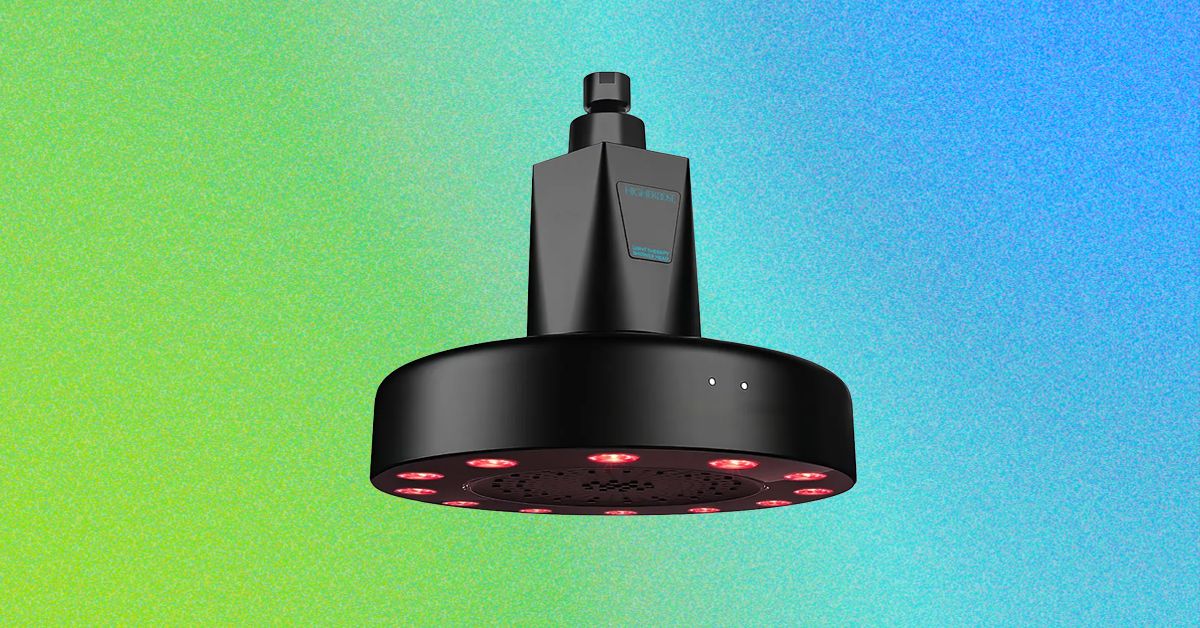
The ring of red LEDs is charged separately via USB-C (this takes an hour and a half to charge fully), and can then be pushed up onto the showerhead and rotated to lock in place. The water-resistant, covered charging port is positioned away from where the water flows. One full charge is good for a couple hours of showers, which for most people is at least a week’s worth.
The showerhead does have a power switch. But it’s best operated via its little shower-safe remote control, which is also charged by USB-C. Click the On button, and the remote will pair with the showerhead. The red light turns on for 5, 10, or 15 minutes. This works just fine, though it’d be nice if the buttons were more clearly marked than just with raised black text on a black button.
Finding the power button, which looks like the other buttons, requires trial and error. But once you’ve got the remote figured out, the red light does indeed offer relaxation and a little bit of drama to my morning shower.
Obviously, don’t stare directly into the red lights. HigherDose offers darkened shower goggles if you plan to face your showerhead. But I don’t typically confront hot jets of water face-to-face anyway. So in effect, this device is mostly raining light down on my scalp and neck.
Effective Filtration
As far as the water filter goes, I can vouch for the fact that HigherDose’s 10-stage filter is quite effective at reducing total chlorine in my water to undetectable levels, as measured by chemical tests I performed at home. Unlike most shower water filters I test, the filter removed all total chlorine levels down to undetectable levels in my chloramine-treated water system. Indeed, it’s actually one of the most effective filters I’ve tested for chlorine removal. The levels stayed undetectable for weeks.
The filter is fairly complex compared to many other shower filters. Most contain some combination of activated carbon, calcium sulfite, and KDF-55 filter media. HigherDose’s adds a layer of vitamin C, which has been demonstrated to reduce chlorine and other contaminants. There are also layers of vitamin E (vague wellness) and a layer of “far-infrared ceramic balls” whose claims to filtration seem more dubious. A stainless steel mesh layer traps some sediment.
Beyond chlorine reduction, HigherDose makes bold additional claims for its shower filter, namely that the filter removes the vast majority of volatile organic compounds, microplastics, mineral hardness, and heavy metals like lead and cadmium. Company reps cited independent third-party testing but did not answer questions about the identity of the lab or how many gallons of water were run through the shower filter to attain these results. In general, a reputable lab will test substance removal across thousands of gallons of water, not just right out of the box.
Either way, total dissolved solids in the water were only slightly reduced after passing through the HigherDose filter, decreasing from about 26 parts per million to 24 parts per million. This is a fairly normal result for shower filters, which rarely can remove large quantities of minerals from high volumes of water. It is not, however, easily reflective of HigherDose’s claims to remove the majority of minerals.
Disclaimer : This story is auto aggregated by a computer programme and has not been created or edited by DOWNTHENEWS. Publisher: wired.com







