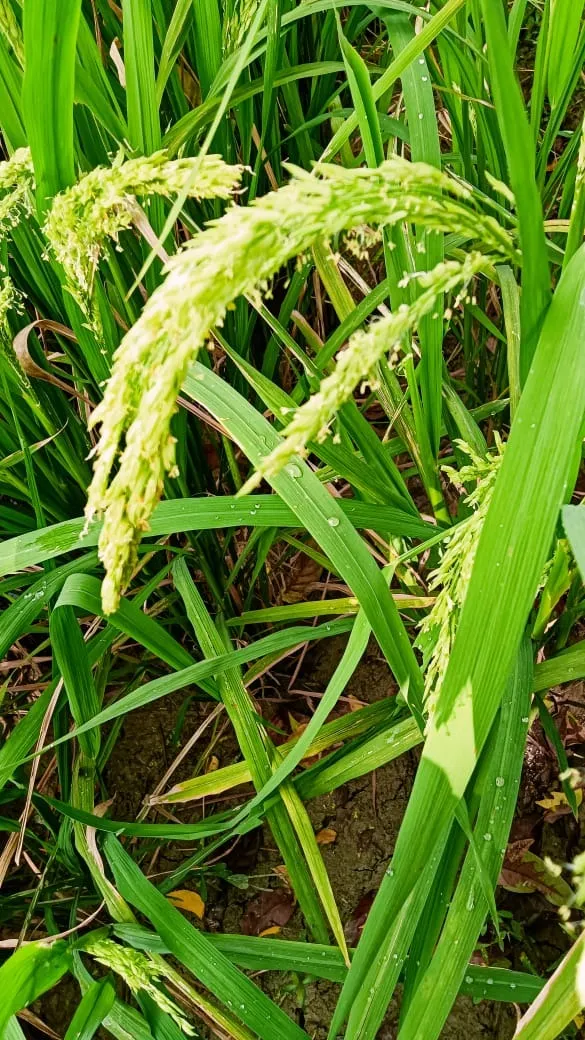
In the spring of 2012, in the West Bengal Sundarbans, Sudhanshu Dey bent down to the soil with a handful of indigenous rice seeds. The Sundarbans had already taught him and his community hard lessons. Every year, cyclones and tidal floods swept across their lands, leaving behind saltwater that poisoned the fields. For four or five years at a stretch, farmers would watch their fields lie barren, their labour unrewarded, their hopes drowned.
By 2014, government offices began distributing salt-tolerant rice seeds. They came free of cost, with promises of survival in saline soils. But when the harvests came, the truth was bitter. Yields were poor, the grain lacked taste, and the price in the market did not justify the farmer’s effort. Land lost its value, and families lost their faith.
They came free of cost, with promises of survival in saline soils.
Yet, in the corners of villages, farmers had preserved their own indigenous seed varieties, passed down through generations. When sown, these seeds stood tall against the salt. They yielded better, tasted richer, and carried the strength of their ancestors. For Sudhanshu, now 60, that was the turning point.
His experiment
Determined to test this himself, Sudhanshu filled large plastic pots with soil. He poured five litres of water and mixed in salt bought from the market. Into this, he planted ten local rice varieties. He watched closely to see how much salinity each could endure.
“It was a small experiment,” he recalls, “but it carried a big dream: to find which native varieties could secure our future.”
The seed bank
From this dream grew the Durbachati Folk Seed Bank in his village of Durbachati. Today, it holds 192 local rice varieties, including several from the state, proudly called “Banglar Dhan” or paddy of Bengal — a place where the Green Revolution nearly wiped out a 5,000-year rice heritage.
/filters:format(webp)/english-betterindia/media/media_files/2026/04/03/varieties-of-paddy-growing-on-the-fields-2026-04-03-15-56-12.jpeg)
Each variety is planted in neat plots of 10 feet by 10 feet, with 100 seedlings spaced carefully apart. From these beds, seeds are collected, preserved, and shared. Farmers take them, NGOs and government departments purchase them, and the cycle continues.
“When we hold these seeds in our hands, we feel we are holding our ancestors’ wisdom,” says farmer Barendra Nath Jana, who now cultivates Dudhersar on his saline plot in Gopal Nagar village.
Alor Barta– message towards light
Sudhanshu’s vision has grown into a collective movement called Alor Barta — “Message Towards Light.” Today, over 1,500 farmers across Kakdwip and Patharpratima nurture 26 indigenous rice varieties across nearly 6,000 bighas of land.
Each February, during the annual Krishi Mela, women showcase their culinary skills in a spirited contest. They present a wide range of rice-based dishes — from Basanti Pulao and Pakhala Bhat to Murki and Mutton Biryani.
/filters:format(webp)/english-betterindia/media/media_files/2026/04/03/rice-delivacies-2026-04-03-15-56-33.jpeg)
“We have already documented around 500 recipes, and the list keeps growing every year,” Sudhanshu notes with pride.
Every month, farmers gather to share stories — of floods survived, organic fertilisers prepared, and seeds saved. Since 2018, they have also held an annual organic farming fair, with a clear purpose:
-
To protect soil, water, and wildlife
-
To revive food culture
-
To strengthen the rural economy
“We no longer wait for government-supplied seeds,” says Saleya Bibi. “We save our own, we share our own. That is our strength.”
The varieties
Among the many traditional rice varieties, some stand out for their unique qualities, resilience, and cultural significance:
-
Matla – Named after the Matla River, this variety is salt-tolerant and well-suited to coastal soils
-
Dudhersar – Known for its fine grains and delicate aroma, often considered a premium table rice
-
Gobindobhog – A short-grain, fragrant rice widely used in festive dishes and sweets
-
Talmugur – Highly resilient to waterlogging, making it ideal for flood-prone areas
-
Kalo Nunia – A black-husked variety rich in nutrition and traditionally prized
-
Radhatilak – Aromatic and soft, often used on special occasions
-
Kalo Boro – Another black-grained variety valued for its taste and adaptability
-
Nona Bokra – Extremely salt-tolerant, crucial for survival in saline tracts
-
Jugal – Unique for producing two grains in a single husk, symbolising abundance
-
Kanakchur – Famous for its fragrance, often used in making muri (puffed rice)
-
Chamor – Aromatic, fine-grained rice prized for household consumption
-
Mani-Marichshal – A traditional variety known for its distinct characteristics
These varieties are not only disaster-resistant but also fetch high prices in the market. They are valued for their taste, nutrition, and easy digestion.
“Balam rice is soft, fragrant, and easy to digest,” explains Kabita Jana, another farmer. “My children prefer it over any modern variety. It feels like home.”
Sudhanshu’s role
Sudhanshu Dey is a farmer and a homeopathic doctor by profession. But his passion lies in the soil. With his family beside him, he cultivates, collects, and preserves native seeds. Together, they encourage farmers to trust their heritage, believe in the strength of indigenous varieties, and carry forward the wisdom of their ancestors.
/filters:format(webp)/english-betterindia/media/media_files/2026/04/03/sudhanshu-dey-at-a-stall-of-paddy-varirties-2026-04-03-15-57-01.jpeg)
For him, this is not just farming. It is resistance against the tide, a song of resilience, and a message towards light.
Dr Anupam Pal, retired Additional Director of Agriculture, who transformed the Industrial Training Institute in Fulia, Nadia district into a sanctuary for over 400 endangered folk rice varieties — helping West Bengal rise to the forefront of folk rice production — remarks: “Folk rice growers and conservators like Sudhanshu are not just farmers; they are the sentinels of our food heritage. Through their dedication, they have sown service into every grain, ensuring that the wisdom of the past continues to nourish the future.”
The larger struggle
Since Cyclone Aila struck the Sundarbans in 2009, the delta has endured 14 cyclones, the most recent being Remal in May 2024. Each storm deepens the challenge — saline water intrusion, soil degradation, and declining yields from high-yielding varieties that demand excessive water and chemicals. The aman (winter) crops barely survive, while the boro (summer) crops fail more often each year.
Yet, indigenous rice varieties — Malabati, Dudhersar, Nona Bokra, Talmugur — continue to thrive in saline soils and waterlogged conditions. They require fewer inputs, preserve biodiversity, and ensure food security even in difficult years. Farmers preserve and share these seeds through community systems, keeping alive a legacy that commercial markets have long ignored.
“Cyclones will come, floods will come,” says Mrinal Das, a farmer from Patharpratima who cultivates Mani Mirich Shal, a distinctive traditional landrace with slender, flavourful grains. “But if we have our seeds, we will never starve.”
From soil to market
Since 2022, scientist Dr Partha Chakrabarti of the Indian Institute of Chemical Biology and physician Dr Arup Dhali of Kolkata Corporation Clinic have been bringing traditional rice varieties back to local markets. Each year, they source about 60 quintals of Dudhersar, Chanormani, and Balam and sell them through two Kolkata-based outlets.
Balam carries a proud legacy. Dr Chakrabarti notes it was once Queen Victoria’s favourite, shipped to England through the Kolkata Port. Through their Prakrit outlets in Sodepur and Garia, they make these grains available to families in Kolkata.
/filters:format(webp)/english-betterindia/media/media_files/2026/04/03/types-of-rice-2026-04-03-15-57-22.jpeg)
Alongside rice, they also bring moong dal, chire (flattened rice), khoi (popped rice), and muri (puffed rice), made specially from the Jamai Nadu variety.
Today, nearly 500 families regularly buy from them, proving that traditional grains still hold strong demand.
The Sundarbans delta is more than a landscape — it is a living classroom of resilience. Here, farmers are not just cultivators; they are custodians of heritage, defenders of biodiversity, and innovators of survival.
Sudhanshu Dey’s journey shows that every seed saved is a story carried forward. Every grain harvested is a promise kept. And every farmer who bends to the soil is part of a larger resistance — against salt, against storms, against forgetting.
This is the Sundarbans’ message towards light.
Disclaimer : This story is auto aggregated by a computer programme and has not been created or edited by DOWNTHENEWS. Publisher: thebetterindia.com