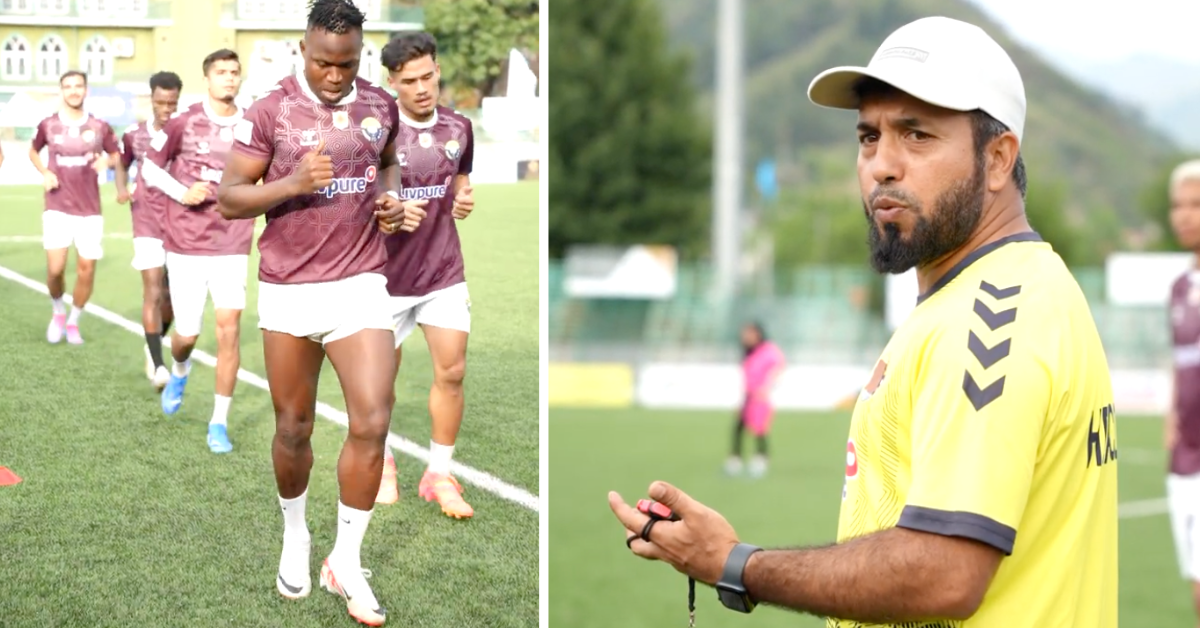
When we talk about Kashmir, our minds instinctively drift to snow-draped mountains, blurred headlines, and the unending hum of conflict. But beneath that familiar narrative lies another Kashmir, one that beats with rhythm, sweat, passion, and an emotion older than insurgency itself.
Football.
The Valley’s bond with the game began in the late 19th century when Cecil Tyndale-Biscoe introduced football to schoolboys who had never seen a leather ball before. Slowly, it became part of Kashmir’s soul. By the 1980s, Kashmir was a thriving hub of local football. Many boys rose to wear the India jersey.
And then the 1990s arrived. Insurgency took over the streets. The game, like so much else, fell silent.
Yet in a Valley where despair sometimes feels permanent, two men dared to believe in impossible things. Their belief would one day become Real Kashmir FC. But long before the club had a name, there were floods, heartbreak, and a purpose bound together by sheer will.
When hope was underwater
In September 2014, Kashmir was hit by its worst floods in more than a century. Torrential rains pushed the Jhelum nearly four feet above the danger mark, and its discharge tripled in a matter of hours. Within days, more than 2,550 villages were submerged, close to 80,000 people were evacuated, and hundreds of lives were lost. Homes, schools, businesses and entire neighbourhoods disappeared underwater. For many families, life was not only disrupted but completely erased.
Relief teams rescued over 200,000 people. When the water finally receded, however, a quieter crisis began. Houses had collapsed, routines had vanished, and markets remained shut. Livelihoods disappeared overnight. With schools and playgrounds closed indefinitely, young people lost much more than shelter. They lost structure, purpose and hope.
Shamim Meraj, editor of The Kashmir Monitor, documented the destruction every day, although he felt helpless inside. His friend, Sandeep Chattoo, an engineer turned entrepreneur, witnessed similar scenes around his beloved “Hotel CH2,” which stood eerily still among the ruins.
One afternoon, as they walked through a neighbourhood still coated with damp silt, they noticed young boys drifting through the lanes with nothing to do and nowhere to be. Their eyes looked dull, and their energies felt misdirected.
Shamim had once been a passionate footballer. He knew what the sport meant to the Valley, and he knew what it could heal.
They bought 100 footballs and distributed them in the locality.
A week later, when they returned, the same boys who had been throwing stones were kicking footballs.
That moment changed everything. A community club no longer felt like an idea. It felt like a necessity.
The dream that no one thought possible
From distributing balls, the idea grew naturally into a question: Why not create a football club that showed the world the real Kashmir?
But turning that dream into a professional football club in a conflict zone was almost laughable.
There were curfews. Shutdowns. Checkpoints. Internet blockades.
Players who worked as mechanics, shopkeepers, or labourers couldn’t quit their jobs. Families were unsure. The world wasn’t watching.
Except for a few.
Like a young midfielder named Danish Farooq.
Known today as “The Kashmiri Ronaldo” and now playing for Kerala Blasters FC in the Indian Super League, Danish has also represented the Indian national team. But back then, he was a banker waiting for a door to open.
“My father and uncle were footballers, but we couldn’t afford for me to just play. I was working in a bank then. When Shamim bhai approached me, I immediately said yes. I was waiting for this one opportunity.”
That opportunity, however, came with its own struggle. These boys suddenly faced real expenses, including commutes, gear, nutrition, and the basic costs of staying committed. Many were spending out of pocket just to appear for practice. The ambition was immense, but the resources were painfully limited.
Funding was a nightmare.
Shamim ran pillar to post. He mortgaged his wife’s jewellery. Friends pitched in. “My wife is a psychiatrist. She and my daughter fully supported me. It was a beg-borrow-steal situation,” he recalls.
But the players never felt the strain.
“They never let us know the financial issues,” Danish says. “We always felt like a top club. Fresh towels, bottles, things that were not common back then. Shamim bhai treated us like family. He’d say: ‘This is my part. Now you do yours.’”
Seeing his friend drowning in responsibility, Sandeep stepped in too.
And in March 2016, Real Kashmir FC — The Snow Leopards — was born.
Thrown into the deep end
Just four months after forming, RKFC was selected to compete in the 128th Durand Cup.
The team was raw, mostly semi-professional, and completely unprepared for that level. Predictably, they finished last.
But they had taken their first national step. And they wanted more. They needed someone who understood world football, someone who could turn Kashmiri grit into a structured, disciplined force.
Enter David Robertson — the Scotsman who found a home in Kashmir
David Robertson — a former defender for Rangers FC and Leeds United, and a seasoned coach in Scotland — came with decades of top-flight football experience.
Shamim emailed David Robertson, former player for Rangers, Aberdeen, Leeds United, and Montrose, never imagining he’d respond.
Why would an international coach come to a conflict zone?
Destiny had other plans. David said yes. He landed in Srinagar in peak winter. No internet. No electricity. A biting cold. Within hours, he asked for a return ticket.
But then he met the boys. He saw their hunger. He stayed. Under his warrior-like discipline, something extraordinary began to take shape.
The miracle season
In the 2017–2018 I-League Second Division, Real Kashmir didn’t lose a single match.
Foreign players like Loveday Enyinnaya and Yao Kouassi Bernard fortified the squad. Local stars—Danish, Ritwik Das, Hammad—became the heartbeat.
On May 30, 2018, Real Kashmir became the first club from the Valley ever to be promoted to the I-League.
No government aid. No modern stadium. Players crossed checkpoints to get to training.
Sometimes they practised in neighbourhood parks with no goalposts.
Still, they made history.
A valley rediscovers its voice
Their first I-League match?
They defeated defending champions Minerva Punjab.
Soon after:
-
Adidas came on board as kit partners — a first for any Kashmiri club
-
The BBC filmed two documentaries on the team, one of which won a BAFTA
-
The boys even played in Scotland and Germany
Real Kashmir was no longer just a football club.
It was a movement.
Danish remembers one moment vividly: “Once, before a match, thousands of people were standing outside the stadium. I thought it was a protest. But no, they were waiting to cheer for us.”
In a place known more for unrest than applause, this mattered.
Healing a wound that spanned generations
For every dream that never got a chance…
For every player whose career the conflict cut short…
For legends like Abdul Majeed Kakroo, the first Kashmiri to captain India, whose career ended at 25…
Real Kashmir FC became the answer.
A bridge between conflict and childhood.
Between stereotypes and reality.
A new chapter begins
Around 2019–2020, Arshad Shawl, a veteran in sports marketing and advertising, joined the club’s leadership. He strengthened the foundation. Arshad brought structure, vision, and long-term thinking.
“This club was born out of emotion. But emotion alone cannot sustain a dream. Someone must build the systems that allow a dream to grow,” he tells The Better India.
He focused on youth development, professional management, corporate partnerships, and expanding the club’s footprint beyond Kashmir.
In an hour-long conversation with TBI, he reflected:
“Real Kashmir is not just about winning matches. It is about telling the world that hope can come from places where people least expect it.”
He became one of the key hands steadying the wheel during a difficult phase.
Unfortunately, in 2023, the Valley lost co-founder Sandeep Chattoo to a heart attack — a loss still felt deeply.
But the legacy he and Shamim built was strong enough to endure.
Today, the Snow Leopards roar on
RKFC today has:
-
A top-tier senior team
-
A reserve squad
-
U-18, U-15, and U-13 teams
-
Training programs for children as young as 5
A full pipeline of dreams.
The story has even been retold on screen, not as a commercial pitch, but as a testament to ordinary men who did something extraordinary.
Because Real Kashmir FC is not just a football club.
It is
a lifeline,
a rebellion against despair,
a homecoming for a region that waited decades for a reason to cheer.
It is the story of two friends who looked at destruction and said, “Let’s build something.”
It is the story of boys who carried footballs across checkpoints and curfews just to train.
It is the story of a valley rediscovering joy.
And perhaps the most important win of all.
Disclaimer : This story is auto aggregated by a computer programme and has not been created or edited by DOWNTHENEWS. Publisher: thebetterindia.com