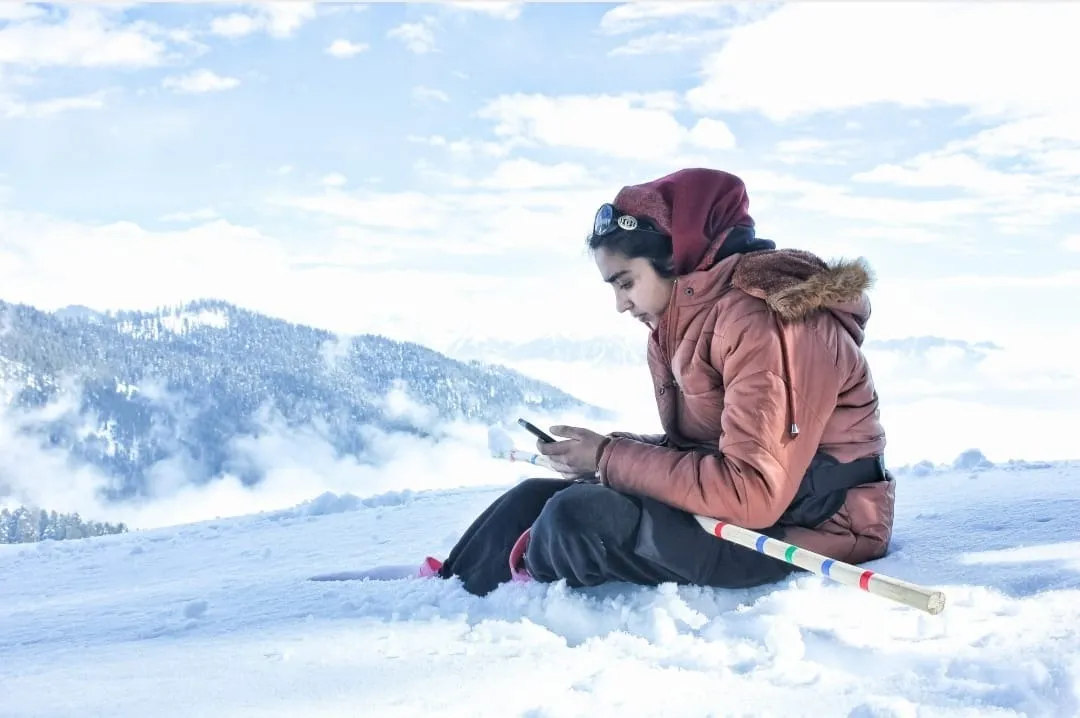
At dawn in the high meadows, 25-year-old Shabnam Bashir walks through knee-deep grass, her boots soaked with melting snow. A mobile phone camera rests in her hand and a notebook sits tucked inside her backpack. Clouds drift low over Nagmarg as she pauses to mark a trail that, until a few years ago, existed only in the memory of shepherds.
There are no phone signals, no signboards, and no tourist infrastructure — only silence, alpine flowers, and the distant sound of grazing sheep.
For Shabnam, this solitude is not an escape but a mission. Each step she takes is part of her effort to bring Kashmir’s hidden landscapes — and her marginalised Gujjar–Bakarwal community — into a future shaped by sustainable tourism.
Breaking barriers in a conservative community
Born into a nomadic Gujjar–Bakarwal family, Shabnam grew up in a society where early marriage and limited mobility often define a girl’s life. But from a young age, she felt drawn to the mountains surrounding her village in Bandipora district. She would watch trekkers pass through the foothills of Harmukh and imagine herself on similar journeys.
Choosing to travel alone was not easy. When she began trekking, her family and relatives strongly resisted.
“People questioned my character, my safety, and even my sanity,” she recalls. Some elders warned that a girl wandering in the mountains would damage the family’s reputation.
Financial challenges followed. With no sponsorship, she relied on personal savings, often walking for hours instead of hiring transport and carrying basic food supplies during long treks.
There were moments of fear — nights in unfamiliar settlements, sudden weather changes, and navigating wild terrain without backup support.
“Sometimes I fear alone on the mountains, wondering if I should quit,” she says. “But every time I saw a new valley, I remembered why I started.”
/filters:format(webp)/english-betterindia/media/media_files/2026/02/26/shabnamwomen-2026-02-26-15-51-08.jpg)
What began as personal exploration gradually turned into a larger vision.
“It was my dream from childhood to explore new destinations and document the natural beauty around us,” she says. “I wanted to serve my community, and there was no better way than to create livelihood opportunities for people who struggled even for a penny.”
Mapping the unexplored
Bandipora, nearly 80 kilometres from Srinagar, lies between Wular Lake and the Harmukh peak. Despite its scenic beauty, many of its valleys remained unmapped and overlooked by the tourism industry.
Eight years ago, armed with a backpack, pen, and notebook, Shabnam began documenting these unexplored landscapes. She travelled alone or with local residents, recording water sources, seasonal weather patterns, grazing routes, camping zones, and ecological details. She also spoke to shepherds and elders to understand the historical significance of each site.
/filters:format(webp)/english-betterindia/media/media_files/2026/02/26/kashmir-hidden-destinations-2026-02-26-15-35-45.jpg)
“I hiked through unexplored valleys and documented their elegance. My goal was to bring these places to the eyes of the administration,” she says.
Her documentation did not stop at photographs. She structured trekking routes and destination profiles, which she later shared with the district tourism office, forest officials, and local panchayats. In Chandaji and Nagmarg, she personally accompanied officials during site inspections, explaining access points and conservation requirements.
“Tourism doesn’t grow by itself,” she says. “People need training, confidence and connections.”
Over the years, she has explored around 16 hidden destinations. Several — including Chandaji and Nagmarg — have now been formally recognised on the tourism map, attracting visitors from across the country.
“Thousands of tourists visit these places today because she highlighted their beauty and tourism potential,” says a local resident from Chandaji village of Bandipora, which was brought onto the tourism map after Shabnam’s efforts.
/filters:format(webp)/english-betterindia/media/media_files/2026/02/26/shabnamtourism-2026-02-26-15-37-57.jpg)
Her work gained wider attention with the publication of her book Unexplored Kashmir in 2023. The book serves as a guide to Bandipora’s valleys, meadows, alpine lakes, and pastoral routes.
Rohit Verma, who visited Chandaji after reading her book in September this year, says, “I found the book fascinating. These destinations are better and more relaxing than many popular tourist spots in Kashmir. They are untouched, less crowded, and peaceful. Everyone should explore them.”
Tourism officials and the district administration have also acknowledged that her documentation helped shape trekking circuits, eco-tourism initiatives, and homestay clusters.
Creating livelihoods
Before Shabnam began promoting Nagmarg, Chandaji, and Malangam, tourism in these villages was minimal. Only a handful of trekkers visited each season, often without staying overnight.
Today, nearly 40 homestays operate across Chandaji, Quilmuqam, and nearby hamlets — compared to just two informal guest rooms five years ago. During peak summer months, the area receives an estimated 300–500 visitors per season, many arriving for trekking routes first mapped by Shabnam.
The economic impact has been significant. More than 30 young men now work as trekking guides, pony handlers, cooks, and transport coordinators — roles that previously did not exist. Nearly 30 women earn seasonal income by preparing traditional food, selling handmade woollen products, and managing homestays.
/filters:format(webp)/english-betterindia/media/media_files/2026/02/26/unexploredkashmir-2026-02-26-15-40-49.jpg)
Families that once depended solely on livestock and seasonal labour now earn between Rs 15,000 and Rs 60,000 per season from tourism-linked work, villagers say.
Zahoor Ahmad, a homestay owner, says he earned nearly Rs 20,000 in a single trekking season after hosting about 30 tourists in Malangam. “This was unimaginable earlier,” he says. “The arrival of tourists has changed our lives. All this happened after Shabnam promoted Nagmarg and Chandaji.”
Shabnam sees this transformation as her true success. “Exploring destinations was my passion, but changing lives was my purpose,” she says.
Sustainable tourism and community advocacy
Shabnam strongly advocates responsible tourism in fragile mountain ecosystems. She discourages plastic use, promotes waste-carry-back policies, and limits visitor numbers in sensitive alpine meadows. She also trains homestay owners in water conservation and eco-friendly cooking practices.
“Tourism should not destroy what it comes to admire,” she says. “If we lose our meadows and lakes, we lose everything.”
/filters:format(webp)/english-betterindia/media/media_files/2026/02/26/shabnamcommunityeducator-2026-02-26-15-43-47.jpg)
Beyond tourism, she has become a community educator. While travelling to remote Gujjar–Bakarwal settlements, she realised many families were unaware of central government schemes related to tribal welfare and rural development.
/filters:format(webp)/english-betterindia/media/media_files/2026/02/26/shabnam_aadikarmayogi-2026-02-26-15-48-07.jpg)
She began conducting informal awareness sessions, helping people fill forms and connect with local officials. Her efforts under the government’s recent ‘Aadi Karmayogi’ initiative were appreciated, and she received an award from the district administration.
/filters:format(webp)/english-betterindia/media/media_files/2026/02/26/shabnamtravel-2026-02-26-15-45-10.jpg)
Her journey has also inspired young girls in her community. Many now seek her guidance on education, trekking, and career choices.
“If I can inspire even one girl to break barriers, my journey is worth it,” she says.
Disclaimer : This story is auto aggregated by a computer programme and has not been created or edited by DOWNTHENEWS. Publisher: thebetterindia.com