A Berlin-built satellite named after a legendary art squat launched into space last week as part of NASA’s Artemis II mission – connecting the city’s countercultural past with its high-tech future.
When NASA’s Artemis II mission lifted off in early April, it carried humanity farther from Earth than it had travelled in more than half a century.
Less visible, but quietly remarkable, was a small satellite joining the journey – built in Berlin, roughly the size of a carry-on suitcase and bearing a deeply local name: Tacheles.
For anyone who has lived in Berlin long enough to remember the original Kunsthaus Tacheles on Oranienburger Straße, the name carries weight.
In fact, the recent launch could be said to connect Berlin’s present as a contributor to cutting-edge space exploration to the city’s long-running tradition of doing things differently.
Tacheles in orbit
The satellite Tacheles was developed by the Berlin-based startup Neurospace GmbH and launched on April 2nd from NASA’s Kennedy Space Center, as part of the Artemis II mission.
In simple terms, Tacheles is a small test satellite designed to carry electronic components into some of the harshest conditions around Earth and see if they keep working.
By flying through intense radiation and extreme temperature swings over extended periods in space, the mission will test whether the hardware is tough enough to be used in the future on robots operating near the Moon.
READ ALSO: Which jobs are desperately needed in Berlin and which are being cut?
Neurospace in Berlin
Neurospace itself reflects a familiar Berlin story. The company was founded in 2020 during the pandemic by engineer Irene Selvanathan, who came to Berlin from Sri Lanka with her family in the 1980s.
A graduate of the Technical University of Berlin, Selvanathan built her career across research institutes and international aerospace projects before deciding to start her own company.
The company aims to build hardware that makes space exploration more accessible – not just for major agencies like NASA but also for universities and smaller organizations.
READ ALSO: ‘Germany Fund’ launched to boost startups
That international and collaborative spirit runs through the Tacheles mission itself. For example, alongside Neurospace’s engineers, students and researchers from the university of applied sciences in Jena contributed key components to the experiment, developing systems that protect electronics from sudden radiation damage.
The project is also backed by a network of German institutions, including the German Aerospace Center (DLR), Berlin Partner (which supports Berlin-based businesses), as well as federal funding from the Federal Ministry for Economic Affairs and Climate Action (BMWK).
The original Tacheles
The decision to name the satellite “Tacheles was deliberate”. As Selvanathan told Der Spiegel, the team wanted “something Berlin as a name for our satellite, not another Greek name of a God.”
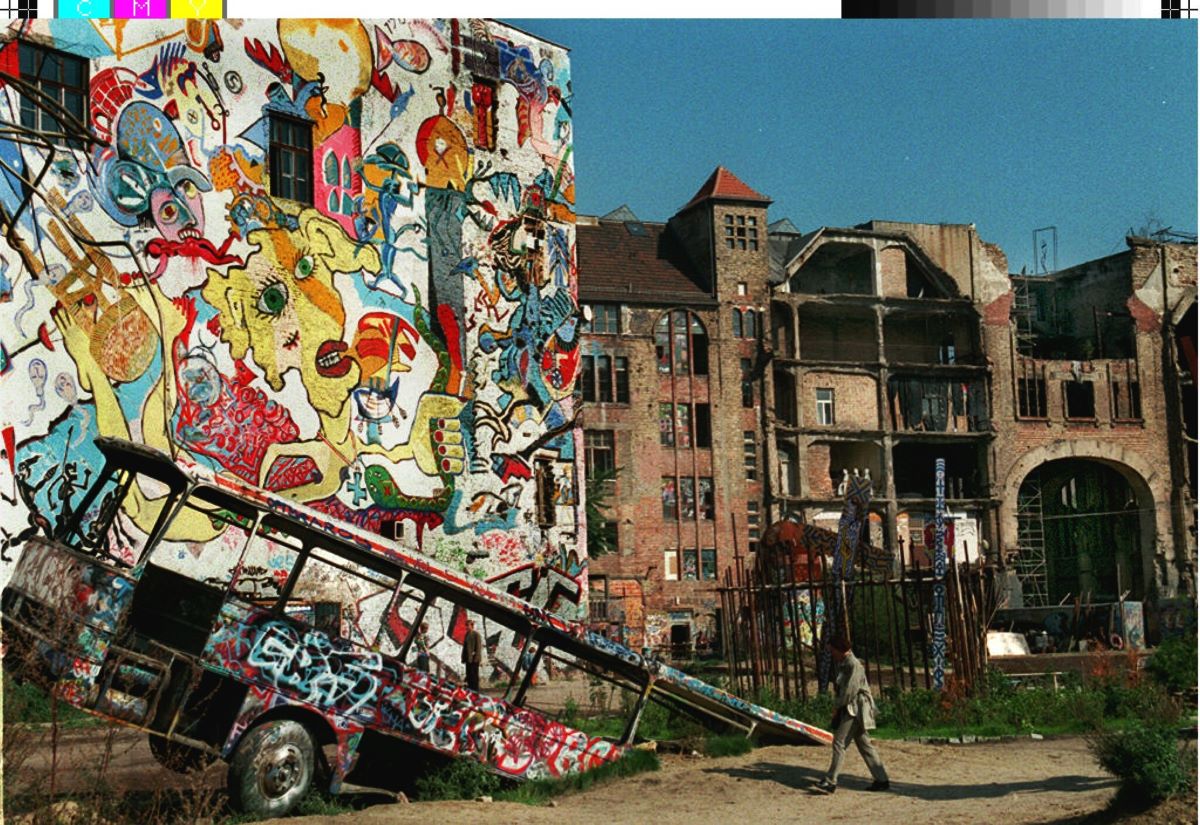
For many Berliners, the name will immediately recall the Kunsthaus Tacheles, the art and event centre that occupied part of a former department store in Mitte from 1990 until its eviction in 2012.
The Tacheles cultural workshop in Berlin’s Mitte district in 2000. Photo: picture-alliance / dpa | Peer_Grimm
Born from occupation rather than planning permission, Tacheles was a vital hub for artists, performers, activists and cultural experimentation in the chaotic years after reunification.
The word “Tacheles” itself comes from Yiddish and Hebrew roots meaning “plain talk” – to speak directly and without euphemism.
That spirit defined the building: bright graffiti, improvised studios, and concerts and performances that rejected polished professionalism in favour of urgency and openness.
READ ALSO: From art squat to Berlin gentrification lightning rod
From squat to startup
Thanks to Neurospace, the city that once made space for artists and outsiders is now exporting technology built by the next generation of people who have chosen to make Berlin their home.
The setting has changed, from squatted buildings to laboratories and launch pads, but the underlying traits arguably persist: openness, collaboration and a willingness to test ideas in unfamiliar territory.
Disclaimer : This story is auto aggregated by a computer programme and has not been created or edited by DOWNTHENEWS. Publisher: thelocal.de