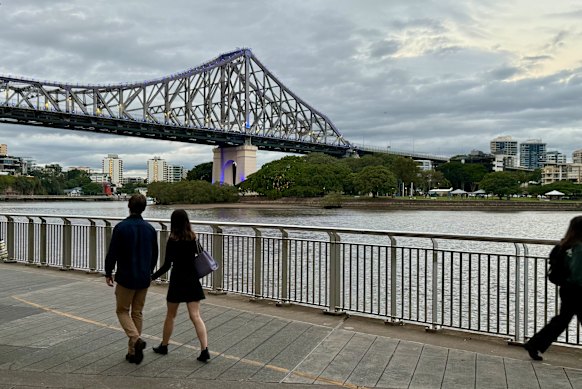
For the first time, Brisbane’s entry-level unit market is now more expensive, and takes longer to save for, than Sydney’s.
In the ultimate gut punch to first home buyers, the Queensland capital has leapfrogged the country’s benchmark city for property pain – taking the crown as the toughest capital for first home unit buyers after entry prices soared almost $130,000 in a year to $660,000, Domain’s latest First Home Buyer Report, released on Thursday, shows.
After five years of extreme growth that at 80.8 per cent has blown past wage rises, the time needed to save a 20 per cent deposit has stretched to four years and 11 months for a young couple buying a unit, the report’s modelling showed.
In Sydney, entry unit prices cost $15,000 less at $645,000.
While Sydney remains the nation’s toughest capital market for entry-level houses – costing $1.15 million – Brisbane is now the second most difficult. Entry-level Brisbane house prices jumped $146,000 over the past year to $856,000 – more than twice as much as five years ago – pushing the savings timeline out to six years and three months.
Mortgage repayments on an entry-priced Brisbane house would now consume about 50 per cent of a young couple’s income, a level at which banks would be unlikely to lend, while unit repayments take up 38.6 per cent – well above the 30 per cent benchmark widely used to define mortgage stress.
The calculations assume a couple aged between 25 and 34, based on Brisbane’s typical post-tax income for an individual of $61,790.
Domain’s chief of research and economics, Dr Nicola Powell, said the shift in Brisbane was one of the most striking changes in the national housing hierarchy.
“I don’t think I ever expected Brisbane to be in the realm of Sydney,” she said.
“It wasn’t that long ago that Brisbane was in an oversupply of units and now we have a property market with Sydney-style saving times, and for a first home buyer, that’s a heck of a headline.
Brisbane property prices have soared.Credit: Courtney Kruk
“And it illustrates the shift. When you’re looking at price point changes more than doubling in a five-year period for houses and almost doubling for units, it’s incredible.”
Powell said Brisbane’s slightly lower average income compared with Sydney compounded the challenge.
“I think it will have a massive impact on pathways to purchase. There’s a gross lack of affordable units in the market in Brisbane, and while there’s no quick fix, we need more medium density and planning reform,” she said.
“We need to unlock well-located land and even incentives for developers, because without more stock at the lower end, we will see deposit timelines stretch out even more.”
Powell argued that while the 5% Deposit Scheme had removed one barrier, it did not solve the underlying imbalance between supply and demand.
“We need to go one step further and make stamp duty concessions permanent. If not, we’re just bringing forward demand,” she said.
“We also have a misallocation of housing in Australia.”
The journey to first home ownership in Brisbane varies by location. Inner-city houses are the toughest entry point, taking an average 11.5 years to save a 20 per cent deposit.
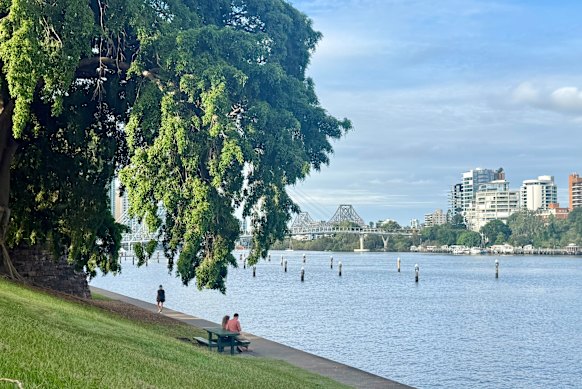
Brisbane entry-level prices have skyrocketed.Credit: Courtney Kruk
On the ground, agents say the structural shift has entrenched the “bank of mum and dad” as a crucial player in the market.
Michael Hatzifotis of Place South Brisbane said the unit sector had seen more first home buyers than ever leaning on parental assistance, while one-bedroom apartments, once dismissed as investor stock, had become the hottest commodity.
“The gauging of prices is out of control at the moment … and the first home buyer deposit scheme has turbocharged it,” he said.
“Everyone can see the trajectory of what is happening in this market and they can see that it’s going to get harder and harder … and they just want to get in.”
Hatzifotis said the average first home buyer in his office was a single woman aged 25 to 32, and the typical purchase was a one-bedroom unit worth about $750,000. Around half were receiving help from their parents.
“I settled a one-bedroom apartment this week that had nine offers and all bar one was an investor. It sold for $745,000,” he said.
“But we’ve sold one-bedders up to $900,000 in the city and we even had one get over $1 million in Queens Wharf.
“This is the reality now.”
In Logan, Ray White agent Ryan Trama said lower socio-economic suburbs recorded some of the sharpest increases.
“Since the start of the 5% Deposit Scheme on October 1, the first home buyer market has been incredibly tight,” he said.
“The townhouse unit sector is where we’re seeing the most growth and especially in lower demographic suburbs such as Woodridge and Eagleby. Prices have gone through the roof – north of 20 per cent in a year.”
Trama said two-bedroom, one-bathroom units were fetching $600,000 and older three-bedroom townhouses had swelled to $700,000.
“Just over a year ago they were fetching sub-$500,000. The growth has been substantial,” he said.
Most Viewed in Property
Disclaimer : This story is auto aggregated by a computer programme and has not been created or edited by DOWNTHENEWS. Publisher: www.smh.com.au