This consistency, according to Hunter Koch, director of Course Rating for the Golf Association of Michigan, allows for a universality of ratings that streamlines how courses are viewed from a difficulty perspective. “Whether you’re in Michigan or New Zealand, everyone is using the same guide,” said Koch. “Hypothetically, there will be replicability of every rating.”
There is, of course, still room for interpretation.
The evolution of the Course Rating System and the recommendations for golf officials regarding hole handicapping have come a long way, thanks in large part to the data Hovde mentioned. While data helps provide courses with an objective evaluation of the rating process, there remains a human element.
“We walk the course to do field work, measuring and rating from tee to green,” says Koch. “Then, we’ll play the course to see and feel it from the perspective of a player.
Courtesy USGA
“At a recent course, I hit three greens with excellent shots from the fairway, but the ball just rolled off the back,” Koch recalls as an example. “That’s the definition of a firm adjustment,” he adds, referring to a characteristic that can affect a hole rating.
As stated in the Golf Association of Michigan handbook, “Green surface difficulty is based on the speed and contours of the putting surface. Speed is determined using a Stimpmeter reading under mid-season playing conditions.” This data point, Koch notes, might influence how a rater sees a course. “You then ask yourself, are these normal course conditions, or was this an abnormal course condition that caused this? Is it just that it’s October and extremely dry because the green hasn’t been irrigated recently? Or is it simply a firm green and the ball won’t hold?”
This is a conundrum Hovde encounters often, especially when local AGAs provide recommendations to courses regarding stroke-index allocations. “When we used scoring data, it would vary from month to month and generate totally different results depending on the group of players involved. Using Course Rating data is a lot more objective because it’s something that’s measurable. It’s not impacted by a player’s ability to play a certain hole; we just evaluate the hole for difficulty.”
Though the WHS has worked hard to overhaul the procedure for stroke index assignments for more consistency, each course ultimately makes their own call on stroke-index values.
Says Derek McKenzie, USGA manager of Course Rating Administration and Handicapping Research, “One of the key points of emphasis is that the USGA is supplying recommendations based on the rating data. However, the adoption of the actual stroke allocation assignment is a decision for the course or club. For example, most clubs have a committee, and it’s their right to assign those stroke indexes based on whatever they think is best for their golfers and the club itself.”
This is why Course Rating and hole handicap allocation is more of a science than ever before but still involves some artistry and local knowledge.
“We’re supplying that recommendation,” adds McKenzie. “Oftentimes, the local committee will simply adopt it or maybe make small tweaks. It’s not the USGA or even the AGA that’s assigning stroke-index values. We’re coming up with recommendations for the club’s consideration, then they’re deciding what they want the assignments to be.”
To help rate courses as accurately as possible, Koch leans on the course staff to gain insight on whether the things he notices during his field work and round of golf are aberrations or features of the course. “We try to meet with the superintendent on-site, because they know the golf course better than anyone else. For example, green speed and rough height are two constant things that get baked into the rating process,” he says. Unfortunately, these are two variables that can be quite different depending on when the course is played.

“If we try to rate a golf course at the end of April, the greens are not going to be up to speed,” Koch says. “The rough might not have grown in yet. Maybe we have a dry stretch or wet stretch during the summer. The course as you rate it is never going to be the perfect representation of the average condition over 10 years. In that regard, we rely on intuition and local knowledge.”
The difference between the method for arriving at a Course Rating and at individual hole rankings is what causes the most confusion for recreational golfers. Both for the entire course and on each individual hole, several additional factors come into play.
“We look at all sorts of effective playing length factors such as elevation changes, doglegs or layups, altitude if the course is at a higher elevation,” says Hovde. “Those are looked at on every hole, which cumulatively creates the 9- and 18-hole ratings. We look at the obstacles for scratch and bogey golfers on those holes and create what’s called a scratch value and a bogey value.”
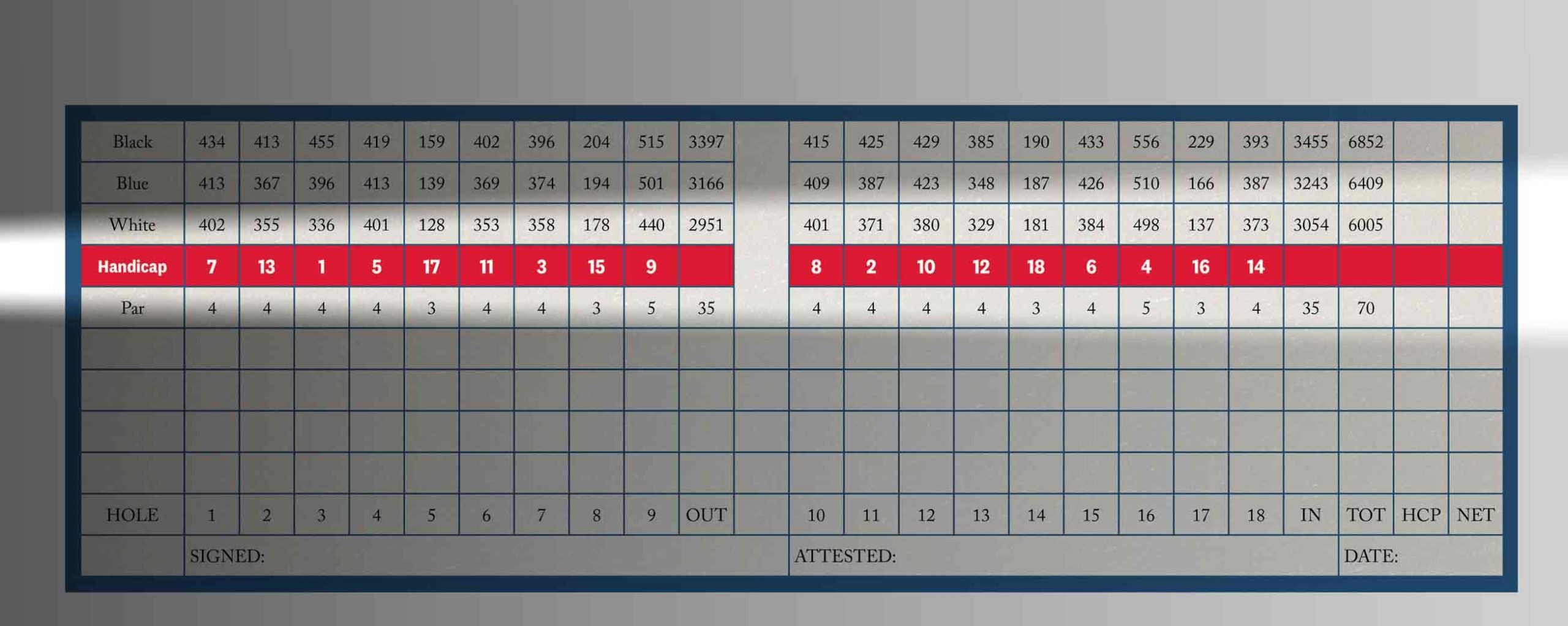
Those values are then compared to par for each hole, which is a fixed number. Ultimately, holes that are reflective of the largest gap in expected score versus par would generate the lowest stroke-index assignment recommendations; in other words, identifying the hole(s) where a golfer may most be in need of a handicap stroke.
Other factors go into these recommendations. “We look at things such as odds and evens,” says Hovde, of the decision about which nine will be assigned the 1-3-5 etc. ranking and which gets 2-4-6 and so on, so that stroke holes for a match are evenly distributed.
“It’s typically odds on the front nine and evens on the back nine. We have some guidelines about avoiding back-to-back low stroke holes. You don’t want the No. 1 and No. 3 stroke holes to be right next to each other if possible, and we also recommend avoiding those at the very beginning or end of a nine.”
Disclaimer : This story is auto aggregated by a computer programme and has not been created or edited by DOWNTHENEWS. Publisher: golf.com